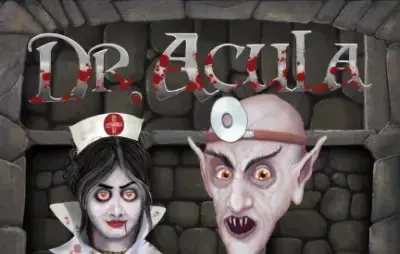

Dracula Review
NetEnt's Dracula is a licensed title built around Universal Studios' classic 1931 Count Dracula film, and it still holds up as one of the more mechanically distinct entries in NetEnt's back catalogue. The 5-reel, 4-row, 40-payline setup is straightforward, but the bat feature — a random mid-spin event that sweeps across the reels and converts symbols into matching groups — gives the base game a texture that pure payline slots rarely manage.
At 96.58% RTP and low-to-medium volatility, the math profile is built for steady, extended sessions rather than moonshot variance. The max win sits at 400x stake, which is modest even by 2015 standards, but that ceiling is a deliberate design choice: Dracula targets players who want frequent engagement over the occasional monster hit. Two stacked character symbols triggering free spins with guaranteed bat activity on every spin rounds out a feature set that remains coherent and easy to follow. This review breaks down what the numbers actually mean for your session and whether Dracula still earns a place in your rotation today.
RTP, Volatility, and What the Math Profile Tells You
A 96.58% RTP places Dracula comfortably above the industry average of roughly 96.00%, and that edge matters across a long session. NetEnt has published this figure officially, so there is no ambiguity in the return calculation — you are working with a well-documented number.
The low-to-medium volatility tag is the more important descriptor for day-to-day play. It means win frequency is relatively high, drawdown periods are shorter than on high-variance titles, and the 400x max win is a realistic ceiling rather than a theoretical outlier. For context, NetEnt's own Gonzo's Quest Megaways can reach 21,000x, and even the original Gonzo's Quest tops out around 2,500x — Dracula's 400x is deliberately conservative, which is a coherent choice given the volatility band but does limit the ceiling for players chasing large single-session wins.
Hit frequency is not published by NetEnt for this title, but the volatility classification and the bat feature's random base-game activations together suggest wins land with reasonable regularity. If you are managing a fixed session budget, the math here is more forgiving than most horror-themed slots on the market.
How Dracula Plays: Layout and Base Game
The 5x4 grid with 40 fixed paylines is a familiar NetEnt framework, but Dracula uses it efficiently. Both the Dracula character and his female counterpart appear as stacked symbols, meaning they can cover multiple rows on a single reel and generate multi-line hits simultaneously. Standard mid-value characters and royal card symbols fill out the rest of the paytable.
The paytable is straightforward: Dracula and the female lead each pay 200 coins for five on a payline, the three mid-value character symbols pay 60 coins for five, and card suit symbols pay 40 coins for five. Wins require between three and five matching symbols on a payline, which is conventional.
What separates the base game from a static payline grind is the bat feature. At random intervals, a swarm of bats flies across the reels and transforms a number of symbols — chosen at random — into a single matching symbol type, which can include the wild. When the transformation lands on the high-value stacked characters, the payout jump is significant relative to the volatility tier. It does not trigger on a schedule, so base-game sessions can vary considerably in how often you see it.
Bonus Features: Bat Mechanic and Free Spins
Dracula has two distinct features: the random bat event in the base game and a triggered free spins round. Both use the same core mechanic — bats converting symbols into matching groups — but they operate differently enough to feel like separate modes.
The free spins round requires a specific trigger: the stacked Dracula symbol must land on reel 2 and the stacked female symbol must land on reel 4 on the same spin. That dual-reel condition makes the trigger less frequent than a standard scatter-based activation, but it rewards patience. Landing it awards 10 free spins, and unlike the base game where the bat event is random, the bats are active on every single free spin. That guaranteed activity on each spin meaningfully increases the expected value of the feature relative to an unaugmented free spins round. An additional two free spins are awarded each time a stacked symbol lands on the middle reel during the feature, giving the round a modest but real extension mechanic.
There is no bonus buy option, so the free spins can only be reached through natural play. For players who prefer organic progression rather than purchased features, that is a non-issue. For those who like to access the feature on demand, it is worth noting before committing to a session.
Expanding Symbols: How They Interact with the Features
The expanding symbols mechanic in Dracula is tied directly to the bat feature rather than operating as a standalone reel event. When the bats transform symbols into a single matching type, those transformed symbols effectively function as an expansion across the affected positions — multiple reels can display the same high-value symbol simultaneously, which is the closest this slot gets to a traditional expanding symbol event.
This integration means the expanding symbol feature has no independent trigger condition. It activates only when the bat mechanic fires, so its impact is felt both in the base game (randomly) and in free spins (on every spin). The practical effect is that large multi-reel hits are possible without the slot needing a dedicated expanding wild reel or a separate multiplier layer — the bat transformation handles both functions.
For players evaluating feature complexity, Dracula keeps things lean: two features, one shared mechanic, no cascades, no multipliers, no bonus game. That simplicity is a design strength for the volatility tier it occupies.
Theme and Presentation
Dracula sits in the horror/vampire genre and draws directly from the 1931 Universal Studios film, making it a branded title with recognisable character likenesses rather than a generic vampire aesthetic. The visual treatment is gothic and dark-toned, consistent with the source material.
The bat animation — the central visual event — is the most dynamic element on screen and is functional rather than decorative: it signals a mechanic activation and its outcome is directly tied to the payout. For a slot released in April 2015, the presentation holds up adequately, though it does not match the production values of NetEnt's more recent catalogue.
Who Dracula Is Best Suited For
The 400x max win and low-to-medium volatility make Dracula a poor fit for players whose primary goal is a large single-session score. If you are comparing it to other NetEnt titles with similar RTP — Dead or Alive 2 carries a 96.82% RTP but reaches 111,111x — Dracula is operating in an entirely different risk category.
Where Dracula earns its place is with players who want a high RTP, predictable session variance, and a base game that stays active rather than cycling through long dead stretches. The 96.58% return combined with the random bat activations means the slot rewards extended play more than it rewards short, high-stakes sessions. Budget-conscious players and those new to higher-volatility titles will find the math profile genuinely comfortable.
The branded Universal Studios licence also makes it a natural pick for anyone with an attachment to classic horror cinema. The gameplay mechanics are accessible enough that the theme can be the primary draw without the math punishing that preference.
Final Verdict
Dracula is a well-constructed low-to-medium volatility slot with a 96.58% RTP that remains one of the more player-friendly figures in NetEnt's library. The 400x max win is a genuine limitation — this slot will never produce the kind of session result that headline-chasing players are after — but within its design brief, everything works cleanly.
The bat mechanic is the slot's most distinctive quality. It prevents the base game from becoming a passive payline-checker and gives the free spins round a reason to feel different from standard free spin modes. The specific dual-reel trigger for free spins adds a layer of anticipation that a simple three-scatter activation would not.
One mild observation: the base game can feel slow between bat activations when the transformation lands on low-value symbols repeatedly. That is the cost of the random trigger mechanic, and it is worth knowing before a long session. For the volatility profile and the RTP on offer, Dracula remains a solid, honest slot that delivers exactly what its math promises.
- +96.58% RTP is above the industry average and officially published
- +Low-to-medium volatility suits extended sessions and tighter bankrolls
- +Bat mechanic keeps the base game active between feature triggers
- +Free spins guarantee bat activations on every spin, increasing feature value
- +Stacked character symbols create multi-line hit potential on a standard grid
- +Licensed Universal Studios branding with recognisable 1931 film characters
- -400x max win is a hard ceiling — unsuitable for high-variance hunters
- -Free spins require a specific dual-reel stacked symbol condition to trigger
- -No bonus buy option to access the free spins feature directly
- -Base game pacing can drag when bat activations land on low-value symbols
Best for
Dracula is a low-to-medium volatility slot with a 96.58% RTP and a 400x max win — numbers that make it a solid pick for bankroll-conscious players who value session length. The bat mechanic keeps the base game from feeling static, and the free spins add genuine upside without demanding patience across hundreds of dead spins. It is not a high-roller slot, and it was never meant to be.