
Jewel Rush Review
Pragmatic Play launched Jewel Rush in May 2023 as a spiritual successor to Sugar Rush, swapping candy for gemstones on a 7x7 cluster-pays grid. The core architecture is familiar — Avalanche/Tumble mechanics, multipliers that compound rather than stack, and a free spins round that cranks up the multiplier frequency — but the execution is clean enough to stand on its own. The headline numbers are competitive: 96.47% RTP, a 5,000x max win ceiling, and high volatility rated 5/5 on Pragmatic's own in-game scale. Bets range from $0.20 to $100, making it accessible across stake levels. Spindex has tracked 11,000 bets across five crypto-casino sources over the last 30 days, with a top recent hit of 1,921x logged during that window. That real-world peak is well below the theoretical 5,000x ceiling, which tells you something about how the variance actually distributes in practice. This review breaks down exactly how the multiplier system works, what the bonus round delivers, and whether the numbers justify the hype.
RTP, Volatility, and Max Win
At 96.47%, Jewel Rush sits a few basis points above Pragmatic Play's typical published RTP, which hovers around 96.00–96.50% for most of their catalogue. That small margin matters over volume. It's worth noting, however, that Pragmatic builds in a customizable RTP range, meaning individual operators can dial the return down — always check the paytable RTP in your specific casino lobby before committing real money.
The volatility is rated 5 out of 5 on the in-game scale, firmly in high territory. That means the hit frequency will feel uneven: stretches of modest cluster wins punctuated by occasional large multiplier payouts. The 5,000x max win matches what Pragmatic delivered in Sugar Rush, and it's a reasonable ceiling — though for context, some competing cluster-pays titles like Hacksaw Gaming's Wanted Dead or a Wild push to 12,500x. Jewel Rush isn't chasing the extreme end of the market; it's targeting a balanced high-volatility experience rather than a moonshot.
The compounding multiplier mechanic is the key variable in reaching that 5,000x. Without multiplier symbols landing in a winning cluster, payouts are modest — a 15+ symbol cluster pays 20–150x stake, while a minimum 5-symbol cluster pays just 0.2–1x. The math only gets interesting when multipliers stack multiplicatively, not additively, which is a meaningful design distinction.
How Jewel Rush Plays
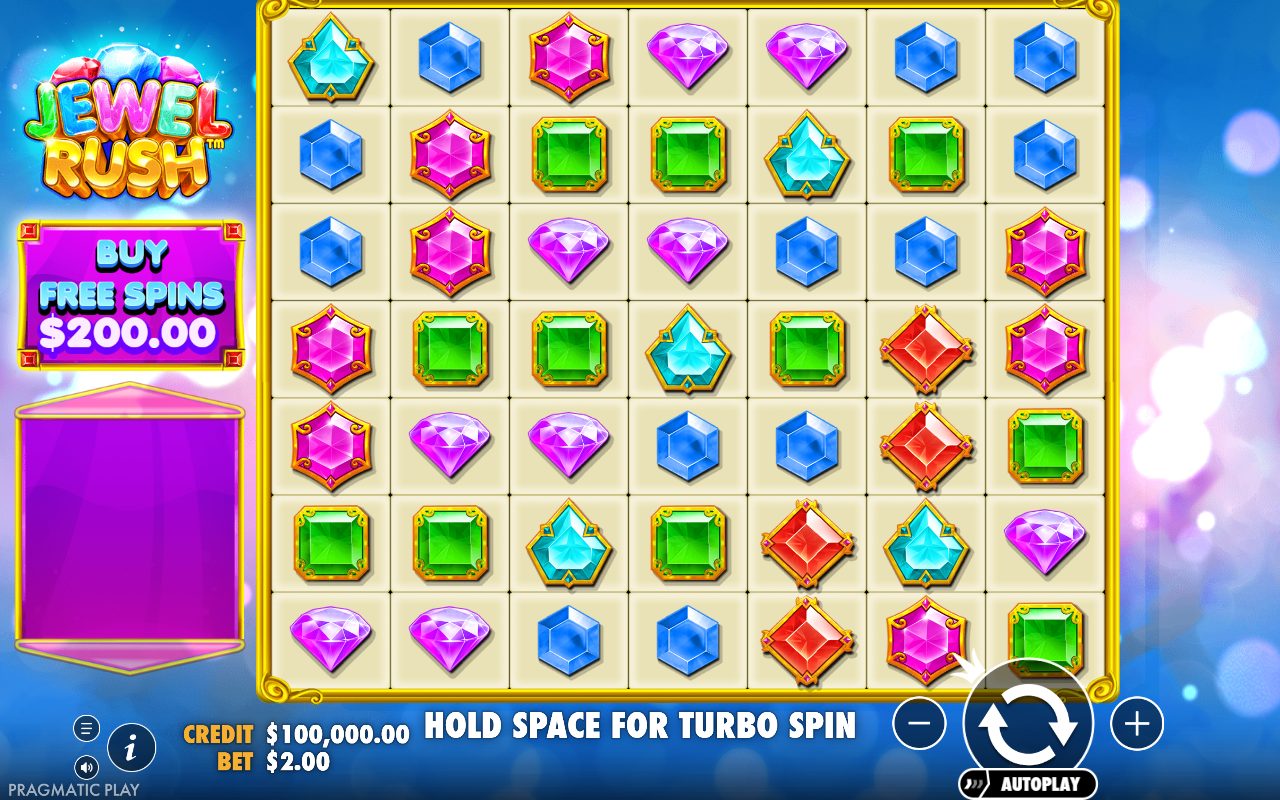
The grid is 7x7, dropping 49 symbols per spin with cluster pays as the win mechanism. A minimum cluster of 5 matching symbols anywhere on the grid triggers a win; 15 or more symbols in a single cluster unlock the higher pay tier. After a win, those symbols are removed and remaining symbols cascade downward while new ones fill the gaps — this is the Avalanche/Tumble mechanic that can chain multiple wins from a single spin.
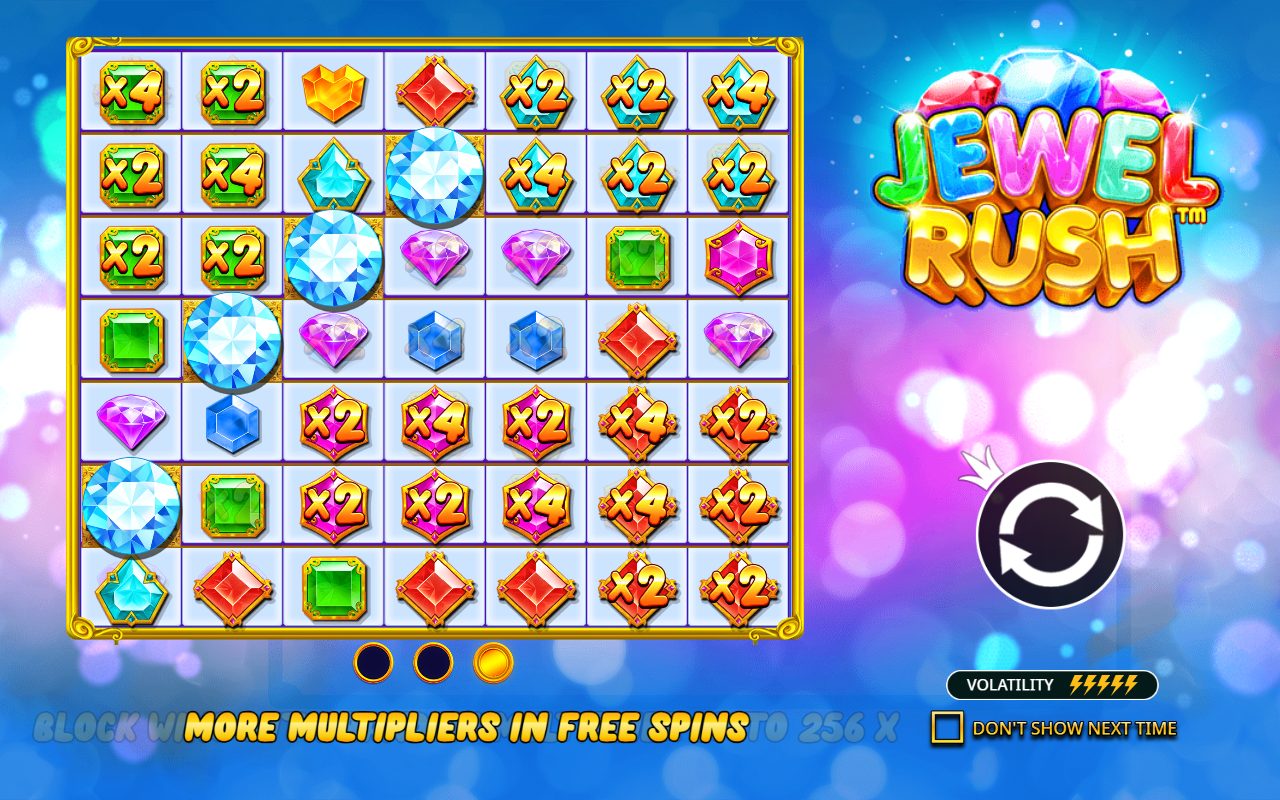
The random multiplier feature activates in the base game when winning symbols carry an x2 multiplier tag. Multiple multiplier symbols within the same winning cluster don't add together — they multiply. Two x2 multipliers in one cluster produce x4. Three produce x8. The theoretical ceiling via this compounding is x256, which requires eight x2 multipliers contributing to a single cluster win — rare, but mathematically possible.
The multiway element listed in the features (1024+) refers to the cluster-pays architecture itself rather than a traditional fixed-line structure. There are no paylines to track; position on the grid is irrelevant as long as symbols connect. This makes the game intuitive to follow, even during fast Tumble chains.
Bonus Features and Free Spins
Three or more scatter symbols trigger the free spins round, awarding 10 spins to start. The core Avalanche and cluster-pays mechanics carry over, but the multiplier system gets an upgrade: winning clusters can now produce x2 or x4 multiplier symbols (versus only x2 in the base game). Since those multipliers still compound multiplicatively, the potential for large single-spin payouts increases substantially compared to base-game play.
Free spins can be retriggered, extending the feature beyond the initial 10. Players outside the UK can also access a Buy Feature at 100x stake, jumping directly into the bonus round without grinding through base-game spins. At $100 max bet, that's a $10,000 single purchase — only relevant for high-stakes play, but the option exists.
Wilds with multipliers are also part of the feature set, adding another layer to the multiplier compounding during both base game and bonus play. The combination of cascading wins, multiplier symbols, and wild multipliers means the free spins round is where the majority of the theoretical max-win potential concentrates. The base game is functional but the bonus is where Jewel Rush earns its high-volatility rating.
Spindex Live Tracked-Bet Data
Jewel Rush has generated 11,000 tracked bets across Spindex's five crypto-casino data sources over the past 30 days, which puts it in the mid-tier activity range for Pragmatic Play releases on our network. The slot is currently trending normal — no unusual spike or drop in volume that would suggest a seeding period or operator promotion skewing results.
The most significant recent hit logged on Spindex came in at 1,921x — a strong result, but notably it represents roughly 38% of the 5,000x theoretical ceiling. That gap between the tracked peak and the published maximum is consistent with high-volatility cluster slots: the extreme outcomes exist in the math but require a specific convergence of multiplier symbols, cluster size, and Tumble chains that doesn't occur often across a 30-day sample of this size.
For players using Spindex to time sessions, the normal trend signal means there's no particular data-driven reason to rush in or hold off. The 11K bet sample is large enough to be directionally meaningful — this is a slot with steady organic play, not one being artificially inflated by promotional activity.
Bet Range and Accessibility
Jewel Rush accepts bets from $0.20 to $100 per spin, a range that covers casual recreational play through to serious session staking. At $0.20, even a 5,000x outcome pays $1,000 — meaningful but not life-changing. At $100, the same result delivers $500,000, which is why the Buy Feature at that stake level carries real risk-of-ruin implications.
The cluster-pays format and Avalanche mechanic mean individual spins can resolve quickly, especially in turbo mode. That pace can accelerate bankroll depletion on high volatility — worth factoring into session budgeting. A 200-spin session at $1 per spin represents a $200 exposure before any wins, and the variance distribution means cold streaks of 30–50 spins without a meaningful hit are within normal range for a 5/5 volatility slot.
Who Should Play Jewel Rush
Jewel Rush is built for players who want high-volatility cluster mechanics without the complexity of multi-stage bonus systems. The compounding multiplier logic is simple to understand — multipliers multiply, not add — which makes big wins legible when they land rather than requiring mental arithmetic to decode.
Players who enjoyed Sugar Rush and want a structurally similar experience on a gems theme will find the transition seamless. The 96.47% RTP is a genuine differentiator versus lower-RTP alternatives in the same genre, making it a better long-run choice for volume players who care about return rate. The Buy Feature makes it particularly relevant for bonus hunters who prefer to skip base-game grinding.
It's a weaker fit for players who need frequent small wins to sustain session length. The high volatility and cluster-pays structure mean dry spells are part of the expected experience, and the base game pacing can feel slow between the multiplier-boosted hits that make the slot worth playing.
Final Verdict
Jewel Rush delivers a coherent, well-tuned high-volatility slot with one genuine mechanical strength: the multiplicative compounding of cluster multipliers. That single design choice separates it from simpler cluster slots where multipliers merely add. The 96.47% RTP is above average for Pragmatic Play's catalogue, the 5,000x ceiling is competitive without being misleading, and the free spins round meaningfully upgrades the multiplier frequency.
The weaknesses are real but minor. The base game can drag between significant hits, and the 5,000x ceiling — while solid — doesn't match the upper range of what high-volatility cluster slots from other studios can offer. Spindex's 30-day data shows a top hit of 1,921x across 11,000 bets, which is a useful reality check against the theoretical maximum.
For a high-volatility cluster slot with a clean mechanic, above-average RTP, and a functional bonus buy, Jewel Rush earns a strong recommendation. It won't redefine the genre, but it executes its design brief reliably.
- +96.47% RTP sits above Pragmatic Play's typical catalogue average
- +Compounding multipliers (not additive) — up to x256 from a single cluster win
- +Free spins upgrade multiplier symbols to x2 and x4, increasing bonus potential
- +Buy Feature available (non-UK) at 100x stake for direct bonus access
- +7x7 grid with Avalanche mechanic supports extended win chains
- +Wide bet range ($0.20–$100) suits multiple player types
- -Base game pacing is slow between meaningful multiplier hits
- -5,000x ceiling is standard for Pragmatic Play but below some competitor cluster slots
- -RTP range is operator-adjustable — published 96.47% may not apply at all casinos
- -Hit frequency data not publicly disclosed, making session planning harder
Best for
Jewel Rush is a well-constructed high-volatility cluster slot with a compounding multiplier mechanic that can reach 256x in a single win. The 96.47% RTP is above the Pragmatic Play average, and the 5,000x ceiling is respectable. The base game can feel slow between meaningful hits, but the bonus round delivers the variance spike the math promises. Solid, not spectacular — but consistently enjoyable for cluster-pays fans.