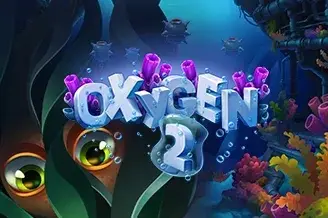

Oxygen 2 Review
ELK Studios released Oxygen 2 in March 2025 as a direct sequel to its 2023 original, keeping the core 6x7 cluster-pays grid intact while layering in a substantially expanded set of modifiers. The result is a high-volatility video slot with a 94% RTP, a 25,000x max win ceiling, and a feature roster that includes cascading mechanics, per-position bubble multipliers capped at 2,048x each, two distinct wild types, and a five-tier X-iter bonus buy panel.
The spec sheet is dense, and that density is the point. ELK has built a slot that rewards players who understand how its multiplier accumulation system works — particularly the interaction between persistent bubble positions, the Octopus feature, and the Jellyfish modifier during free spins. Get that interaction firing and the numbers move fast; miss it entirely and the 94% RTP will make itself felt. This review breaks down every mechanic, puts the numbers in context, and draws on Spindex's own tracked-bet data to give you a clear picture of how Oxygen 2 is actually performing in the wild.
RTP, Volatility, and Max Win in Context
Oxygen 2 carries a 94% RTP — that number deserves attention before anything else. The current industry benchmark for video slots sits around 96%, and many ELK Studios titles come in at 96% or above. Oxygen 2's 94% is a meaningful step below that, which means the house edge here is roughly double what you'd face on a comparable slot from the same studio.
The 25,000x max win is a strong headline figure, though it's worth calibrating expectations. Jawsome by Massive Studios — a comparable cluster-pays title in the same competitive space — targets a 50,000x ceiling, which puts Oxygen 2's upside at the mid-tier for the genre. Sugar Rush by Pragmatic Play, the slot that arguably popularised this multiplier-accumulation cluster format, also offers a higher theoretical ceiling. What Oxygen 2 has over those titles is a more layered modifier stack, which gives the max win more credible pathways even if the number itself isn't the genre's highest.
High volatility combined with a 94% RTP means variance is working against you on two fronts simultaneously — longer dry spells and a lower long-run return rate. That's a real cost. Players who prioritise session longevity or who are new to high-volatility cluster slots should factor that in before choosing Oxygen 2 over a 96%+ alternative.
How Oxygen 2 Plays: Grid, Cascades, and Bubble Multipliers
The foundation is a 6x7 grid using cluster pays — winning groups of matching symbols trigger a payout, those symbols are removed, and the remaining pieces fall under gravity while new ones drop from above. This cascade (called Avalanche here) repeats until no new clusters form. There are no fixed paylines; any cluster of sufficient size anywhere on the grid counts.
The signature mechanic is the Bubble Multiplier system. When symbols explode for the first time on a given grid position, an Oxygen Bubble activates at that spot. If subsequent cascades trigger further explosions at the same position, the multiplier at that position doubles — starting low and potentially reaching 2,048x per position. Crucially, all active position multipliers are summed before being applied to a winning cluster, so a single cluster touching multiple high-value bubble positions can produce outsized payouts without needing to hit every position independently.
Multiplier Strike is a random modifier that seeds additional multipliers across the grid without requiring prior explosions at those spots — effectively accelerating the multiplier build-up. This is one of several random activations in the base game, and its presence means even short sessions can occasionally produce multiplier stacks that wouldn't be possible through the cascade sequence alone.
Wild Types and Symbol Modifiers
Oxygen 2 runs two distinct wild mechanics, and they behave very differently from each other. The Exploding Wild, when it forms part of a winning cluster, generates two cone-shaped blast zones — either left/right or up/down from the wild's position. Every standard paying symbol caught in those zones is removed, triggering new drops and activating any special wilds that were sitting in the cleared area. The Super Exploding Wild extends this further by also activating all previously dormant Bubble positions behind the cleared symbols.
The Blaster Wild operates on a transformation logic rather than removal. Once it's part of a cluster, it selects one target symbol type at random — either a standard paying symbol or a regular wild — then explodes in an X or plus-shaped pattern, converting every symbol in its path into the selected type. If a symbol is caught in the blast radius of more than one Blaster Wild simultaneously, it converts to a regular wild instead of the targeted symbol.
Big Symbols — available in 2x2, 3x3, and 4x4 sizes — also appear on the grid and can carry their own multiplier values. These aren't a separate feature toggle but part of the standard symbol pool, meaning they can interact with both wild types and the Bubble Multiplier system in the same cascade sequence.
Jellyfish and Octopus: The Random Modifier Pair
Two random modifiers activate independently in the base game and carry over — in different ways — into the free spins round. The Jellyfish Feature can trigger at the start of any drop, placing one or more jellyfish on random grid positions. Each jellyfish carries a random multiplier value that gets added to whatever multiplier is already sitting at that position. This is a straightforward additive boost that can meaningfully accelerate the bubble multiplier stack mid-spin.
The Octopus Feature is position-based rather than multiplier-additive. It anchors itself behind a randomly selected symbol position and waits. If that position becomes part of a winning cluster, the Octopus collects a random number of active Bubble multipliers from positions outside the cluster and folds them into the cluster's payout multiplier. In practice, this means a cluster that wouldn't normally touch high-value bubble spots can still benefit from them — the Octopus effectively bridges the gap.
Both modifiers are random in the base game, which means their contribution to any given spin is unpredictable. In the free spins round, the Octopus becomes persistent and repositions between each free drop rather than disappearing — a significant upgrade in reliability.
Free Spins and Super Bonus Game
Three scatter symbols anywhere in view trigger the standard Free Spins round: 10 free drops with persistent Bubble Multipliers. Unlike the base game, where multiplier positions reset between spins, the bubbles here carry their values forward across all 10 drops. Multipliers still cap at 2,048x per position, but the compounding effect across a full free spins run is substantially more powerful than anything achievable in a single base-game spin sequence.
The Octopus is also persistent during free spins, though it relocates to a new position before each free drop. Four scatter symbols in the base game trigger the Super Bonus Game — the same 10 free drops, but with the Jellyfish Feature guaranteed to activate on every single drop rather than appearing randomly. That's the key structural difference between the two modes: the Jellyfish's multiplier additions become a certainty rather than a variable.
Retriggers are available during both modes. Landing two or three additional scatters adds 3 or 5 free drops respectively; four scatters during the standard bonus upgrades it to Super Bonus and adds 7 drops. The Super Bonus cannot be upgraded further, but the drop additions still apply. Given that the Bubble Multipliers are persistent and progressive, additional drops in the later stages of a free spins run — when positions are already carrying significant multiplier values — are disproportionately valuable compared to the same drops at the start.
X-iter Bonus Buy Panel
ELK's X-iter system gives players five distinct entry points into the feature set, priced relative to the active bet stake. Bonus Hunt at 3x stake increases the probability of landing three or more scatter symbols above the standard rate. Special Wilds at 10x guarantees at least three special wild symbols in the opening drop. Octo Strike at 25x guarantees both a Multiplier Strike and the Octopus Feature activation. Bonus Game at 100x guarantees a direct entry into the standard Free Spins round. Super Bonus Game at 500x guarantees entry into the Super Bonus — the Jellyfish-on-every-drop variant.
The RTP does not change across any of the five X-iter options, which is worth noting. Some bonus buy implementations carry a different (often lower) RTP than the base game, making them mathematically worse value. That's not the case here — the 94% figure applies uniformly regardless of which entry point you use.
At 500x stake, the Super Bonus buy is an expensive commitment in absolute terms — the source material notes the maximum X-iter price can reach €50,000 at high bet levels. For players who want to access the game's ceiling potential without grinding through the base game, the direct Super Bonus entry is the most efficient route, though the 94% RTP means even this option is not a positive-expectation play.
Spindex Live Data: 197 Tracked Bets
Oxygen 2 has logged 197 tracked bets across Spindex's five crypto-casino sources in the last 30 days. For a slot that only launched in March 2025, that's a modest but meaningful early sample — enough to confirm active real-money play without yet establishing a stable long-run pattern.
The top recent hit recorded on Spindex sits at 121x the stake. That's a low multiple relative to the 25,000x theoretical ceiling, which is exactly what you'd expect from a high-volatility slot in its early tracking window — the big outlier hits are rare by design, and 197 bets is nowhere near the sample size needed to see one surface in our data. What the 121x figure does confirm is that the base game and lower-tier bonus rounds are producing returns in the expected range for this volatility class.
Volume is still building. Players who want to watch how Oxygen 2's hit distribution evolves over a larger sample — particularly whether the Bubble Multiplier system produces the kind of clustered big-win events ELK's design suggests it should — can track it directly on Spindex as the bet count grows.
Who Oxygen 2 Is Best For
Oxygen 2 is built for players who are already comfortable with high-volatility cluster-pays mechanics and want a feature set that goes beyond the standard free-spins-with-multiplier template. The interaction between persistent bubble positions, the Octopus's cross-grid multiplier collection, and the guaranteed Jellyfish activations in Super Bonus creates a system where understanding the mechanics directly affects how you interpret what's happening on screen — and that depth appeals to a specific type of slot player.
The 94% RTP makes it a harder recommendation for casual or recreational players who aren't specifically seeking this format. At that return rate, session bankroll will deplete faster than on a 96% title at equivalent volatility. Players who want the cluster-pays multiplier experience with better long-run returns should look at alternatives before committing.
Bonus hunters using the X-iter buy feature will find the five-tier structure genuinely useful — the ability to guarantee a Super Bonus entry at 500x stake is a clean proposition for players who want to target the game's peak feature state directly. The flat RTP across all X-iter options removes the usual penalty for buying in.
Final Verdict
Oxygen 2 is ELK Studios expanding on a proven base rather than rebuilding from scratch. The 6x7 cluster-pays grid and cascade mechanic carry over from the original, but the addition of two distinct wild types, the Jellyfish and Octopus modifier pair, and a five-tier bonus buy panel gives the sequel meaningfully more surface area for big-win construction.
The 94% RTP is the clearest drawback in the spec sheet and should be treated as a real cost, not a footnote. Paired with high volatility, it creates a slot that demands either a substantial bankroll, a short-session approach, or direct access via the bonus buy panel. The 25,000x ceiling is achievable in theory but requires the multiplier accumulation system to fire across multiple persistent free drop positions simultaneously — a low-probability event by design.
For players who specifically want a deep, mechanically complex cluster-pays slot and are willing to absorb the RTP trade-off, Oxygen 2 delivers. ELK has built something that rewards engagement with its systems rather than passive play, and that's a genuine differentiator in a genre that can feel repetitive.
- +25,000x max win on a 6x7 cluster-pays grid
- +Per-position Bubble Multipliers cap at 2,048x each and persist across free drops
- +Two distinct wild types (Exploding and Blaster) with different activation logic
- +Octopus and Jellyfish modifiers add meaningful base-game variance
- +Super Bonus guarantees Jellyfish activation on every free drop
- +Five-tier X-iter bonus buy with flat 94% RTP across all options
- +Big Symbols (2x2, 3x3, 4x4) can carry independent multiplier values
- -94% RTP sits well below the 96% industry benchmark
- -High volatility combined with below-average RTP creates a punishing bankroll curve
- -Core grid and cascade mechanics unchanged from the original Oxygen
- -25,000x ceiling is mid-tier for the cluster-pays genre
Best for
Oxygen 2 is ELK Studios at its most mechanically ambitious — a 6x7 cluster-pays machine with multiplier positions that compound aggressively and a bonus buy menu that goes all the way up to a guaranteed Super Bonus at 500x stake. The 94% RTP is a genuine drawback and sits below the industry norm, but for high-volatility cluster-pays fans chasing a 25,000x ceiling, the feature depth justifies the trade-off.