
Rad Maxx Review
Hacksaw Gaming's Rad Maxx arrived in April 2025 as a sequel to RIP City, keeping the cartoon back-alley setting and the cat-and-mouse duo while shifting the spotlight almost entirely onto Maxx the mouse. The core mechanical hook here isn't free spins or a simple multiplier trail — it's a directional win system that starts with 76 paylines running left to right and can expand to 360 win ways across all four directions when the Wild Plus symbol activates. That single mechanic changes how you read every spin, and it takes a few sessions to fully click.
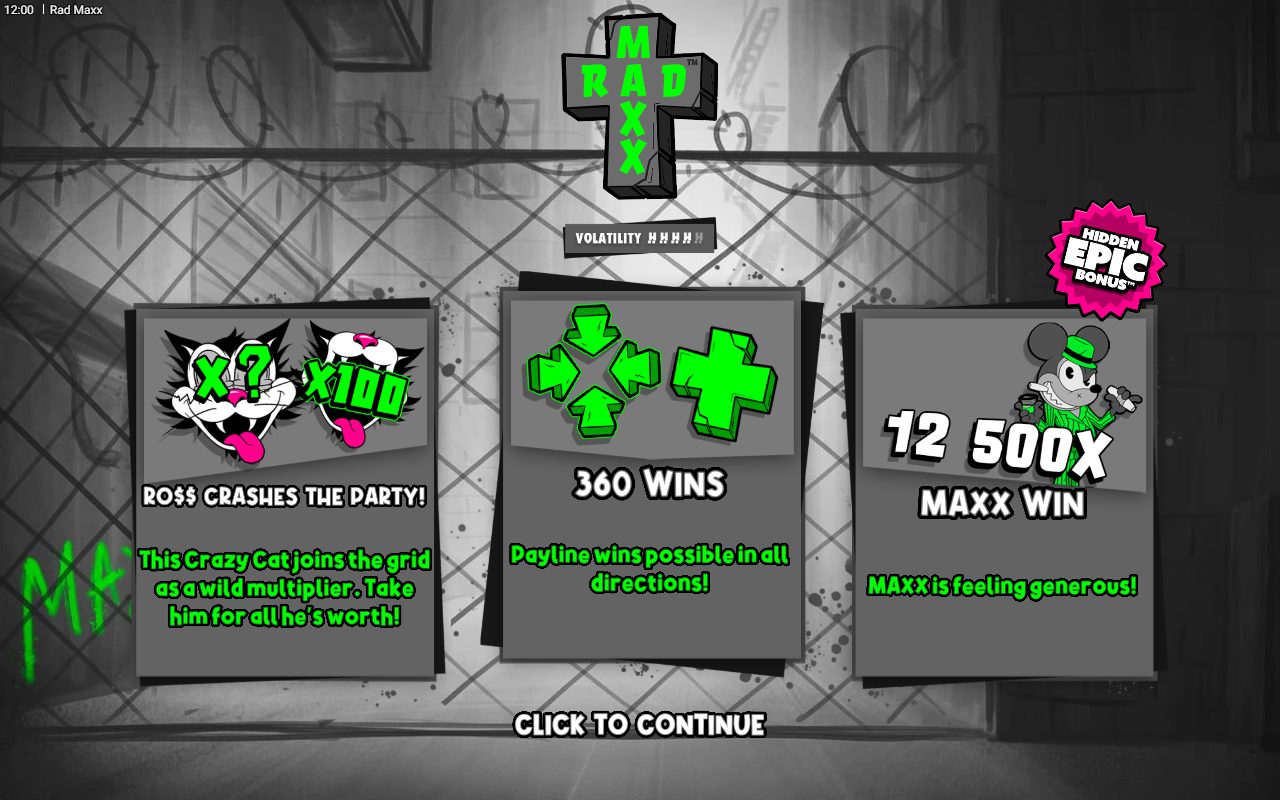
On paper the numbers are polarizing: a 94.42% RTP sits below the Hacksaw studio average and well below what many players expect from a high-volatility release, but the 12,500x ceiling is available at every stage of the game, not just in a locked bonus tier. Three separate free-spins rounds, a bonus buy menu with four options, sticky multiplier wilds that can stack to values far beyond their individual x20 cap — there's real mechanical depth here. Whether that depth justifies the below-average RTP is the central question this review answers.

RTP, Volatility, and What the Numbers Actually Mean
The headline concern with Rad Maxx is the 94.42% RTP. Hacksaw's own catalog average sits closer to 96.20%, so this release is roughly 1.8 percentage points below what the studio typically delivers. For context, Wanted Dead or a Wild — another high-volatility Hacksaw title — carries a 96.38% RTP. That gap compounds over session volume and makes Rad Maxx a noticeably more expensive game to run through at scale.
Volatility is rated high, and the 40% hit frequency softens that somewhat — nearly four in ten spins return something. The catch is that a large share of those hits will be sub-stake returns, which is standard for high-variance mechanics built around multiplier clustering. The max win of 12,500x is achievable in the base game and across all three bonus tiers, which is a meaningful design choice: Hacksaw hasn't gated the ceiling behind a single premium bonus round the way some competitors do.
The RTP is also listed as a range rather than a fixed value, meaning individual casino configurations can push the return lower than 94.42%. Players should verify the RTP displayed in the game's paytable before committing to a session, particularly on platforms where operator-configured RTP variants are common. Bets run from $0.10 to $100 per spin.

How Rad Maxx Plays: The Win Direction System
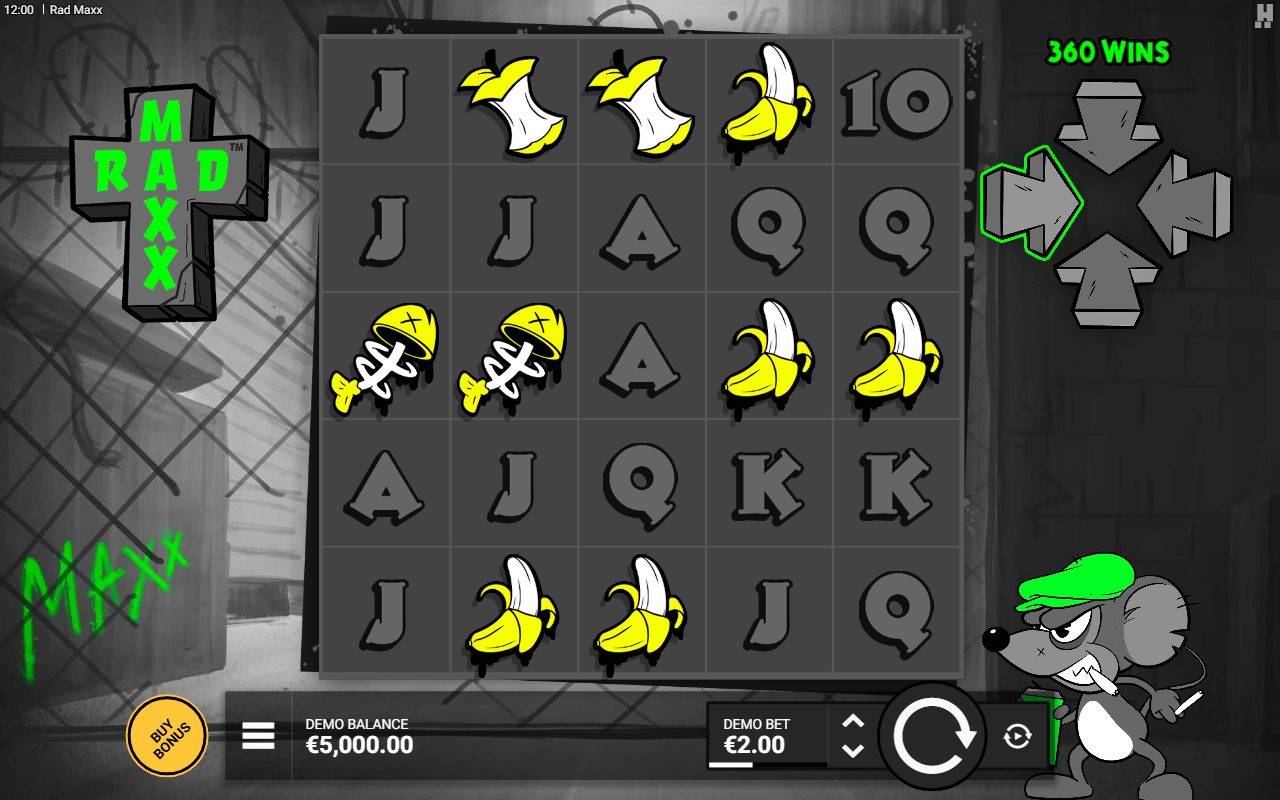
Rad Maxx runs on a 5x5 grid with 76 default paylines, all paying left to right. Four directional arrows displayed outside the game area show which win directions are currently active — in the base game, only the left arrow is lit by default. The Wild Plus symbol is the engine that changes this: landing one activates between one and three additional pay directions randomly, opening wins that run right to left, top to bottom, or bottom to top. At full activation, that's 360 possible win ways across all four directions simultaneously.
The system resets between spins, so Wild Plus activations don't carry over. What does carry over — in the bonus rounds — are the Crazy Cat Multiplier Wilds. These land with multiplier values between x2 and x20. When two or more appear in the same winning combination, their values multiply together rather than add, so two x10 wilds produce a x100 multiplier, not x20. That stacking behavior is where the big numbers come from.
Premium symbols pay between 5x and 10x stake for five of a kind. Maxx the mouse is the top-paying symbol at 10x for five of a kind, followed by rotten fish, banana, pizza slice, and apple core. These are modest base-game values by design — the slot's payout architecture assumes the multiplier wilds are doing the heavy lifting, which means base-game sessions without wild stacking can feel lean.
Three Bonus Tiers: Mad Maxx, Maxximice, and To The Maxx
Rad Maxx has three distinct free-spins rounds, each triggered by landing a different number of scatter symbols in a single base-game spin. Three scatters launch the Mad Maxx bonus: 10 free spins where Wild Plus symbols appear more frequently than in the base game and Crazy Cat Multiplier Wilds become sticky for the duration. Additional scatters during the feature award +2 or +4 extra spins depending on whether two or three appear.
Four scatters trigger Maxximice — the same 10-spin structure, but now a Wild Plus symbol is guaranteed on every single free spin. That guaranteed directional activation on each spin meaningfully increases the frequency of 360-way win setups. Five scatters on a single spin unlock To The Maxx, where all four pay direction arrows are active on every spin from the start — no Wild Plus required to unlock them. This is the highest-variance tier and the one most likely to generate the session-defining multiplier stacks.
One notable limitation: the To The Maxx bonus cannot be purchased through the bonus buy menu. The buy menu offers four options — a 3x stake FeatureSpins boost, a 50x Feline Frenzy spin guaranteeing at least one Wild Plus and three multiplier wilds, a 100x direct entry to Mad Maxx, and a 200x direct entry to Maxximice. Players chasing the top tier must earn it organically, which is a deliberate design decision that keeps the highest-potential outcome off the purchase path.
Spindex Tracked-Bet Data: 30-Day Performance
Across Spindex's five crypto-casino sources, Rad Maxx has logged approximately 7,000 tracked bets in the past 30 days. For a slot released in April 2025, that's a modest but steady early-adoption volume — consistent with a high-volatility release that attracts deliberate players rather than casual mass traffic. The trend signal is currently normal, meaning no unusual clustering of big wins or dry spells relative to expected variance.
The largest recent hit recorded on Spindex is 1,784x. That's a solid session win but sits well below the 12,500x ceiling, which reinforces the high-volatility profile: the top end of the range is real but requires the kind of multiplier wild stacking that the To The Maxx bonus is designed to produce. A 1,784x hit in tracked data suggests the game is paying out at meaningful levels without yet producing a ceiling-approaching event in our sample.
For players using Spindex to time entries, the normal trend signal means there's no particular momentum argument for or against playing Rad Maxx right now. The 40% hit frequency keeps session variance manageable enough that tracked-bet data doesn't show the extended dead stretches common in ultra-high-volatility titles. That said, 7,000 bets is a relatively small sample for drawing strong conclusions about long-run behavior.
Bonus Buy Options Breakdown
The bonus buy menu in Rad Maxx (unavailable to UK players) gives four entry points at different price points and risk profiles. The cheapest option is the BonusHunt FeatureSpins at 3x stake, which multiplies bonus trigger probability by five times without guaranteeing a specific outcome — it's a session-pacing tool more than a direct bonus purchase. The Feline Frenzy FeatureSpins at 50x stake guarantees at least one Wild Plus and three Crazy Cat Multiplier Wilds on the following spin, creating a high-probability setup for a multiplier stack without locking you into a bonus round.
The two direct bonus purchases — Mad Maxx at 100x stake and Maxximice at 200x stake — let players skip the scatter-hunting phase entirely. The 200x cost for Maxximice reflects the guaranteed Wild Plus on every spin, which is a significant structural advantage over the base Mad Maxx feature. The absence of a To The Maxx purchase option is the most interesting menu decision: Hacksaw has kept the highest-variance outcome as an organic-only event, which means the buy menu's ceiling is Maxximice rather than the full four-direction guaranteed bonus.
At a $100 max bet, the Maxximice direct buy costs $20,000 per entry. At minimum bet, it's $20. The math on bonus buys in a 94.42% RTP environment means the expected cost of each purchase is slightly higher than in a standard 96%+ RTP game — worth factoring in for players who rely heavily on the buy feature.
Who Should Play Rad Maxx
Rad Maxx is built for players who are comfortable with high-volatility mechanics and understand that the RTP trade-off is the price of admission for a 12,500x ceiling with multiplier stacking. The 40% hit frequency means it's not a relentlessly punishing session experience, but the below-average 94.42% RTP makes it a poor choice for players grinding volume or playing with tight bankroll margins.
The directional win system adds a layer of mechanical engagement that rewards players who take the time to understand how Wild Plus activations interact with multiplier wild stacking. Casual players who prefer straightforward payline slots may find the arrow indicators and win-direction resets disorienting in early sessions. The learning curve is real, but short — most players will internalize the system within 20 to 30 spins.
Players who enjoyed RIP City will find familiar DNA here: the same back-alley cartoon aesthetic, the same multiplier-wild architecture, and the same Hacksaw tendency toward sudden large wins rather than steady incremental returns. The main difference is that Rad Maxx concentrates the character focus and sharpens the mechanical complexity. Those who found RIP City's expanding multiplier wilds more intuitive may prefer that title; those who want a more structured bonus-tier progression will find Rad Maxx's three-tier system more satisfying.
Final Verdict
Rad Maxx is a technically accomplished slot with a genuinely interesting win-direction mechanic and a well-structured three-tier bonus system. The Wild Plus directional activation, the multiplying multiplier wilds, and the sticky wild behavior in the bonus rounds create a coherent mechanical ecosystem where the pieces reinforce each other rather than existing as isolated features.
The 94.42% RTP is the most significant friction point. It's the lowest number in Hacksaw's recent high-volatility releases and represents a real long-run cost compared to studio peers. The absence of To The Maxx in the bonus buy menu is a minor frustration for buy-feature players, though the logic of keeping the top tier organic-only is defensible from a design standpoint.
The base game can feel slow between Wild Plus activations — the premium symbols' 5x-10x payouts don't move the needle without multiplier involvement, and sessions that don't hit the bonus rounds can drain bankrolls faster than the hit frequency suggests. That's the honest trade: high ceiling, real mechanical depth, but a below-average RTP that demands either a generous bankroll or a patient, bonus-focused strategy.
- +12,500x max win accessible across all game stages, not just a single premium bonus
- +Multiplier wilds stack multiplicatively (not additively), enabling extreme multiplier combinations
- +Three distinct free-spins tiers with meaningful structural differences between each
- +Wild Plus directional system creates genuine mechanical variety within a single session
- +Four bonus buy options cover a wide range of risk profiles and budgets
- +40% hit frequency prevents the extended dead stretches common in ultra-high-volatility titles
- -94.42% RTP is below Hacksaw's typical studio average and well below industry standard
- -RTP is configurable by operator, meaning actual return may be lower than the headline figure
- -To The Maxx (top-tier bonus) cannot be purchased — organic trigger only
- -Base-game payouts without multiplier wild involvement are modest and can make sessions feel lean
- -Win-direction system has a learning curve that may frustrate new players in early sessions
Best for
Rad Maxx is a mechanically dense Hacksaw slot with a genuinely novel win-direction system and three escalating bonus tiers. The 12,500x ceiling is real and accessible across all game stages, but the 94.42% RTP is a meaningful cost. Best suited to high-volatility hunters who can tolerate a below-average return rate in exchange for Hacksaw's characteristically explosive multiplier potential.