
Reactoonz Review
Seven years after its 2017 launch, Reactoonz remains one of Play'n GO's most-played titles — a status earned through a genuinely unusual feature stack rather than nostalgia alone. Built on a 7x7 cluster-pays grid with cascading wins, five distinct Quantum modifiers, a Gargantoon mega-wild, and multipliers baked into symbol merges, it packs more mechanical variety into a single session than most modern slots manage across an entire feature round. The RTP sits at a solid 96.51% at its default configuration, though that number can drop dramatically depending on where you play — something every player should verify before depositing. Volatility is rated 10 out of 10 by Play'n GO themselves, and the 4,570x max win is modest relative to that risk level. Our Spindex tracked-bet data shows 94K spins logged across crypto-casino sources in the last 30 days, with the top recent hit landing at 1,674x. The signal is currently trending cool. That combination of facts — high variance, capped upside, and a cooling trend — shapes everything in this review.
RTP, Volatility, and the Max Win Problem
The headline RTP of 96.51% is above the industry average and competitive within Play'n GO's own catalog — but it is not guaranteed. Play'n GO publishes multiple RTP configurations for Reactoonz, and casinos can deploy versions running at 94.51%, 91.49%, 87.50%, or even 84.51%. That bottom figure is among the lowest you'll encounter on a mainstream video slot, and the gap between 96.51% and 84.51% is large enough to meaningfully change long-run expected return. Always check the paytable or rules screen before playing for real money.
Volatility is rated 10/10 by the developer — the maximum on their scale. In practice that means extended dry stretches are normal, and the Quantum meter can cycle through multiple modifiers before a win of any real size materialises. The source's own 200-spin test at €1 per spin produced no significant win despite frequent Quantum feature triggers, which is consistent with what high-10/10 volatility actually looks like in practice.
The 4,570x max win is where Reactoonz shows its age. For comparison, Play'n GO's own Rise of Olympus reaches 5,000x, and later cluster-pays titles from competing studios routinely push 10,000x or higher. For a slot rated maximum volatility, a sub-5,000x ceiling means the risk-to-reward ratio is less favourable than modern alternatives. That is not a dealbreaker — the feature complexity compensates — but players chasing life-changing hits should factor it in.
How Reactoonz Plays: Grid, Clusters, and Cascades
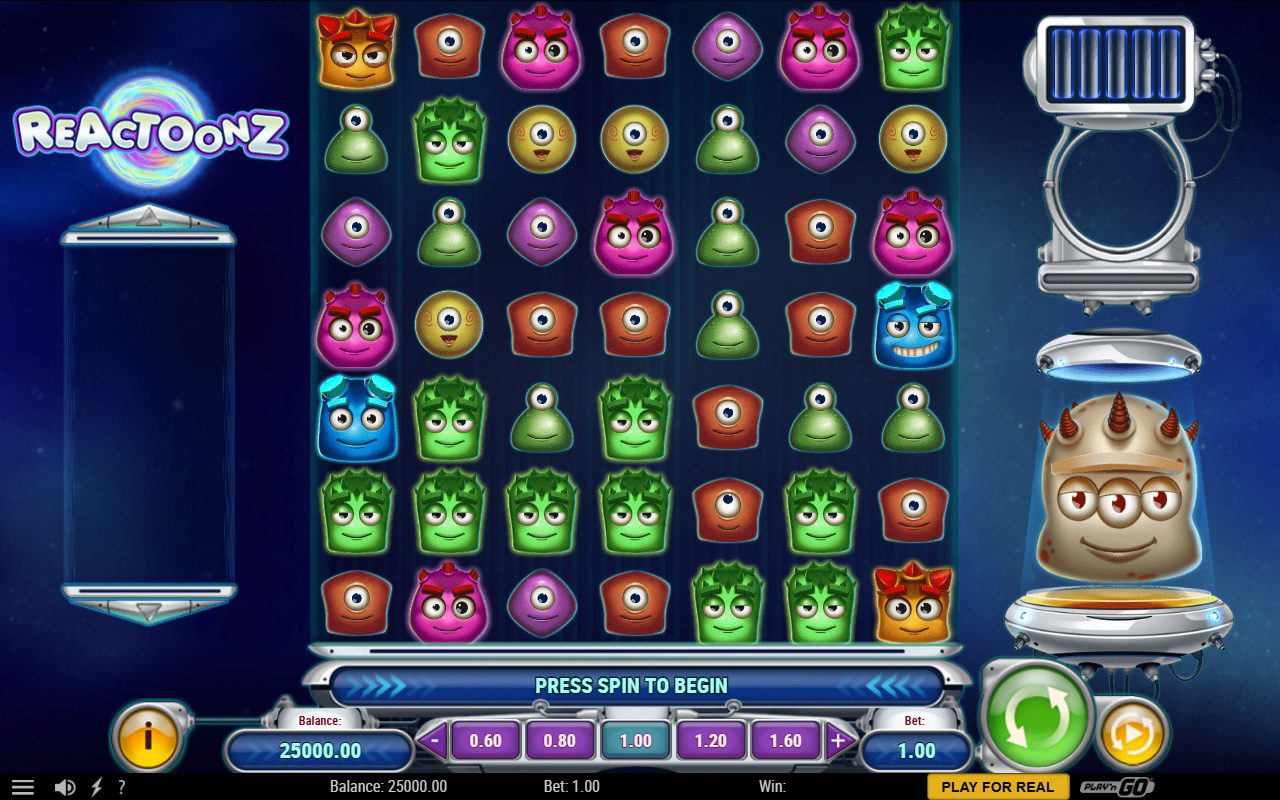
Reactoonz runs on a 7x7 grid with no traditional paylines. Wins form when five or more identical symbols connect horizontally or vertically in a cluster. After a winning cluster pays out, those symbols are removed and the remaining pieces fall downward, with new symbols dropping in from above to fill gaps. This cascade continues until no new clusters form — a mechanic that allows a single paid spin to generate multiple consecutive wins without any additional bet.
The symbol set divides into lower-paying one-eyed aliens and higher-paying two-eyed variants. Wild symbols substitute for any alien in a cluster but only appear through the game's feature mechanics — they are never part of the base reel set. When four identical symbols land in a 2x2 square configuration, they merge into a single Giantoonz symbol carrying a 2x multiplier, doubling the value of any cluster it contributes to.
Betting runs from $0.20 to $100 per spin, which covers the full spectrum from casual low-stakes play to serious high-roller sessions. The grid format and cascade structure mean that a single spin can stay active for considerably longer than a standard reel spin, which affects session pacing — rounds can feel slow during cold streaks but accelerate significantly once clusters start chaining.
Bonus Features: Quantum Modifiers and the Gargantoon
Reactoonz's feature system is built around a Quantum Leap progress bar that fills as winning symbols are collected — every symbol in a winning cluster contributes one point, and 25 points fill one segment. Each completed segment queues a random Quantum feature, up to four stored at once. Filling the bar a fifth time guarantees the Gargantoon feature. Queued features trigger sequentially once cascades stop producing new wins.
The four Quantum modifiers each work differently. Implosion converts three to six random symbols into Wilds and destroys all adjacent symbols. Demolition clears every lower-paying one-eyed alien from the grid. Incision places a Wild in the centre cell and draws two diagonal lines across the entire grid, filling them with a randomly selected symbol. Alteration picks one lower-paying alien type and converts all visible instances into a different random symbol. Each of these can set up cluster chains in distinct ways, which is why no two Quantum sequences play out identically.
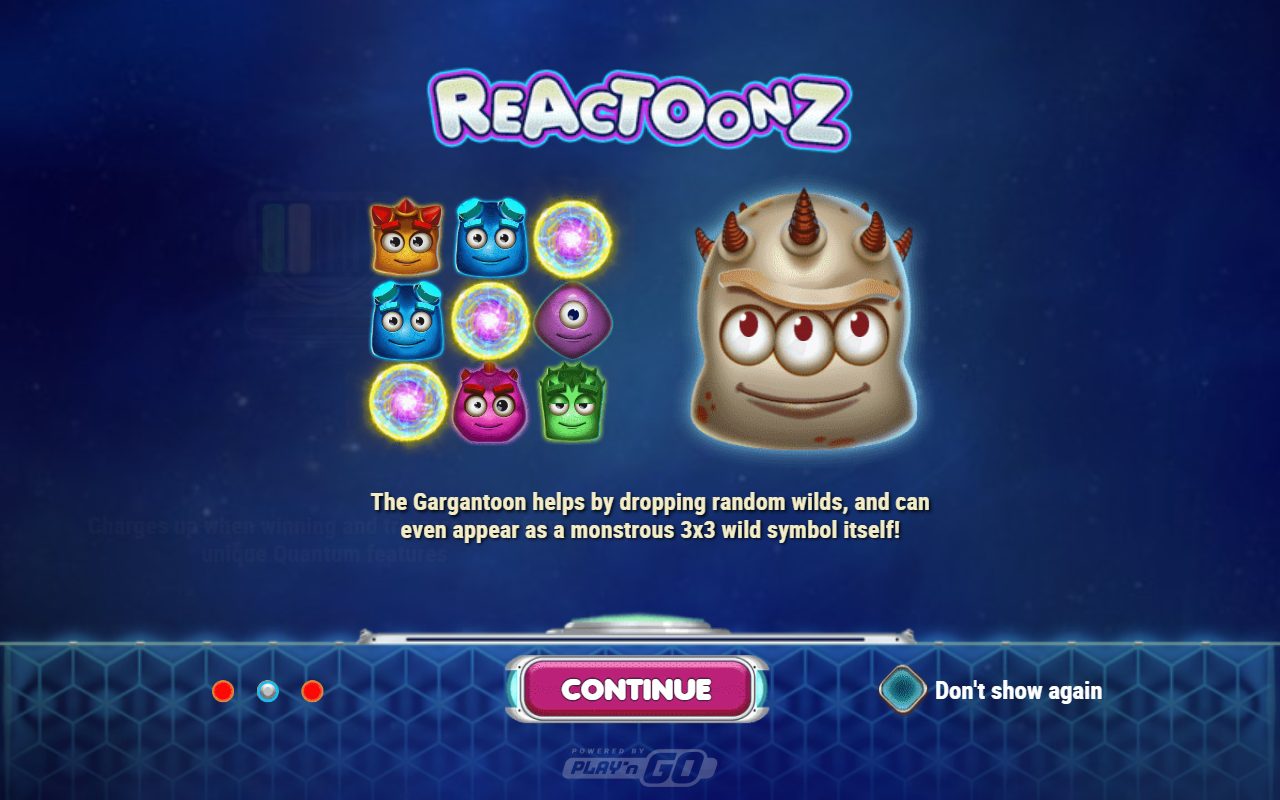
The Gargantoon itself is a 3x3 Wild block placed at a random grid position. On each subsequent cascade it splits — first into two 2x2 Wilds, then into nine individual 1x1 Wilds scattered across the grid. A well-placed Gargantoon during a cascade chain is the primary route to the slot's larger wins. Two additional mid-spin mechanics add further Wild sources: the Fluctuation feature marks a random low symbol at spin start, and if it wins, it leaves two Wilds behind before the next cascade; the Instability mechanic can add four to eight random Wilds on a non-winning spin.
Spindex Live Data: 94K Tracked Bets, Trending Cool
Reactoonz has logged 94,000 tracked bets across Spindex's five crypto-casino data sources over the past 30 days, which places it firmly in the active tier for a 2017 release — most slots of this age see a fraction of that volume. The largest single hit recorded in that window was 1,674x, which is well below the 4,570x theoretical ceiling but consistent with the slot's high-volatility, moderate-peak profile.
The current trend signal is cool, meaning bet volume and win frequency are running below their rolling averages. That does not predict future outcomes — slot RNG is session-independent — but it does indicate the slot is not currently in a high-activity period that might draw in new players organically. For players who track momentum signals, this is a holding pattern rather than a hot entry point.
The 94K volume figure is worth contextualising: Reactoonz 2, the official sequel, competes for the same player base. The original maintaining five-figure monthly tracked bets on crypto platforms specifically suggests it has a loyal repeat audience rather than casual discovery traffic. That audience profile aligns with the game's complexity — it rewards players who understand the Quantum meter and feature sequencing.
The RTP Range Issue: What Casinos Don't Advertise
The multi-configuration RTP is one of the more important practical details in any Reactoonz review. Play'n GO builds the game with five selectable return rates — 96.51%, 94.51%, 91.49%, 87.50%, and 84.51% — and individual casinos choose which version to deploy. The 96.51% figure is the default and the one most review sites quote, but it is not universal.
A player spinning at 84.51% is operating under conditions that return roughly 12 percentage points less per unit wagered than the advertised default. Over a high-volatility session with significant bet volume, that gap compounds materially. The practical advice is straightforward: load the game's information panel or paytable before committing real funds and confirm the active RTP. If it is not displayed, check the casino's game-specific rules page or contact support.
This is not unique to Reactoonz — Play'n GO uses variable RTP configurations across much of its catalog — but the spread here is wider than typical. It is also worth noting that Reactoonz free play (demo mode) typically runs at the default 96.51%, so demo performance does not reflect what a player will experience at a low-RTP casino deployment.
Who Should Play Reactoonz
Reactoonz suits players who engage with slot mechanics rather than just outcomes. The Quantum meter, the four distinct modifiers, the Gargantoon split sequence, and the cascade chain structure all reward attention and understanding — knowing that Demolition clears low-pays and can set up a Gargantoon placement, for example, changes how a player reads a developing spin.
High-volatility players who need a max-win ceiling above 5,000x should look elsewhere. The 4,570x cap means Reactoonz is not the right vehicle for a single-session moonshot strategy. Players comfortable with extended variance in exchange for frequent feature activity — the Quantum meter fills regularly even on losing sessions — will find the pacing more tolerable than a simpler high-variance slot where dry spells offer nothing.
Low-stakes players benefit from the $0.20 minimum, which allows meaningful session length even on a small bankroll. The cluster-pays format also means wins can arrive from unexpected grid positions, which keeps base-game spins more visually engaging than a standard payline slot during cold stretches. The Aliens and Space theme is presented in a cartoonish style — factually, the grid is populated by colourful alien characters rather than realistic sci-fi imagery.
Final Verdict
Reactoonz holds its position in casino lobbies because its feature architecture is genuinely more complex than most of what came after it. Five Quantum modifiers with distinct grid effects, a splitting mega-wild, multiplier-bearing merged symbols, and two independent Wild-injection mechanics create a system where sessions rarely feel identical — even when the bankroll result is the same.
The limitations are real. A 4,570x max win is underwhelming for a 10/10 volatility rating — players absorbing that level of variance deserve a higher ceiling. The RTP range issue requires active verification at every casino. And Spindex's current cool trend signal suggests the slot is not in a momentum phase that would make this a particularly timely entry.
For players who value mechanical depth and are comfortable with extended variance and a moderate payout cap, Reactoonz remains a well-constructed slot that has aged better than most 2017 releases. For those chasing maximum upside, the sequel or other high-ceiling cluster-pays titles are the more efficient choice.
- +96.51% default RTP is above industry average
- +Five distinct Quantum modifiers create genuine session variety
- +Gargantoon 3x3 wild with cascade-split mechanic is mechanically unique
- +Cluster pays on a 7x7 grid with cascades allows multi-win chains from a single spin
- +$0.20 minimum bet supports low-stakes play
- +Still generating strong tracked-bet volume for a 2017 release
- -4,570x max win is modest for a 10/10 volatility rating
- -RTP can be as low as 84.51% depending on casino configuration
- -No traditional free spins round — all bonus activity runs through the Quantum meter
- -Currently trending cool on Spindex live data
- -Wild symbols only appear through features, not the base reel set
Best for
Reactoonz earns its reputation through mechanical depth: five Quantum modifiers, cascading clusters, and a Gargantoon 3x3 wild that splits across cascades make each bonus sequence genuinely unpredictable. The 4,570x ceiling is the main limitation for high-volatility hunters, and the RTP range issue is a real concern. Best suited to players who want complex, system-driven gameplay rather than a single big-swing bonus round.