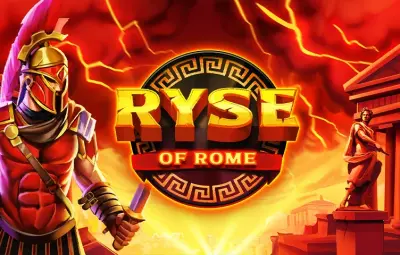

Ryse of Rome Review
OneTouch released Ryse of Rome in November 2022, and it remains one of the studio's most mechanically ambitious titles. Built on a 6x4 grid with 262,144 ways to win, it stacks a cascading win engine, Mega Symbols, and a bonus buy into a high-volatility package that targets players comfortable with variance in exchange for a legitimate shot at 10,000x their stake.
The RTP sits at 96.11%, which lands comfortably above the current industry median of around 95.5% for high-volatility slots. That number, combined with a hit frequency of 29.72%, tells an interesting story: nearly one in three spins produces a return, yet the overall math is still skewed toward infrequent but large payouts. That kind of profile suits players who want regular small feedback loops without sacrificing ceiling potential.
Bets run from $0.20 to $100 per spin, covering a wide range of bankroll sizes. The buy feature makes the bonus round directly accessible for those who prefer not to grind the base game. Whether the 10,000x ceiling justifies the ride depends heavily on your volatility tolerance — and this review breaks down exactly what you're signing up for.
How Ryse of Rome Plays
The 6x4 grid is the foundation, and it matters more than it might first appear. With 262,144 ways to win — a format calculated by multiplying symbol positions across reels rather than fixed paylines — winning combinations form across the entire grid rather than along preset lines. That structure rewards wider symbol coverage and makes cascading wins particularly potent, since each cleared symbol creates new positions for the next drop.
The cascading mechanic works as follows: winning symbols are removed after each payout, and new symbols fall into the vacated positions. If the replacement symbols form additional wins, the process repeats within the same spin. In practice, a single spin can chain multiple payouts without any additional cost. This is the core loop of Ryse of Rome, and it's what makes the 29.72% hit frequency feel more generous than a flat-payline slot with the same number.
Mega Symbols add a layer on top. These 3x3 symbols occupy nine grid positions simultaneously, and when they land in useful positions they can anchor multi-cascade sequences. The interaction between Mega Symbols and the cascading engine is where the slot's biggest single-spin potential concentrates — land one in the right spot during free spins and the multiplier effect becomes substantial.
RTP, Volatility, and the 10,000x Ceiling
At 96.11%, the RTP for Ryse of Rome is competitive for a high-volatility title. For context, OneTouch's catalogue average sits closer to 95.8%, so this slot is positioned slightly above the studio's typical output. It also carries an RTP range feature, which means some casino configurations may offer a lower RTP variant — always worth checking the in-game paytable to confirm which version you're playing.
High volatility combined with a 29.72% hit frequency is an unusual pairing. Most high-variance slots land hit rates below 25%, so Ryse of Rome's 29.72% is notable — it suggests the base game returns smaller wins with reasonable regularity while reserving the heavy payouts for cascade chains and free spin sequences. The 10,000x max win is achievable but requires the free spins round to run deep with Mega Symbols contributing to cascades. That ceiling is on par with Pragmatic Play's Book of Fallen (10,000x) but falls below outliers like Hacksaw Gaming's Wanted Dead or a Wild at 12,500x.
The $0.20 minimum bet keeps the slot accessible, and the $100 maximum makes it viable for higher-stakes sessions. At $0.20 per spin, the theoretical maximum payout is $2,000 — modest in absolute terms but meaningful relative to the stake. At $100, the 10,000x ceiling translates to a $1,000,000 theoretical hit, though that scenario requires an exceptionally deep cascade chain in the bonus round.
Bonus Features Breakdown
The free spins round is the primary bonus mode and is triggered by scatter symbols landing across the reels. Once inside, the cascading mechanic continues to operate, and Mega Symbols become more impactful because each cascade within the bonus can extend the sequence further. Additional free spins can be awarded during the round, extending the session without an extra cost — a mechanic that meaningfully raises the ceiling when it fires at the right moment.
The buy feature lets players skip the base game entirely and purchase direct access to the free spins round. This is a significant quality-of-life addition for players who find base-game grinding unrewarding. The cost of the bonus buy is set as a multiple of the current bet, and the trade-off is straightforward: you pay a premium upfront in exchange for guaranteed bonus access. For high-volatility slots with infrequent triggers, this feature has real utility rather than being cosmetic.
Wilds substitute for standard paying symbols across the grid, contributing to cascade chains in the same way as any other winning symbol. Scatter symbols serve as the free spins trigger. The combination of wild substitution, Mega Symbols, cascading wins, and retrigger-capable free spins creates a feature set where the interactions — rather than any single mechanic — drive the top end of the payout range.
Who Ryse of Rome Is Best For
The slot is built for players who want high-variance mechanics without sacrificing RTP quality. The 96.11% return rate is genuine value for a high-volatility title, and the 29.72% hit frequency means the base game isn't a pure drought between bonuses. That combination makes Ryse of Rome more manageable on a session basis than many comparable titles, even if the big wins are still concentrated in the free spins.
The bonus buy is the feature that most clearly defines the target audience. Players who prefer direct, controlled access to bonus rounds — and who have the bankroll to absorb the upfront cost — will find Ryse of Rome a better fit than slots where the only path to the bonus is grinding. The $0.20 minimum also makes it accessible to lower-stakes players who want to explore the mechanics without heavy exposure.
High-volatility hunters chasing four- and five-figure multipliers will find the 10,000x ceiling credible given the cascading and Mega Symbol interactions. This is not a slot for players who prefer steady, low-variance returns — the math is unambiguous on that point. But for anyone comfortable sitting through variance in pursuit of a meaningful payout, Ryse of Rome has the mechanical depth to justify the patience.
Final Verdict
Ryse of Rome is a well-constructed high-volatility slot that earns its spec sheet rather than just advertising it. The 6x4 cascading grid with 262,144 ways, Mega Symbols, retriggerable free spins, and a bonus buy form a coherent mechanical system — each feature reinforces the others rather than existing in isolation. The 96.11% RTP is above the OneTouch studio average and above the high-volatility category median, which is a meaningful data point.
The one mild criticism worth noting: the base game pacing can feel drawn out before the free spins trigger, particularly at lower bet sizes without the bonus buy. The 29.72% hit frequency helps, but the gap between base-game returns and bonus-round potential is wide enough that the slot's real character only shows during free spins. Players using the bonus buy will sidestep this entirely, but those grinding the base game should set session expectations accordingly.
At $0.20 to $100 per spin with a legitimate 10,000x ceiling and a published 96.11% RTP, Ryse of Rome is a serious option in the ancient-civilizations category and one of OneTouch's stronger mechanical releases.
- +96.11% RTP sits above the OneTouch studio average and above most high-volatility category benchmarks
- +262,144 ways-to-win cascading engine creates genuine multi-payout potential on a single spin
- +Mega Symbols (3x3) interact directly with cascades to drive the slot's top-end payouts
- +Bonus buy provides direct access to free spins — a meaningful utility for variance-aware players
- +Retriggerable free spins extend bonus sessions without additional cost
- +29.72% hit frequency is higher than typical for a high-volatility title, reducing base-game drought
- +Wide bet range ($0.20–$100) accommodates both casual and higher-stakes play
- -High volatility means the 10,000x ceiling is achievable but requires deep cascade chains — patience required
- -Base-game pacing drags before the bonus triggers for players not using the buy feature
- -RTP range feature means some casino configurations may offer a lower return than the headline 96.11%
Best for
Ryse of Rome is a technically solid high-volatility slot from OneTouch with a 96.11% RTP that edges above most studio averages, a 10,000x max win, and a 262,144-way cascading engine that gives the math genuine depth. The bonus buy is a meaningful addition for session-focused players. Best suited to high-volatility hunters with a bankroll that can absorb variance before the free spins trigger.