
Aztec Clusters Review
BGaming's Aztec Clusters arrived in February 2024 with a math model that immediately stands out from the crowd — a flat 97% RTP, no range reduction on bonus buys, and a 10,000x ceiling sitting on top of high volatility. That combination is genuinely rare. Most high-volatility cluster pays games either compromise on return rate or throttle the RTP when you hit the buy feature; Aztec Clusters does neither.
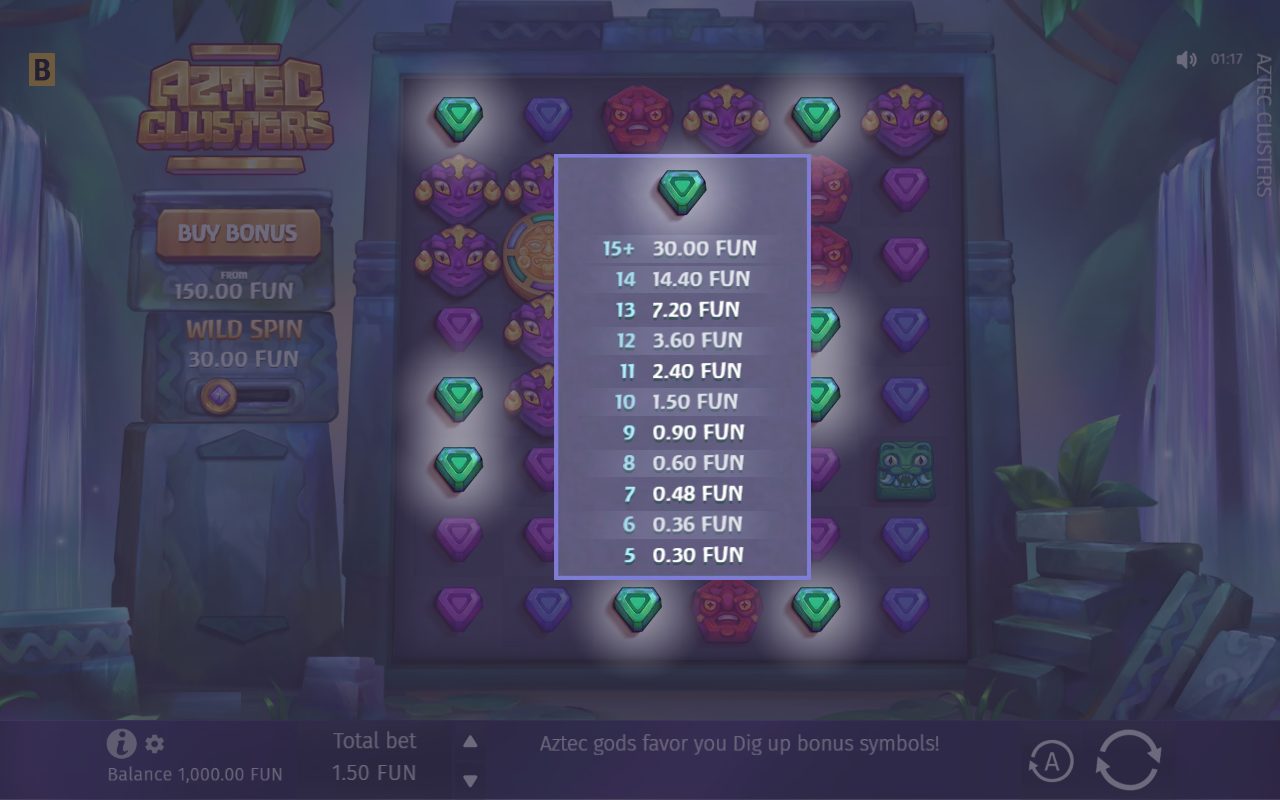
The slot runs on a 6x8 grid with a Cluster Pays mechanic, meaning wins form when five or more matching symbols connect horizontally or vertically. Cascades follow every win, and the game's central engine — a cell-based Multiplier Area — builds value with each successive cascade in a way that separates it mechanically from most Aztec-themed releases. Add four bonus buy tiers, a Wild Spin mode, and a Dig-Up random feature system, and the feature set is genuinely dense.
This review breaks down exactly how the mechanics interact, what the live Spindex data says about real-money performance, and whether the 97% RTP holds up in practice for the player types most likely to benefit from it.
RTP, Volatility, and Max Win: The Numbers That Matter
The 97% RTP on Aztec Clusters is the headline stat, and it deserves context. The industry average for video slots sits around 96%, and most BGaming titles land in the 96.0–96.5% range. A flat 97% — with no downward adjustment for the Buy Feature or Wild Spin mode — puts Aztec Clusters in a small group of high-return releases that don't penalise players for using premium entry points.
Volatility is rated high, and the hit frequency of 33.33% provides some cushion against variance — roughly one in every three spins produces a return. That doesn't mean wins are large; many will be sub-stake returns from short cluster chains. The real money is concentrated in cascading sequences where the Multiplier Area compounds across multiple cells simultaneously.
The 10,000x max win is competitive at the upper end of the cluster pays category. For comparison, BGaming's own Elvis Frog TrueWays caps at 10,000x with a lower 96% RTP, while Hacksaw's Nitropolis 4 reaches 50,000x but ships with a 96.06% return rate. Aztec Clusters trades raw ceiling for a superior return rate — a deliberate math model choice that suits bankroll-conscious high-volatility players.
How Aztec Clusters Plays: Grid, Cascades, and the Multiplier Area
The 6x8 grid is larger than the cluster pays standard — most titles in this format use a 7x7 or 6x6 layout — which gives longer cluster chains more room to develop. Symbols pay when five or more identical icons connect adjacently. After a winning cluster is cleared, new symbols fall from above to fill the vacated positions, triggering further cascades if new clusters form.
The Multiplier Area is the mechanic that elevates the base game beyond a standard cascade slot. Each time a winning cluster is cleared, the cells those symbols occupied become marked. If a subsequent win lands on a marked cell, that cell activates a multiplier starting at 2x, increasing by 2x with each additional winning cluster that touches it, up to a cell maximum of 10x. When a winning cluster spans multiple multiplier cells, the values are summed and applied to the entire cluster win — so a cluster crossing three cells at 6x, 4x, and 2x generates a 12x total multiplier.
All cell multipliers reset between base game spins, which keeps the base game honest. The system is designed to reward extended cascade chains rather than single large clusters, and it means session variance is driven more by cascade depth than by raw cluster size — a meaningful distinction for players who want to understand why a spin paid what it did.
Dig-Up Symbols and the Wild System
The Dig-Up feature triggers randomly on winning spins, placing a special bonus symbol into an empty cell after the winning cluster has cleared but before new symbols fall. Four symbol types can appear: a Booster that upgrades all visible multiplier values before vanishing; a Destroyer that removes all low-paying symbols currently on the grid; a Wild that locks in place for the remainder of the spin sequence; and a Scatter that contributes toward free spins activation.
The Wild variant of the Dig-Up is the highest-value outcome. It operates as a sticky wild for the duration of the spin, is not removed by cascades, and if it lands on a multiplier cell it starts with a 10x value rather than the standard 2x floor. Each subsequent winning cluster it participates in adds another 10x to its cell value, up to a maximum of 100x. A single wild on a high-traffic cell, combined with a deep cascade chain, is the primary route to the 10,000x ceiling.
The Destroyer symbol deserves attention as a volatility lever. Removing all low-pays from the grid mid-cascade restructures the symbol distribution in real time, increasing the probability that the next cascade contains a high-pay cluster. It's a feature that doesn't just add multipliers — it actively changes the odds of the next event, which is a more sophisticated mechanic than most cluster pays titles deploy.
Free Spins and Bonus Buy Options
Free spins activate when three or more Scatter symbols appear simultaneously, either from natural reel positions or via the Dig-Up feature. The initial spin count scales with trigger size: three Scatters award 10 spins, four award 12, five award 15, and a full six-Scatter trigger delivers 20 spins. Retriggering is possible if additional Scatters appear during the bonus round.
The Buy Feature menu offers four entry points. The base option at 100x the bet triggers free spins with three to six Scatters. At 200x, the same trigger is guaranteed plus at least one starting Wild symbol. At 400x, at least two starting Wilds are included, and the premium 800x option guarantees three starting Wilds alongside the Scatter trigger. The Wild guarantee at higher tiers directly increases the probability of activating the 100x Wild cell multiplier early in the free spins sequence — the math difference between a 100x and 800x buy is not just scatter count but the structural advantage of pre-loaded sticky wilds.
Separately, the Wild Spin mode — technically the Bonus Bet — costs 20x the base bet per spin and guarantees at least one Wild Dig-Up before the spin resolves. BGaming's own figures put the probability of hitting the max win on a Wild Spin at 1-in-4,600, which is a specific and unusually transparent disclosure. Bet range runs from $0.25 to $25 in standard mode; Wild Spin effectively extends the upper stake to $500 per spin.
Spindex Live Data: 10K Tracked Bets, Trending Warm
Aztec Clusters has logged 10,000 tracked bets across Spindex's five crypto-casino data sources over the past 30 days, and the slot is currently trending warm — meaning bet volume is growing relative to its 90-day baseline. For a February 2024 release, sustained and increasing engagement at this point in its lifecycle is a positive signal; many high-volatility cluster slots see a sharp drop-off in tracked volume three to four months post-launch as players move to newer titles.
The top recorded hit in our recent data set is 3,688x. That's a substantial real-money outcome — on a $25 max bet that's $92,200 — but it also illustrates that the 10,000x ceiling remains theoretical territory for most sessions. The 3,688x result required a deep cascade chain with multiple high-value multiplier cells active simultaneously, which is the mechanical path the game is designed around rather than a statistical outlier.
The warm trend signal, combined with the 97% RTP and the transparent 1-in-4,600 max win probability on Wild Spins, suggests Aztec Clusters is finding a stable audience among players who want documented math rather than marketing claims. That's a different player profile than the typical high-volatility chaser, and it may explain the sustained volume.
Bet Range and Stake Structure
Standard bets run from $0.25 to $25 per spin, which covers recreational players through to mid-stakes regulars. The Wild Spin mode multiplies the active bet by 20x before the spin, meaning a $1 base bet becomes a $20 Wild Spin stake and the $25 maximum becomes a $500 per-spin commitment. Players need to be clear on this distinction before activating the mode — it's not a separate bet size selector but a multiplier applied to whatever base bet is currently set.
The four-tier Buy Feature ladder (100x, 200x, 400x, 800x) gives players meaningful choice about how much guaranteed Wild coverage they want entering the bonus. A 100x buy at $25 costs $2,500; the 800x premium tier at $25 costs $20,000. These are crypto-casino-scale stakes, and the fact that Spindex's tracked data includes a 3,688x hit suggests the player base engaging with this slot at upper stakes is active and real.
Who Should Play Aztec Clusters
The 97% RTP makes Aztec Clusters a strong candidate for players who prioritise return rate and want a high-volatility game that doesn't sacrifice mathematical edge to fund flashy marketing. It's particularly well-suited to bonus buy users, since the RTP doesn't compress when you access the Buy Feature — a problem that affects many competing titles where the buy option quietly operates on a 94% or 95% return.
The Multiplier Area mechanic rewards players who understand cascade depth and can read the grid state — specifically, which cells are marked and where Wilds are positioned. This is not a passive slot; sessions where players pay attention to the Multiplier Area structure will feel different from sessions where they don't, even if the math is identical. That engagement layer suits players who want to feel involved in the outcome rather than purely spectating.
Casual players on tight budgets can access the game from $0.25 per spin without using Wild Spin or Buy Feature, and the 33.33% hit frequency means the base game isn't a relentless drain. However, the high volatility means bankroll swings will be significant even at low stakes, and the most interesting mechanical territory — deep cascade chains with multiple active multiplier cells — requires patience and session length to encounter consistently.
Final Verdict
Aztec Clusters is a technically strong release from BGaming that earns its 97% RTP rather than just advertising it. The Multiplier Area is a genuinely differentiated mechanic in the cluster pays space, the Dig-Up system adds meaningful mid-spin variance, and the four-tier Buy Feature gives players real structural choice rather than a single all-or-nothing purchase.
The one honest criticism is that the base game can feel slow to develop before cascades chain deeply enough to activate multiple multiplier cells. Sessions without Buy Feature access will require patience, and the 10,000x ceiling — while real — demands a specific sequence of events that the 3,688x top hit in Spindex's recent data illustrates is achievable but not routine.
For players who want high volatility paired with a class-leading return rate and transparent math disclosures, Aztec Clusters is one of the more credible options BGaming has produced. The warm trend signal on Spindex suggests the market agrees.
- +97% RTP with no reduction on Buy Feature or Wild Spin tiers
- +Multiplier Area creates compounding win potential across cascade chains
- +Four-tier Buy Feature with transparent Wild guarantee structure
- +Wild Spin max win probability explicitly disclosed at 1-in-4,600
- +33.33% hit frequency provides base game returns despite high volatility
- +Destroyer Dig-Up symbol actively restructures grid composition mid-cascade
- -Base game pacing is slow before cascade chains develop meaningful multiplier depth
- -Wild Spin's 20x bet multiplier can catch players off guard if base bet is not adjusted first
- -10,000x max win requires a specific convergence of mechanics — the 3,688x Spindex top hit shows the ceiling is rarely approached
Best for
Aztec Clusters is one of BGaming's most technically ambitious releases. The 97% RTP is class-leading and — critically — holds across all buy feature tiers. The Multiplier Area and Dig-Up system create genuine variance within high volatility, and the 10,000x max win is reachable via a well-structured bonus buy ladder. The base game can feel slow before cascades chain, but that's the trade-off for a ceiling this high.