
Burning Hot Review
Amusnet's Burning Hot arrived in 2014 as a deliberately stripped-back fruit machine — five reels, five fixed paylines, and a symbol set lifted straight from the classic arcade era. A decade on, it still circulates across European and crypto casinos, and Spindex has tracked over 46,000 bets on it in the last 30 days alone. That kind of sustained volume on a ten-year-old game tells you something useful: a specific type of player keeps coming back, and it's worth understanding exactly what they're getting.
The headline numbers are genuinely solid for a game this age. A 96.45% RTP sits comfortably above the industry average of roughly 96%, and the low-medium volatility means the bankroll doesn't swing violently between sessions. The one real gameplay feature — a randomly triggered Jackpot Cards bonus with four progressive jackpot tiers — adds a ceiling that the base game alone couldn't justify. The max win of 3,000x per line rounds out a math profile that punches above what the visual package would suggest.
RTP, Volatility, and the Math Behind Burning Hot
At 96.45%, Burning Hot's RTP is the clearest reason to take this game seriously despite its age. The industry standard for video slots hovers around 96%, and many modern releases from major studios actually come in below that mark. By comparison, a contemporary Amusnet title like 20 Super Hot sits at 95.79% — meaning Burning Hot quietly outperforms it on theoretical return.
The low-medium volatility classification means wins arrive with reasonable regularity, though the absence of a published hit-frequency figure makes it harder to pin down exact cadence. What the volatility tag does confirm is that this isn't a high-risk grind. Bankroll erosion between bonus triggers should be manageable, which matters more here than in high-variance games because the base game has no free spins or multipliers to compensate for long dry spells.
The 3,000x max win applies per line on a single combination — a meaningful distinction on a five-payline structure. That ceiling is modest against modern releases; Pragmatic Play's Fruit Party 2, also a fruit-themed slot, reaches 5,000x. But paired with the progressive jackpots accessible through the Jackpot Cards feature, the effective ceiling is higher than the base-game number implies. Bets range from $0.01 to $1,000, which is an unusually wide spread for a game of this era.
How Burning Hot Plays: Layout and Base Game
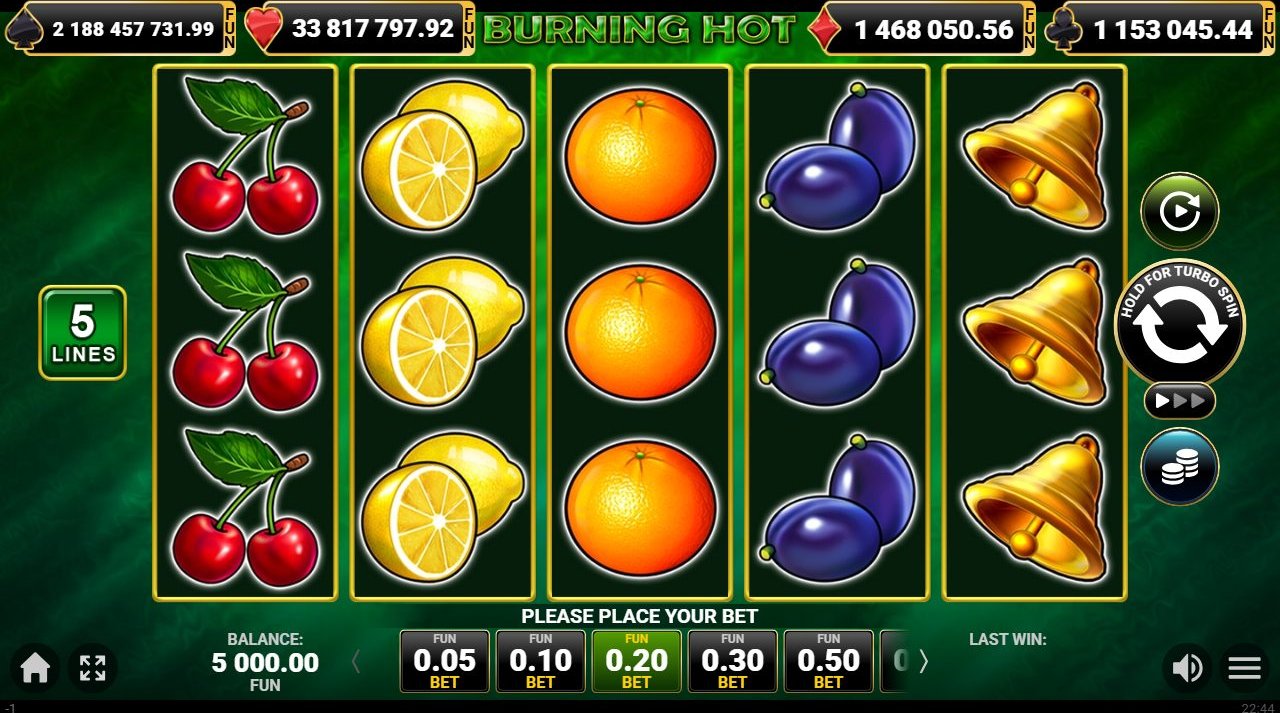
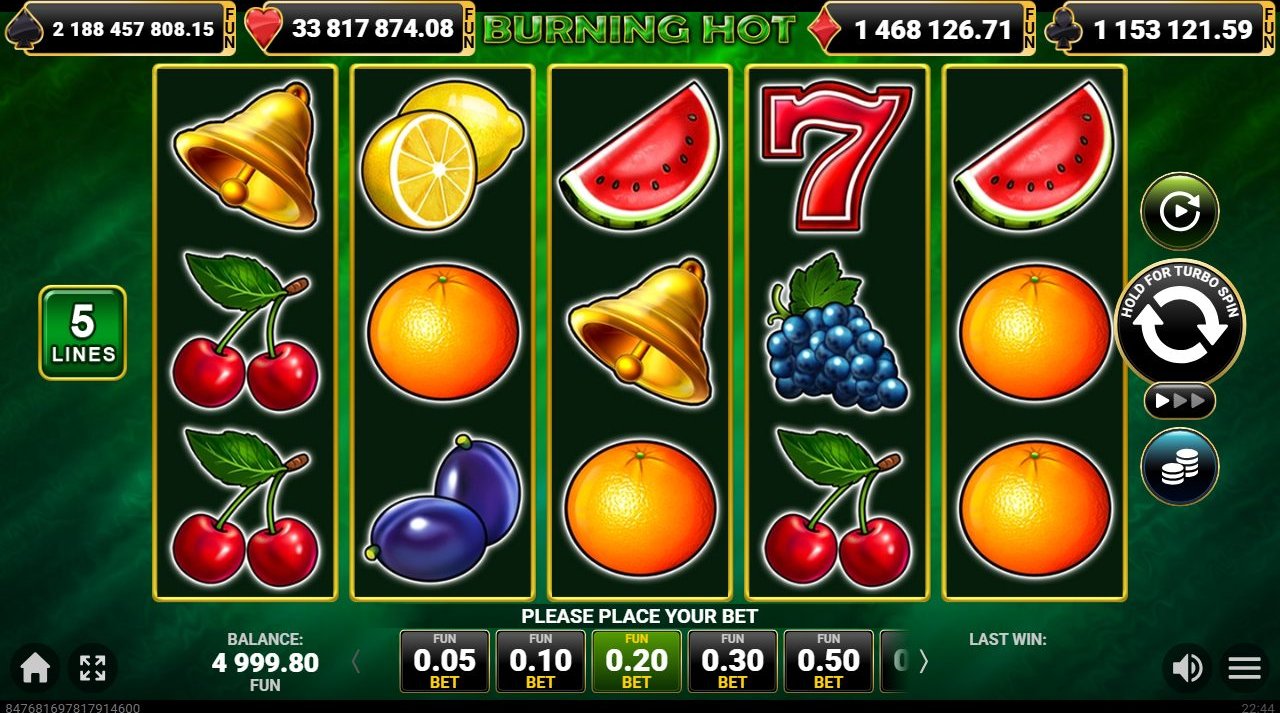
The 5x3 grid with five fixed paylines is about as lean as a video slot gets. There are no adjustable lines, no cluster mechanics, no cascades — a spin either lands a combination on one of those five paths or it doesn't. That simplicity is a deliberate design choice, not a limitation of the engine, and it produces a very direct feedback loop.
The symbol hierarchy follows classic fruit-machine logic. Oranges, plums, lemons, and cherries occupy the lower pay tier. Bells, watermelons, grapes, and sevens sit above them, with sevens functioning as the top-paying base symbol at 3,000x per line. Wild symbols substitute for standard pay symbols in winning combinations. Scatter symbols pay from any position on the reels regardless of payline alignment, and a second scatter variant — the Purple Star — operates on the same any-position basis.
The pacing in the base game is slow by contemporary standards. With no expanding features, no bonus-building mechanics, and no free spins to anticipate, sessions between Jackpot Cards triggers can feel repetitive. That's not a fatal flaw for the audience this game targets, but players accustomed to feature-dense modern slots will notice the difference within a few minutes.
Jackpot Cards and Other Features
Burning Hot has one primary gameplay feature: Jackpot Cards. It triggers randomly after any base-game spin — winning or not — which means there's no build-up mechanic or scatter count to track. When it fires, the player flips cards until three matching suit symbols are revealed, and the matching suit determines which of the four progressive jackpot tiers is awarded.
The four-tier structure is standard for Amusnet's jackpot network. The lowest tier pays out frequently enough to feel achievable; the highest tier accumulates across the network and can reach meaningful sums depending on how long it's gone without hitting. Because the trigger is fully random, there's no strategic element to the feature — it's a pure variance event layered on top of an otherwise low-volatility game.
The Gamble feature allows players to risk a base-game win by attempting to double it through a card-guessing mechanic. This is a standard addition across Amusnet's catalog and adds no structural complexity. Wild symbols and Scatter symbols round out the feature list — neither triggers a bonus round, but the Scatter's any-position payout rule does add marginal value to otherwise losing spins.
Spindex Live Data: 46K Bets and Trending Cool
Burning Hot has generated 46,000 tracked bets across Spindex's five crypto-casino data sources over the past 30 days. For a 2014 release with no recent update or relaunch, that's a notable activity level — it places the game comfortably in the mid-tier of our tracked catalog, ahead of most slots from the same era.
The current trend signal is cool, meaning bet volume has declined relative to the prior 30-day window. That's consistent with seasonal patterns we see on low-volatility classics: they spike when players rotate away from high-variance games and dip when new releases pull attention back. The top recent hit logged on Spindex was 1,276x — well below the 3,000x per-line ceiling, but also well below the progressive jackpot tier, which suggests the jackpot hasn't fired on our tracked sources recently.
The 1,276x result is a useful data point for expectation-setting. It's a solid session win on a low-medium volatility game, but it also confirms that reaching the top of the pay table in the base game is genuinely rare. Players chasing the progressive jackpot rather than base-game maximums will find that framing more relevant.
Theme and Presentation
Burning Hot is a classic fruit-machine theme — cherries, bells, sevens, and stars on a plain reel background. The visual design reflects 2014 production standards, which means it looks noticeably dated against anything released in the last five years.
That's not a dealbreaker for the audience this game serves, but it's worth stating plainly for players who haven't seen it. The interface layout is functional rather than polished, and there are no animated sequences or visual flourishes beyond the standard reel spin.
Who Should Play Burning Hot
The clearest use case for Burning Hot is the low-stakes, long-session player who wants a high RTP and minimal complexity. At $0.01 minimum bet with low-medium volatility and a 96.45% return rate, it's one of the more bankroll-friendly options in Amusnet's catalog for extended play.
Players with nostalgia for physical fruit machines — particularly those familiar with EGT's land-based cabinet history in Eastern Europe — will recognize the format immediately. The game's continued popularity in that market segment explains the sustained bet volume Spindex tracks despite the absence of any modern features.
High-volatility hunters, bonus-feature enthusiasts, and players who prioritize visual production quality will find Burning Hot unsatisfying. The single gameplay feature and thin base-game structure simply don't offer enough variation to hold attention across long sessions for that audience. The progressive jackpot is the only genuine surprise element, and its random trigger means there's no way to optimize toward it.
Final Verdict
Burning Hot is a functional, honest fruit slot that has aged into a niche role. The 96.45% RTP is its strongest asset and remains competitive even against 2024 releases. The Jackpot Cards feature adds a ceiling that the five-payline base game couldn't reach alone, and the low-medium volatility makes it accessible for cautious bankroll management.
The weaknesses are real and not worth minimizing: one gameplay feature, no free spins, dated visuals, and a base-game loop that offers little variation. Amusnet has released more feature-rich titles since 2014, and players with options should at least compare before committing sessions to Burning Hot.
For the specific player it targets — low-stakes, high-RTP, minimal-complexity — it still does its job a decade after launch. The 46K monthly bets tracked on Spindex confirm there's a real audience for exactly that.
- +96.45% RTP is above the industry average and competitive against modern releases
- +Four-tier progressive jackpot adds a meaningful win ceiling beyond the base game
- +Low-medium volatility suits extended sessions and cautious bankroll management
- +Wide bet range ($0.01–$1,000) accommodates casual and high-roller play
- +Randomly triggered Jackpot Cards fires on any spin, including non-winning ones
- -Only one real gameplay feature; no free spins or multiplier mechanics
- -Visual design and interface are noticeably dated by current standards
- -Five fixed paylines creates a very thin base-game structure
- -Hit frequency data is unpublished, making session variance harder to plan around
- -Base-game pacing drags during long stretches between Jackpot Cards triggers
Best for
Burning Hot is a no-frills fruit slot that earns its place on the floor through a strong 96.45% RTP and a randomly triggered four-tier progressive jackpot. The base game is bare-bones by any modern standard, and the interface shows its age. Players who want sustained, low-volatility sessions with an occasional jackpot shot will find it functional. Everyone else will likely move on quickly.