
Cursed Seas Review
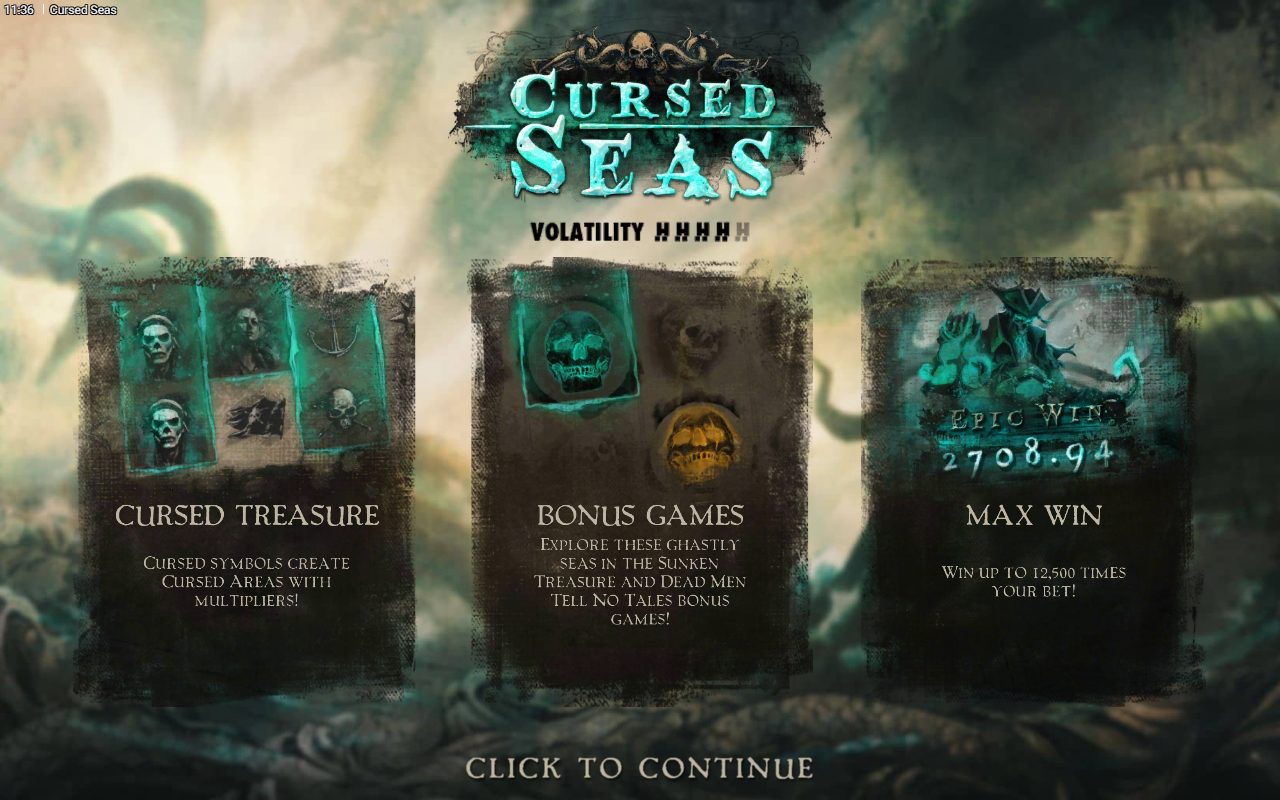
Hacksaw Gaming released Cursed Seas in April 2023, and it arrives with one of the more distinctive mechanical setups the studio has put out — an additive reel multiplier system that fires in both the base game and the free spins round, stacking multipliers across reels rather than replacing them. The result is a high-volatility video slot sitting on a 5x4 grid with 26 paylines, a 12,500x max win ceiling, and an RTP that operators can dial down from a ceiling of 96.22% to as low as 88.38%. The version most players will encounter is set at 94.24%, which is worth flagging before you spin.
The pirate theme lands in skull-and-shipwreck territory — ocean, weapons, and cursed chests are the visual anchors. What separates this from the crowded pirate-slot category is less the aesthetic and more the layered bonus structure: a base-game multiplier mechanic, a free spins round with persistent cursed areas, and a hold-and-win feature targeting the top end of that 12,500x potential. Across Spindex's tracked sources, Cursed Seas has logged 59,000 bets in the last 30 days and is currently trending warm — enough volume to draw some meaningful conclusions about how it actually plays.
RTP, Volatility, and What the Numbers Actually Mean
The RTP situation on Cursed Seas deserves its own section upfront because it's one of the most player-relevant facts about this game. Hacksaw publishes a top-tier RTP of 96.22%, but the version most casino operators deploy sits at 94.24% — nearly two full percentage points lower. There are two further reduced configurations at 92.21% and 88.38%, meaning the theoretical return can vary enormously depending on where you play. Always check which RTP version your casino is running before committing real money.
At 94.24%, Cursed Seas is noticeably below the industry standard of 96%. For context, Hacksaw's own Wanted Dead or a Wild runs at 96.38% RTP — a meaningful gap when compounded over session volume. The 12,500x max win ceiling matches Wanted Dead or a Wild's top-end potential, so the trade-off here is reduced expected return for the same upside, not a better one. Volatility is rated high — 4 out of 5 on Hacksaw's own internal scale — which aligns with the 37% hit frequency. That figure sounds reasonable until you factor in that most hits at high volatility return less than the bet size, so the effective dry-spell experience is longer than the raw number implies.
For players who prioritise RTP, the math here is a genuine drawback. For those chasing large multiplier outcomes and willing to absorb variance, the 12,500x ceiling and the mechanical path to get there are at least coherent and well-constructed.
How Cursed Seas Plays: The Multiplier System Explained
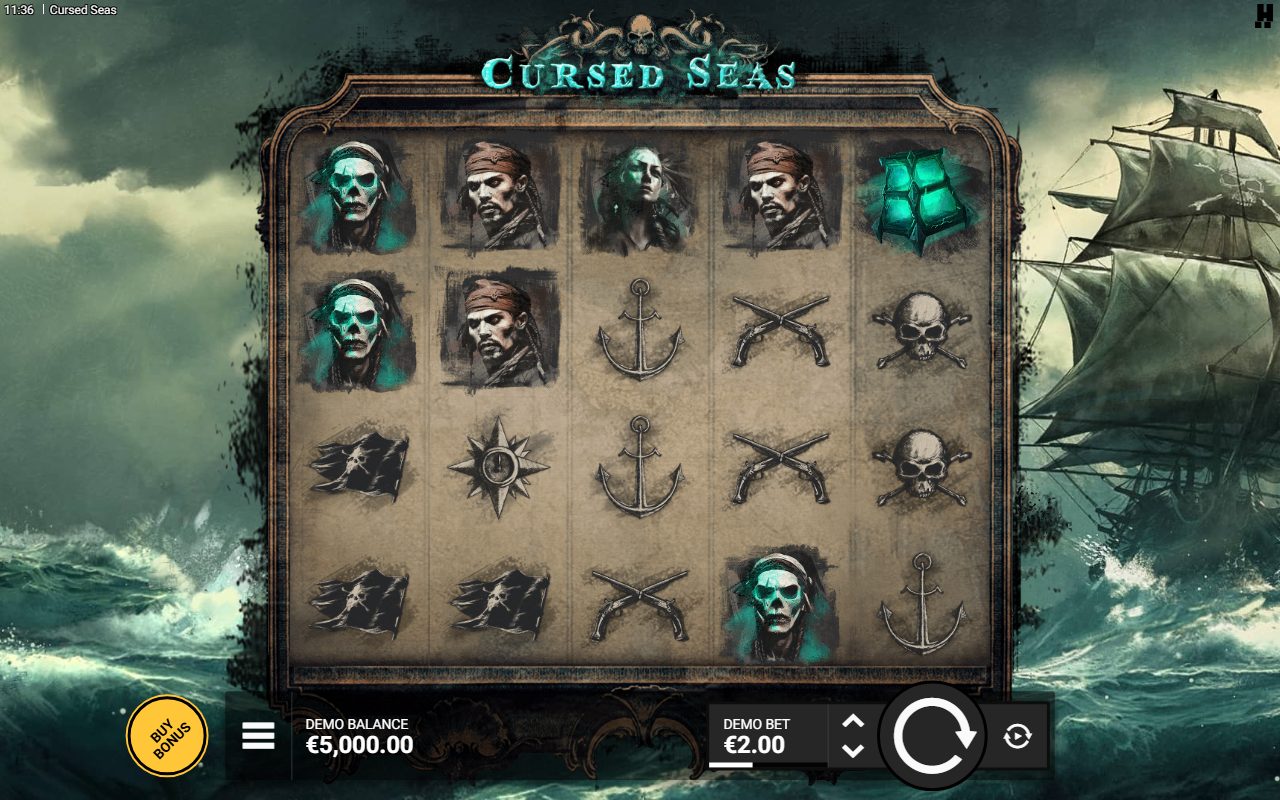
Cursed Seas runs on a 5x4 grid with 26 paylines. Premium character symbols pay between 3x and 10x stake for a five-of-a-kind, which is a reasonable symbol value range for the volatility tier. Both a standard Wild and the Cursed Chest symbol substitute for pay symbols, but the Cursed Chest does considerably more work than a typical wild.
When a Cursed Chest lands, it creates a Cursed Area covering its own position and every cell above it on that reel — but this only activates if at least one of those cursed positions contributes to a winning line. When triggered, the chest opens to reveal a reel multiplier between 2x and 200x. If multiple reels generate Cursed Areas simultaneously, those multipliers are added together rather than multiplied against each other — an important distinction. A 50x on reel two and a 30x on reel four combine to 80x, not 1,500x, so the system rewards breadth of cursed coverage rather than exponential stacking. All winning lines that pass through a multiplier-boosted reel benefit from the combined value.
This additive structure keeps the base game genuinely interesting between bonus triggers. It's not a feature that sits dormant until a scatter lands — Cursed Chest appearances can deliver meaningful wins mid-spin without needing the free spins round to activate. That said, the 200x single-reel ceiling means the base game's realistic output is constrained; the really large numbers require the free spins round or the hold-and-win feature to compound things further.
Free Spins and the Hold-and-Win Bonus
Three lantern scatter symbols trigger the Sunken Treasure free spins round, awarding 10 initial spins. The core difference from the base game is persistence: once a Cursed Area is created during free spins, it stays locked in place for the remainder of the feature. Each new Cursed Chest that lands adds its multiplier to a cumulative total win multiplier, meaning the feature builds progressively rather than resetting between spins. All wins occurring within cursed areas are boosted by the accumulated multiplier total.
Retriggers are possible during the free spins round. Landing 2 scatter lanterns on the same free spin adds 2 extra spins; 3 scatters add 4 extra spins; 5 scatters add 6 extra spins. This gives the feature a genuine escalation path — a session that starts with 10 spins and accumulates several Cursed Areas while retriggering can extend significantly and compound multipliers across a larger portion of the grid.
The second bonus game — Dead Men Tell No Tales — is a hold-and-win style feature. Three distinct symbol types each upgrade the bet multiplier in different ways, and this is the mechanical route most likely to reach the upper range of the 12,500x max win. The hold-and-win format is familiar across the industry, but Hacksaw's three-symbol variation adds enough differentiation to keep it from feeling generic. Both bonus modes are capable of large payouts, but the hold-and-win feature is the more direct path to the game's absolute ceiling.
Cursed Seas on Spindex: Live Bet Tracking and Recent Wins
Cursed Seas has generated 59,000 tracked bets across Spindex's five crypto-casino data sources in the last 30 days, which puts it in the mid-tier activity range for a Hacksaw release of this age — active enough to produce statistically meaningful signal, not so dominant that it's crowding out newer titles. The current trend reads as warm, suggesting steady player interest without the spike pattern you'd see from a newly viral slot.
The top recent hit logged on Spindex came in at 2,762x — a solid result, though it sits well below the 12,500x theoretical ceiling. That gap is expected for a high-volatility game where the absolute maximum requires a specific convergence of the hold-and-win feature and optimal multiplier accumulation. A 2,762x outcome in real tracked play is more representative of what a strong session actually looks like on this title.
The warm trend signal combined with consistent 30-day volume suggests Cursed Seas has found a stable player base rather than burning through early-launch hype. For players considering it now, the data doesn't show a cooling-off pattern — it's holding engagement, which for a high-volatility slot released in April 2023 is a reasonable indicator of sustained mechanical appeal rather than novelty-driven traffic.
Bet Range and Practical Session Considerations
Cursed Seas accepts bets from $0.10 to $100 per spin, covering the full spectrum from micro-stake casual play to serious session wagering. At the minimum bet, the 12,500x ceiling translates to a $1,250 absolute maximum win — modest in dollar terms but structurally identical to the high-stakes experience. At $100 per spin, that same ceiling reaches $1,250,000, which is the territory where high-roller players with appropriate bankrolls might find the risk-reward calculation interesting.
The high volatility and 94.24% RTP combination demands a larger session bankroll than a medium-volatility slot at the same stake level. The 37% hit frequency means roughly one in three spins returns something, but at high volatility, a significant portion of those returns are sub-stake. Players should budget for extended dry runs between meaningful bonus triggers. A session bankroll of 100-200x the per-spin stake is a reasonable floor for this volatility profile — less than that and variance will end sessions prematurely before the features have a chance to deliver.
There is no bonus buy option listed in the verified feature set, so players cannot shortcut directly to the free spins or hold-and-win feature. Patience — and bankroll — are the primary tools available.
Who Should Play Cursed Seas
Cursed Seas is built for high-volatility players who understand that session-level results will be heavily skewed by whether the bonus features land and compound. The mechanical design — additive multipliers, persistent cursed areas, a hold-and-win ceiling — rewards players who appreciate structural depth over surface-level action. If frequent small wins are the priority, the 37% hit frequency and high-volatility profile will feel punishing rather than rewarding.
The 94.24% RTP is the main reason to pause before committing. Players who are RTP-conscious and have access to casinos running the 96.22% configuration will find the same game significantly more favourable — worth checking before selecting a platform. Crypto-casino players in particular, given where Spindex's tracking data originates, may have more access to the higher RTP configuration depending on operator agreements.
Players who enjoy Hacksaw's other high-volatility releases — particularly those familiar with the studio's multiplier-stacking approach — will find Cursed Seas mechanically coherent with that catalogue. It doesn't reinvent the studio's formula, but it executes the formula with enough specificity in the Cursed Chest system to feel like a distinct game rather than a reskin.
Final Verdict on Cursed Seas
Cursed Seas is a well-constructed high-volatility slot with a genuinely differentiated multiplier mechanic. The additive reel multiplier system — active in the base game and escalating through the free spins round — gives the game a coherent progression that holds up across extended play. The hold-and-win feature provides a credible mechanical path to the 12,500x ceiling, and the two-bonus structure means there are multiple routes to large outcomes rather than a single feature carrying all the weight.
The primary reservation is the RTP. At 94.24% — the most commonly deployed configuration — players are giving up meaningful expected value compared to most Hacksaw alternatives. The base game can also feel slow between Cursed Chest appearances, particularly during dry spells where the multiplier mechanic doesn't activate. That pacing issue is a real friction point for players who prefer sustained engagement over intermittent peaks.
For the right player profile — high-volatility tolerant, bankroll-prepared, and ideally on a platform running the higher RTP variant — Cursed Seas delivers on its mechanical promise. The 59,000 tracked bets and warm trend signal on Spindex confirm it's holding a genuine audience more than a year post-launch, which is a reasonable endorsement of its staying power.
- +Additive reel multiplier system fires in both base game and free spins
- +Two distinct bonus modes (free spins + hold-and-win) targeting the 12,500x ceiling
- +Persistent cursed areas during free spins create genuine escalation potential
- +Wide bet range ($0.10–$100) suits multiple player types
- +Hacksaw's 4/5 volatility rating is transparent and accurately reflects the experience
- +Warm trend signal and 59K tracked bets show sustained post-launch engagement
- -Default RTP of 94.24% is well below industry standard; operators can reduce it further
- -No bonus buy feature — free spins and hold-and-win can only be triggered organically
- -Base game pacing drags between Cursed Chest activations during dry spells
- -High volatility demands a larger session bankroll than most players budget for
- -Top recent tracked hit of 2,762x shows the 12,500x ceiling is rarely approached in practice
Best for
Cursed Seas is a mechanically solid high-volatility slot with a genuinely interesting additive multiplier system. The 94.24% RTP is a real cost to players, and the base game can feel slow between bonus triggers, but the 12,500x ceiling and Hacksaw's layered feature design give patient, bankroll-aware players a legitimate target. Best approached with a session budget and realistic expectations about hit frequency.