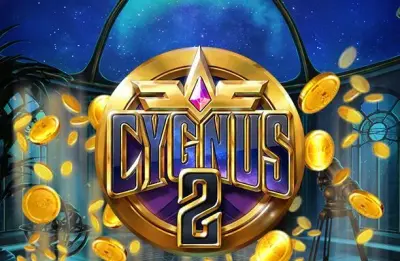

Cygnus 2 Review
ELK Studios pushed the ceiling hard with Cygnus 2, turning a 5,000x max win from the original into a 50,000x upper limit — a tenfold jump that immediately repositions this sequel at the very top of ELK's own catalog. That ambition has a cost: the RTP drops to 94%, sitting noticeably below the 96% industry benchmark and below what the first Cygnus offered. Whether that trade-off works in your favor depends entirely on how you feel about chasing extreme upside at reduced expected return.
The gravity mechanic that defined the original returns here, now set against an observatory backdrop rather than the Egyptian pyramid of the first game. The 6x4 starting grid can expand to 6x8 through the Avalanche mechanic, scaling ways to win from 4,096 up to 262,144. Multiplier symbols, a persistent free-spins multiplier, and a feature-buy menu via the X-iter system round out the toolkit. This is a medium-high volatility release, and the 23.6% hit frequency means you will see wins regularly — but the real money is locked behind the bonus mechanics, as is almost always the case with ELK's gravity-driven designs.
RTP, Volatility, and the Max Win Trade-Off
The headline number is 50,000x, and it earns its place at the top of ELK's catalog alongside Nitropolis 3. To put that in context, the original Cygnus capped at 5,000x — the same ceiling as ELK's IO, another gravity-mechanic title. Cygnus 2's 50,000x figure also outpaces Coba, ELK's Mayan-themed release that tops out at 25,000x. This is genuinely one of the higher max-win ceilings in the studio's history.
The cost is a 94% RTP, which is a meaningful step down. Most ELK titles sit closer to 96%, and the industry standard for video slots hovers around 96% as well. Over a long session, that 2% gap compounds. The medium-high volatility rating and 23.6% hit frequency soften the blow somewhat — you won't be spinning completely dry for extended stretches — but base-game wins alone won't recoup much. The real expected value lives inside the bonus round.
For players who track theoretical return closely, the 94% RTP is the single most important number in this review. For players who treat each session as a discrete shot at a big hit, the 50,000x ceiling and the mechanics that support it are what matter. Know which camp you're in before you load this one.
How the Grid and Gravity Mechanic Work
Cygnus 2 starts on a 6x4 grid with 4,096 ways to win. The Avalanche mechanic removes winning symbols and drops replacements from above — standard cascade behavior. What separates ELK's gravity system is what happens next: after each drop, symbols tumble laterally toward the leftmost column. That directional pull is the engine behind both the multiplier system and the bonus trigger.
Each Avalanche also adds one row to the grid, expanding it up to a maximum of 8 rows. At 6x8, the ways-to-win count reaches 262,144 — a 64x increase from the starting configuration. Pay symbols award between 0.2x and 15x stake for a six-of-a-kind, and Wild symbols substitute for all pay symbols. The expansion mechanic means a single long cascade sequence can fundamentally change the shape of the game mid-spin.
The lateral gravity movement is the detail that rewards understanding. Symbols don't just fall — they migrate left. That directional logic is what makes multiplier and bonus symbols meaningful: their value is only realized when they reach the leftmost grid frame. A multiplier symbol landing in the middle of the grid is inert until cascades and gravity carry it to the edge.
Bonus Features Breakdown
Multiplier symbols carry values of 2x, 3x, 5x, or 10x. They don't activate on landing — they must physically reach the leftmost column through the gravity mechanic or via a transport rule: any multiplier symbol that hits the bottom of rows 2 through 6 is moved one column to the left. Once a multiplier symbol touches the leftmost frame, it converts to a Wild and its value is added to a global win multiplier that applies to all subsequent wins in that spin sequence. The multiplier resets on the next paid spin.
The Free Spins bonus triggers when a single bonus symbol reaches the leftmost column by the same gravity and transport rules. This awards 7 free drops. Any multiplier built up in the base game carries into the feature. During free spins, landing additional bonus symbols at the leftmost frame adds 3 extra drops each — and critically, the win multiplier never resets for the duration of the bonus. That persistent multiplier is the mechanism that makes the 50,000x ceiling theoretically reachable.
The X-iter feature-buy menu gives eligible players access to a Super Bonus Round purchase option. Note that this is unavailable to players in the UK. The base free spins can also trigger organically, but the Super Bonus is exclusively accessible via purchase. Players who want the highest-variance, highest-ceiling experience will gravitate toward the buy option where available.
Spindex Live Tracked-Bet Data
Cygnus 2 has recorded 104 tracked bets across Spindex's five crypto-casino data sources over the last 30 days. That's a modest volume figure — enough to establish a baseline but not enough to draw strong statistical conclusions about observed RTP or bonus frequency from our sample alone. The top recent hit logged in our data sits at 40x, which is well below the slot's medium-high volatility profile and nowhere near the ceiling.
A 40x top hit across 104 tracked bets is consistent with a game where the meaningful wins are concentrated inside the bonus round rather than distributed across base-game play. It also suggests our current sample hasn't captured a bonus-round sequence that let the persistent multiplier run. That's not unusual for a high-ceiling, medium-high volatility slot — the variance means you need a much larger sample before the distribution starts reflecting the theoretical max-win potential.
For players using Spindex data to time their sessions, the low recent hit ceiling here is worth noting. It doesn't indicate the slot is cold in any mechanically meaningful sense — RNG doesn't work that way — but it does confirm that the big-win events this game is built around haven't surfaced in our tracked window. If you're drawn to Cygnus 2 specifically for its 50,000x upside, our current data neither validates nor contradicts that expectation.
Bet Range and Accessibility
The minimum bet is $0.20 and the maximum is $100, which is a standard ELK Studios range. At $0.20 per spin, recreational players can extend session length comfortably, though the 94% RTP means the house edge is working harder against smaller bankrolls than on most comparable slots.
The X-iter feature-buy menu adds a layer of decision-making for players with larger bankrolls. Feature buys on high-volatility slots are a high-variance move on top of an already high-variance game — the Super Bonus purchase concentrates risk and potential reward into a single transaction. Players in jurisdictions where the buy feature is available should factor that into their bankroll planning. UK players do not have access to the buy feature.
At $100 maximum bet, a 50,000x win would return $5,000,000 from a single spin sequence. That's theoretical ceiling territory, but the math is worth stating plainly for players evaluating the risk-reward ratio at higher stakes.
How Cygnus 2 Compares to the Original and ELK's Catalog
The original Cygnus set its max win at 5,000x with a higher RTP — Cygnus 2's 50,000x ceiling represents a deliberate repositioning toward extreme-variance play. ELK's IO shares the cosmic gravity-mechanic DNA and also caps at 5,000x, making Cygnus 2 a ten-times improvement in ceiling over both predecessors in the gravity mechanic series. Coba, ELK's 25,000x Mayan release, sits between them.
The gameplay loop in Cygnus 2 is closely related to the original — the gravity mechanic, the leftmost-frame trigger logic, the cascading grid expansion all carry over. The math model is where the sequel diverges sharply. Players who found the original's 5,000x cap limiting but liked the mechanic have a direct upgrade path here. Players who preferred the original's RTP efficiency are trading that for ceiling.
Within ELK's broader catalog, Cygnus 2 sits at the high end of both max win and volatility. The 94% RTP is on the lower end for the studio, and players who regularly play ELK titles should adjust expectations accordingly. This is ELK operating at maximum ambition in terms of potential, with the associated RTP concession that entails.
Who Should Play Cygnus 2
Cygnus 2 is built for players who specifically want a high-ceiling, high-variance experience and are willing to accept a below-average RTP as the price of admission. The 50,000x max win is one of the larger ceilings in ELK's catalog, and the persistent multiplier in free spins is the mechanic that makes it theoretically achievable.
Players who prioritize RTP efficiency — those who track long-run return and prefer slots at 96% or above — will find the 94% figure here a significant deterrent. The 23.6% hit frequency provides some rhythm, but base-game returns won't compensate for the reduced theoretical return over volume.
Casual players who enjoy the gravity mechanic from the original Cygnus or from IO will find the gameplay familiar and the stakes manageable at $0.20 minimum. The base-game pacing can feel slow before a bonus sequence develops, which is a mild structural quirk of gravity-mechanic slots in general — the big action requires the cascade chain to build. Players who want frequent bonus triggers may find the wait frustrating.
Final Verdict
Cygnus 2 is a technically accomplished sequel that achieves exactly what it sets out to do: take ELK's gravity mechanic to a higher ceiling. The 50,000x max win, expanding grid up to 262,144 ways, and persistent free-spins multiplier form a coherent system where the biggest wins are genuinely possible given the right cascade sequence.
The 94% RTP is the unavoidable caveat. It's 2% below the industry standard and below most of ELK's own catalog. That's not a dealbreaker for players chasing maximum upside, but it's a real number that affects expected return over any meaningful session volume. The Spindex tracked-bet data — 104 bets with a 40x top hit — reflects a game where the variance is real and the ceiling events are rare.
For high-volatility players who have already exhausted the original Cygnus and want a substantially higher ceiling with familiar mechanics, this is the logical next step in ELK's gravity-mechanic series.
- +50,000x max win — one of ELK's highest ceilings
- +Grid expands to 262,144 ways via Avalanche mechanic
- +Persistent win multiplier during free spins creates genuine big-win conditions
- +X-iter feature-buy menu available (non-UK)
- +23.6% hit frequency provides base-game rhythm
- +Familiar gravity mechanic for returning ELK players
- -94% RTP is below industry average and below most ELK titles
- -Super Bonus Round only accessible via purchase — not organically triggerable
- -X-iter buy feature unavailable to UK players
- -Base-game pacing is slow before cascade chains develop
- -Low Spindex tracked-bet volume suggests limited recent big-win events
Best for
Cygnus 2 is a high-ceiling sequel that trades RTP efficiency for a 50,000x max win potential. The expanding grid and persistent multiplier in free spins create genuine big-win conditions, but the 94% RTP is a real concession. Best suited to high-volatility players who prioritize maximum upside and are comfortable with longer dry spells between meaningful hits.