
Honey Rush Review
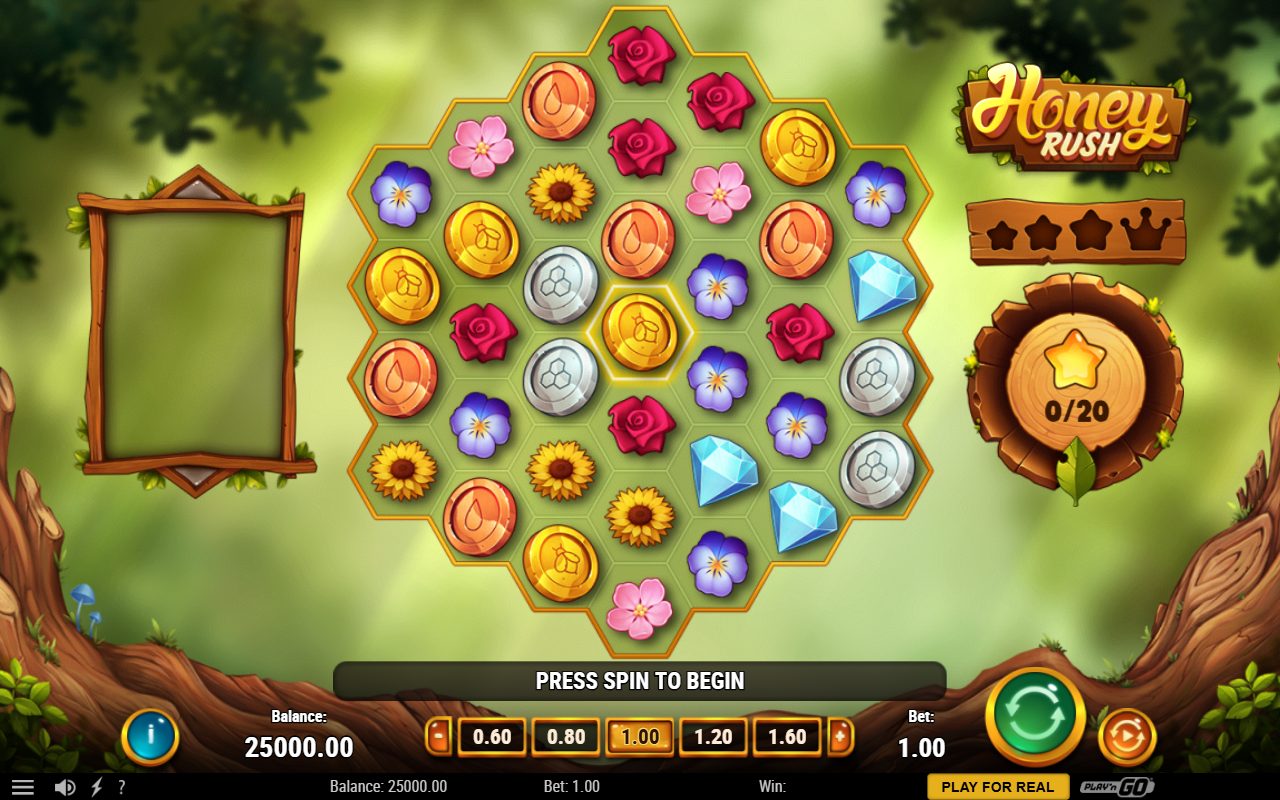
Play'n Go built a reputation on high-volatility video slots that cap out around 5,000x, so when Honey Rush landed in October 2019 with a 9,000x ceiling, it marked a genuine departure. The honeycomb-shaped 4-5-6-7-6-5-4 grid runs on a cluster pays engine, meaning there are no fixed paylines — wins form from groups of five or more matching symbols anywhere on the reels. A tumble mechanic clears winning symbols after each hit and drops replacements, which means a single paid spin can chain into multiple consecutive wins before the round ends.
The real engine driving the big numbers is the Rush meter, a four-level progression system sitting alongside the grid that charges with every winning symbol collected. Clearing each level unlocks one of three Colony features — and the fourth level, Queen Colony, can fill the entire grid with a single symbol type. Bets run from $0.20 to $100 per spin, so the stake range is wide enough to suit both cautious sessions and high-roller runs. The RTP is 94.5%, which sits below the Play'n Go average and is worth factoring into any session plan.
RTP, Volatility, and What the Numbers Mean in Practice
Honey Rush carries a 94.5% RTP, which is the first number any serious player should register. Play'n Go's flagship high-variance titles — Book of Dead, Reactoonz — typically publish at 96.21%, so Honey Rush runs roughly 1.7 percentage points lower. Over a long session, that gap is meaningful: for every $100 wagered, the expected return is $94.50 versus $96.21. That's not a dealbreaker, but it's a real cost of admission for the 9,000x ceiling.
Volatility is listed at Play'n Go's maximum setting, which aligns with the cluster mechanic. Cluster pays games tend to produce either nothing or a cascade of consecutive wins — the variance profile is spiky rather than gradual. Hit frequency data isn't published for this title, but the tumble mechanic means individual paid rounds can generate multiple payouts, which partially offsets the dry-spin stretches between bonus triggers.
The 9,000x max win is the headline stat, and it's worth contextualising: Play'n Go's standard ceiling for high-variance releases sits at 5,000x. Honey Rush clears that by 4,000x, making it the developer's most ambitious release at its 2019 launch date. For comparison, Pragmatic Play's high-variance cluster slot Sweet Bonanza published the same year with a 21,100x ceiling, so Honey Rush doesn't lead the wider market — but within the Play'n Go catalogue it remains a standout.
How Honey Rush Plays: Grid, Tumbles, and Cluster Mechanics
The grid shape is the first thing that separates Honey Rush from a standard video slot. The 4-5-6-7-6-5-4 column layout creates a hexagonal honeycomb silhouette with 37 symbol positions at full capacity. Cluster wins require a minimum of five adjacent matching symbols, and the paytable scales steeply — the diamond symbol pays 200x for a cluster of 35 or more, while the lower-tier flower symbols pay 20x at the same cluster size. The gap between minimum and maximum cluster payouts is what makes the Colony features so significant.
Tumbling reels operate on every winning spin. Matched symbols disappear, the remaining symbols shift down, and new ones drop from above. This continues until no new cluster forms, at which point the spin concludes. Each tumble also contributes to the Rush meter, so a long cascade sequence can push the meter through multiple levels within a single paid spin — the mechanism by which the largest wins accumulate.
The wandering honey pot wild adds a positional element. It carries a multiplier of up to 3x and moves across the grid over successive spins, meaning its location on any given round can significantly change the value of a cluster it joins. There are no free spins in Honey Rush — the entire bonus structure runs through the Rush meter system, which some players will find refreshing and others may find limiting if they're accustomed to traditional free-spin rounds.
Bonus Features: The Rush Meter and Colony System
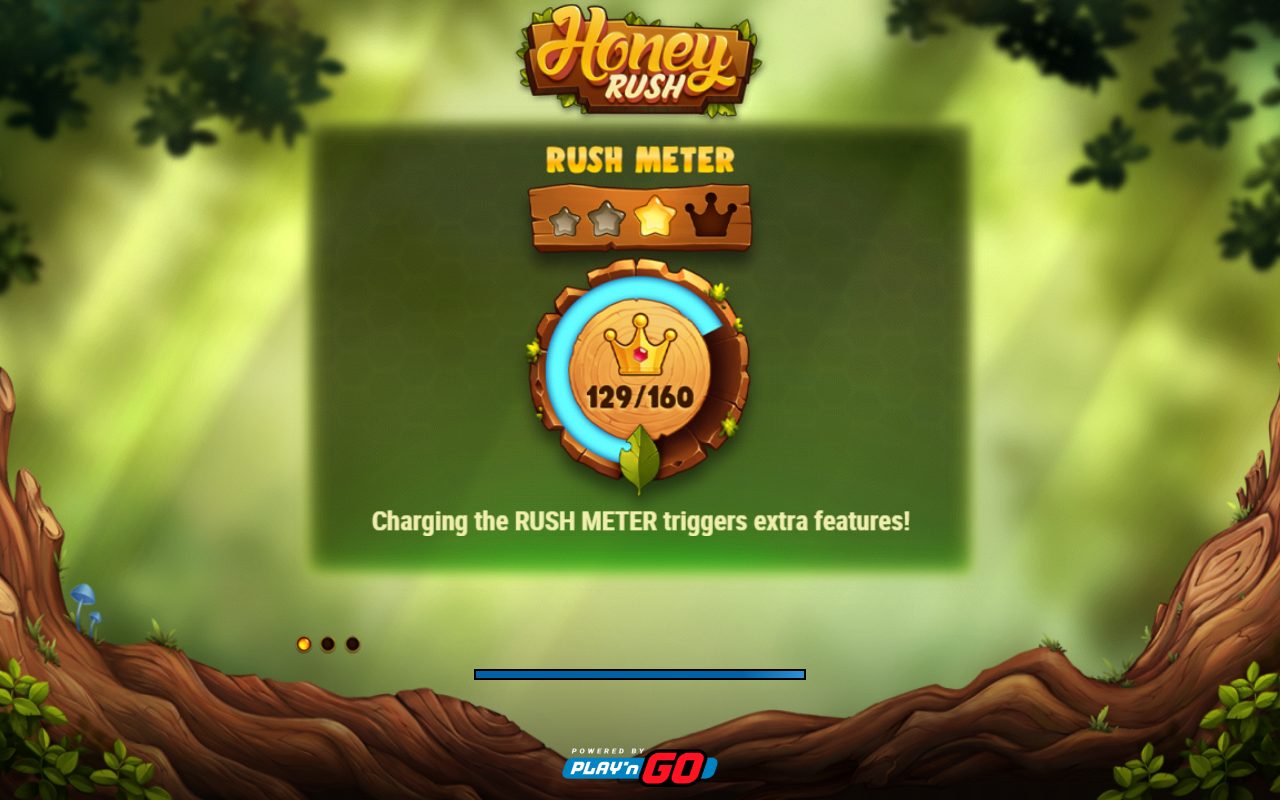
The Rush meter has four levels, each requiring progressively more winning symbols to complete. Level 1 needs 20 winning symbols, Level 2 needs 40, Level 3 needs 80, and the final Level 4 — Queen Colony — requires 160. Completing Levels 1 through 3 each triggers the Drone Colony feature: a guaranteed cluster of at least seven matching symbols drops onto the grid alongside a sticky wild. These aren't free spins; they resolve within the active spin's tumble sequence, contributing further to the Rush meter as they do.
Queen Colony is the feature where the ceiling lives. Reaching 160 collected winning symbols triggers a cluster that can expand to fill all 37 positions on the grid with identical symbols. At the diamond symbol's 200x rate for a full 35+ cluster, combined with a multiplied wild, this is the pathway to the 9,000x headline figure. It requires sustained winning chains — not a single lucky spin — which means it's a genuine grind to reach rather than a randomly triggered jackpot.
The Worker Colony feature operates independently of the meter. It activates randomly on losing spins and creates a cluster of up to 15 matching symbols, converting what would have been a blank round into a win. This is the only feature that fires outside of the meter progression, and it provides a floor of occasional activity during cold stretches. The sticky wild from Drone Colony events can also persist across subsequent tumbles, adding positional multiplier value to follow-up clusters.
Live Bet Data: Honey Rush on Spindex
Honey Rush has logged 7,000 tracked bets across Spindex's five crypto-casino sources over the last 30 days, placing it in the mid-tier activity range for Play'n Go titles on the platform. The current trend signal reads normal — no unusual spike in play volume or payout frequency compared to its rolling average. That's a useful baseline: the slot isn't running hot or cold in any statistically notable way right now.
The top recent hit recorded on Spindex sits at 1,084x. That's a solid real-money result, but it's a long way from the 9,000x theoretical ceiling — which is expected behaviour for a high-variance game where the Queen Colony trigger requires 160 collected winning symbols. The 1,084x figure is consistent with a mid-tier Rush meter progression rather than a full Queen Colony resolution, suggesting the tracked sample reflects typical play rather than outlier sessions.
For players using Spindex to time entries, the normal trend signal means there's no current data-driven reason to prioritise or avoid Honey Rush over comparable Play'n Go cluster titles. The 7K monthly bet volume is enough to make the live data meaningful rather than anecdotal, but the sample is smaller than higher-traffic titles like Reactoonz, so treat the trend signal as directional rather than definitive.
Paytable Breakdown: Symbol Values and Cluster Scaling
Honey Rush uses four high-value symbols and a set of lower-value flower symbols. The diamond is the top-paying symbol at 200x for a cluster of 35 or more. Below it sit three coin symbols with bee-themed motifs: a golden bee coin at 100x, a silver beehive coin at 75x, and a bronze honey drop coin at 50x — all at the 35+ cluster threshold. The flower symbols form the lower tier, each paying 20x for a 35+ cluster.
The paytable's structure rewards maximum cluster size heavily. The gap between a minimum five-symbol cluster and a 35+ cluster is substantial, which means small wins from base tumbles contribute incrementally to the Rush meter but don't move the session balance significantly on their own. The real payout leverage sits in the Colony features, where cluster sizes are guaranteed to be large enough to hit the upper end of the pay scale.
This structure creates a deliberate pacing: base-game wins are modest and function primarily as meter fuel, while the Colony events are where meaningful payouts occur. Players who prefer frequent mid-sized wins over infrequent large ones will find the base game lean. The design is intentional — every small win is a step toward the next Colony trigger rather than a standalone reward.
Who Should Play Honey Rush
Honey Rush is built for players who are comfortable with extended dry periods in exchange for a credible shot at a large multiplier. The maximum volatility rating isn't marketing language — the Rush meter's requirement of 160 winning symbols for Queen Colony means the highest-value feature can take many spins to reach, and the 94.5% RTP means the house edge is working harder against you than on most comparable titles.
The $0.20 minimum bet makes it accessible for low-stakes players who want to experience the mechanic without heavy exposure, but the high-variance profile means even small-stake sessions can deplete a bankroll before a Colony event fires. A session budget of at least 100x the chosen stake is a reasonable minimum to give the Rush meter enough spins to cycle meaningfully.
High-stakes players get a $100 maximum bet, which at 9,000x would produce a $900,000 theoretical maximum — though that's a theoretical ceiling, not a realistic expectation. The slot suits experienced cluster-game players who already understand tumble mechanics and are specifically drawn to Play'n Go's design approach. Players new to cluster pays or those who prefer the structure of free-spin rounds may find the meter-only bonus system less intuitive than expected.
Final Verdict
Honey Rush does what it set out to do: it pushed Play'n Go's max-win ceiling to a level the developer hadn't reached before, and the Rush meter system provides a coherent mechanical path to that ceiling rather than relying on a randomly triggered bonus. The four-level Colony progression gives every spin a purpose, and the Worker Colony feature prevents the base game from feeling entirely inert during cold runs.
The 94.5% RTP is the honest caveat. It's 1.7 points below Play'n Go's standard rate for high-variance titles, and players should account for that before committing to longer sessions. The absence of a free-spins feature is a secondary consideration — the Colony system is a functional replacement — but it does mean there's no low-stakes free-spins mode to explore the game's range without full variance exposure.
Spindex's live data shows steady mid-tier activity and a recent top hit of 1,084x, which reflects the game's normal operating range. For a high-variance cluster slot from 2019 that still draws 7,000 monthly tracked bets, Honey Rush has held its audience. It earns that loyalty through mechanical depth rather than surface-level appeal.
- +9,000x max win — Play'n Go's highest ceiling at launch, still among their top releases
- +Four-level Rush meter gives every spin a clear progression goal
- +Worker Colony converts losing spins into wins, reducing dead-spin frustration
- +Wide bet range ($0.20–$100) suits multiple bankroll sizes
- +Tumble mechanic enables multi-win chains within a single paid spin
- +Wandering honey pot wild adds a positional multiplier element (up to 3x)
- -94.5% RTP is below Play'n Go's typical 96.21% standard for high-variance slots
- -No free spins feature — the entire bonus structure runs through the Rush meter only
- -Queen Colony requires 160 winning symbols — a high bar that demands sustained chains
- -Hit frequency data not published, making session planning harder
- -Base-game wins are modest and function mainly as meter fuel rather than standalone payouts
Best for
Honey Rush is a technically ambitious cluster slot that punches above Play'n Go's usual max-win ceiling. The Rush meter's four-level progression gives every spin a sense of direction, and the 9,000x potential is real — not just a theoretical outlier. The 94.5% RTP is the main drawback; it's noticeably below the 96%+ standard most players expect from a high-volatility release. Best suited to experienced variance players who are comfortable with dry spells.