
Hot Ross Review
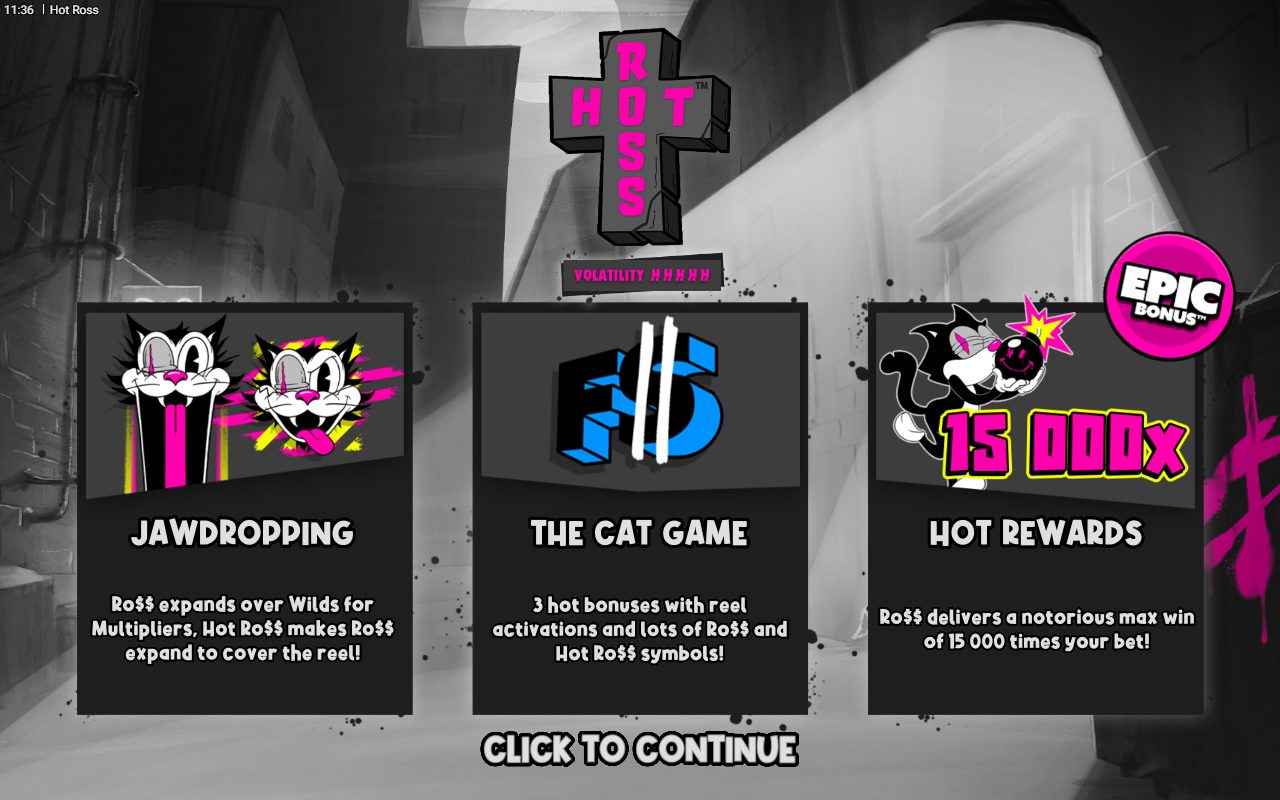
Hacksaw Gaming's Hot Ross arrives as the third entry in a connected cartoon universe that started with RIP City and continued through Rad Maxx. Where Rad Maxx took the mouse and ran with a different structure, Hot Ross pulls the camera back to Ro$$ the Cat and rebuilds close to the RIP City blueprint — same 5x5 grid, same 19 paylines, but with the mechanics pushed further and a max win raised to 15,000x. That ceiling is a meaningful step up, and the three distinct free spins modes give the game a range that the original lacked.
The core numbers position this firmly in high-volatility territory: a 20.74% hit frequency means roughly one in five spins produces something, which is serviceable but not generous for a game that can go long stretches between bonus triggers. RTP sits at 96.32% in the standard configuration, though the buy-feature variants each carry their own adjusted RTP figures worth knowing before you spend. Bets run from $0.10 to $50 per spin. This review breaks down exactly how the expanding wild system works, what separates the three bonus modes, and whether the buy-feature pricing makes sense given the volatility profile.
RTP, Volatility, and Max Win
The headline RTP of 96.32% applies to standard base-game spins and sits slightly above Hacksaw Gaming's typical studio average of around 96.20%, which is a small but genuine edge for players spinning at default settings. The max win of 15,000x is the figure most players will focus on, and it represents a clear upgrade over the series — RIP City's ceiling was lower, and this number now puts Hot Ross above many of Hacksaw's mid-tier releases while staying below the studio's outlier peaks like Stick 'Em (up to 20,000x).
Volatility is rated high, and the 20.74% hit frequency confirms that roughly four in five spins return nothing. That's not unusual for the genre, but it does mean base-game sessions can feel grinding without bonus involvement. The multiplier system — which can stack values from 2x up to 200x across multiple wild interactions — is where the real variance lives. A single bonus round with stacked Hot Ro$$ expansions and additive multipliers can compress a long dry spell into one significant payout.
The RTP range feature is worth flagging explicitly. Different buy options carry different RTPs: the Bonushunt FeatureSpins mode drops to 96.22%, while the Nine Lives direct trigger edges up to 96.35%. None of these deviate dramatically from the base figure, but players who exclusively use buy features should check which mode they're purchasing before spending.
How Hot Ross Plays
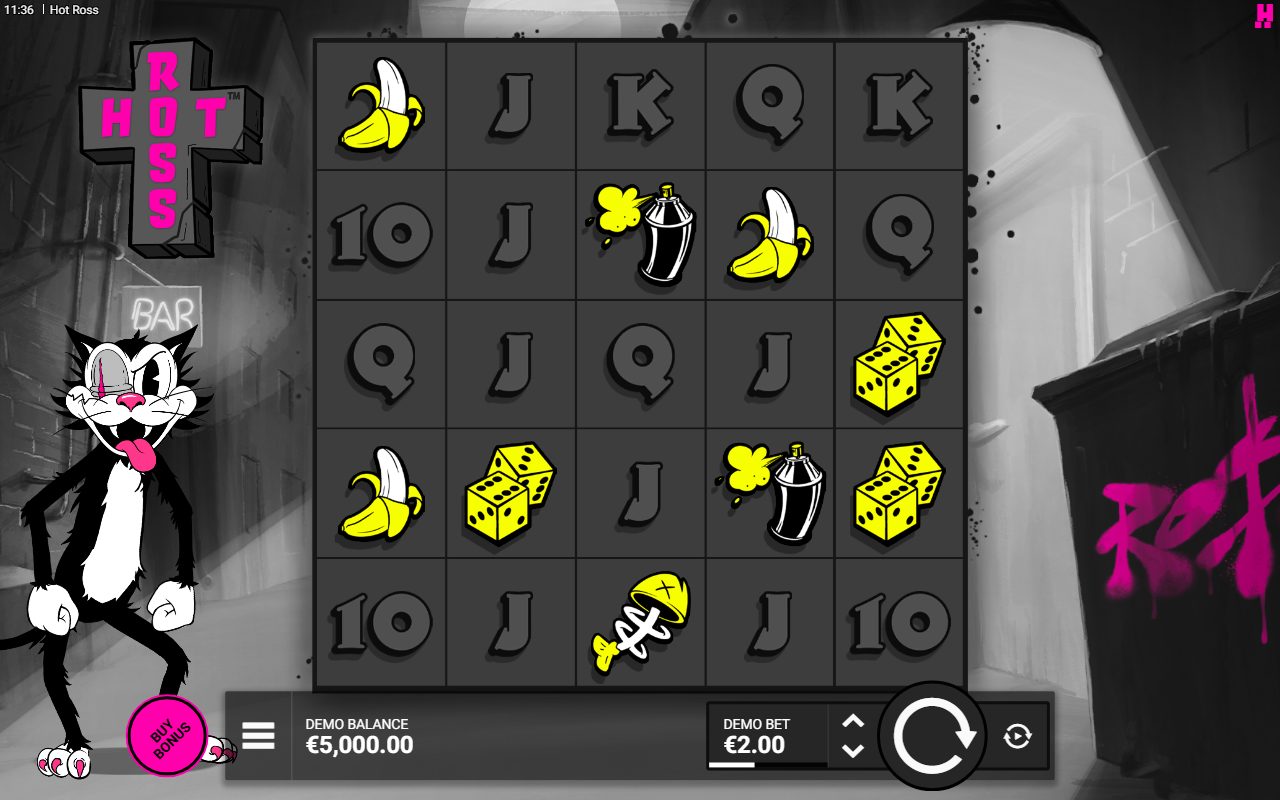
Hot Ross runs on a 5-reel, 5-row grid with 19 fixed paylines, paying left to right on three or more matching symbols across adjacent columns. The layout is identical to RIP City and a step back from Rad Maxx's 76-way structure — a deliberate design choice that keeps the payline math tighter and makes the expanding wild interactions more predictable to read.
The two core symbols driving the base game are Ro$$ and Hot Ro$$, both functioning as expanding wilds with conditional behavior. A Ro$$ symbol checks on landing whether expanding downward from its position would complete at least one win. If yes, it expands to the bottom of the reel, with all expanded positions counting as wilds. If no win is formed, it stays as a single wild. Hot Ro$$ goes further: it first moves to the top of the reel before expanding downward, guaranteeing full reel coverage, and a fully expanded Hot Ro$$ can force adjacent Ro$$ symbols to behave as boosted Hot Ro$$ symbols in turn.
Multipliers enter when an expanding symbol passes through a standard wild during its expansion. That wild converts into a multiplier (ranging from 2x to 200x), which is then applied to the expanded symbol's wins. Multiple multiplier wilds in a single expansion add their values together rather than multiply them — an important distinction for understanding how big numbers build. Only one Ro$$ or Hot Ro$$ can occupy a reel at a time, which keeps the system from becoming chaotic while still allowing significant multi-reel interactions.
Three Free Spins Modes Explained
Hot Ross separates its free spins into three distinct modes triggered by the number of scatter symbols landing simultaneously, and the differences between them are substantial enough to affect how you value the buy-feature options.
Cat Calls, triggered by three scatters, starts with 10 free spins and plays similarly to the base game but with a higher frequency of Ro$$ and Hot Ro$$ symbols appearing. Retriggers are available: two scatter symbols during the bonus add two spins, three scatters add four. It's the entry-level bonus — still capable of strong results, but without the structural escalation of the higher modes. Nine Lives requires four scatters and adds a reel activation mechanic on top of the Cat Calls foundation. Any reel where a Ro$$ or Hot Ro$$ lands becomes permanently activated for the remainder of the bonus, guaranteeing at least one such symbol on that reel for every subsequent spin. As more reels activate across the 10-spin session, the density of expanding wilds increases steadily. The retrigger structure is identical to Cat Calls.
Big Boss Ross is the top-tier mode, unlocked by five scatters, and it removes the gradual build entirely. Every spin is guaranteed to include at least two Hot Ro$$ symbols and one standard wild from the first spin onward. That means full-reel expansions and multiplier involvement are near-constant rather than earned over time. This is where the 15,000x ceiling becomes genuinely reachable rather than theoretical, and it's also the most expensive direct purchase at 1,000x the stake.
Buy Feature Pricing and Value
Hot Ross offers six distinct purchase and bonus bet options, which is one of the more comprehensive buy-feature menus in Hacksaw's catalog. The range covers both modified base-game spins and direct bonus triggers, giving players meaningful choices depending on their session goals.
The three FeatureSpin options modify how the base game behaves rather than skipping directly to a bonus. Bonushunt FeatureSpins multiplies the bonus trigger probability by five for 3x the standard bet — useful for players who prefer the organic tension of triggering a bonus rather than buying it outright, at a 96.22% RTP. Feisty FeatureSpins guarantees at least three Ro$$ symbols per spin at 60x the bet (96.28% RTP), and Epic Drop FeatureSpins guarantees five Ro$$ and three wilds per spin at 1,000x the bet (96.29% RTP).
For direct triggers: Cat Calls costs 100x the stake, Nine Lives costs 200x, and Big Boss Ross costs 1,000x. The jump from Nine Lives to Big Boss Ross is steep — a tenfold cost increase for a bonus that skips the reel-activation buildup and starts at maximum intensity. Whether that premium is justified depends on session bankroll and how much the player values the guaranteed density of Big Boss Ross over the escalating structure of Nine Lives. At $50 maximum bet, Big Boss Ross costs $50,000 per trigger, which puts it firmly out of reach for most recreational players.
Spindex Live Data: 74K Tracked Bets
Across our five crypto-casino tracking sources, Hot Ross has logged 74,000 bets in the past 30 days, which is a solid early-adoption figure for a release of this type. The trend signal is currently reading normal — no unusual volatility clustering or payout anomalies that would suggest the sample is skewed by a small number of large sessions.
The top recent hit recorded on Spindex sits at 2,902x, which is meaningful context. At 74K bets, seeing a top hit of 2,902x rather than something approaching the 15,000x ceiling is exactly what high-volatility math models predict at this sample size — the max win is a statistical outlier that requires a specific convergence of expanded Hot Ro$$ symbols, stacked multiplier wilds, and favorable payline coverage. It's achievable, but players should calibrate expectations around the 2,000–4,000x range as a realistic strong-session outcome rather than treating 15,000x as a near-term target.
The 74K bet volume also suggests a healthy player base is actively testing the game, which means the tracked data will become more statistically meaningful over the next 60–90 days. We'll update this section as the sample grows.
Who Should Play Hot Ross
Hot Ross is built for players who are comfortable with extended base-game variance and understand that the value is concentrated in the bonus rounds rather than distributed across regular spins. The 20.74% hit frequency is low enough that casual players spinning for entertainment value may find the base game unrewarding between features.
Players already familiar with RIP City will find the mechanics immediately readable — the expanding wild logic is the same foundation, just extended with the Hot Ro$$ upgrade and the third bonus mode. That familiarity lowers the learning curve significantly. For players new to the series, the feature complexity is real: three bonus modes with different trigger conditions, six buy options with different RTPs, and a multiplier system that requires attention to read accurately.
The $0.10 minimum bet makes the game accessible at low stakes for players who want to experience the bonus modes without heavy exposure, though at that level the buy features become impractical. At mid-stakes ($1–$5 per spin), the Cat Calls and Nine Lives buy options sit at $100 and $200 respectively — reasonable for players who want to skip the base-game grind and spend their session budget on bonus time.
Final Verdict
Hot Ross does what a good series entry should: it builds on a working formula without simply repackaging it. The return to 19 paylines over Rad Maxx's 76-way structure is a deliberate choice that makes the expanding wild interactions easier to track and the payline math more transparent. The addition of Hot Ro$$ as a distinct symbol tier and Big Boss Ross as a third bonus mode gives the game genuine range that RIP City didn't have.
The 15,000x max win is the number that will drive interest, and it's supported by a multiplier system that can realistically build to that range through stacked Hot Ro$$ expansions — not just a single theoretical scenario. The base game pacing can drag during long cold stretches before a bonus triggers, which is the honest trade-off for high-volatility math. The buy-feature menu addresses that directly, though the pricing on the upper tiers is steep.
At 96.32% RTP and a 15,000x ceiling, Hot Ross sits comfortably as one of Hacksaw's stronger high-volatility releases in the current catalog. It's not a casual game, but it doesn't pretend to be.
- +15,000x max win backed by a realistic multiplier stacking system
- +Three meaningfully different free spins modes with distinct mechanics
- +96.32% RTP at standard settings, slightly above Hacksaw's studio average
- +Six buy-feature options including modified base-game spin variants
- +Hot Ro$$ symbol adds a genuine mechanical upgrade over the base Ro$$ wild
- +Minimum bet of $0.10 keeps the game accessible at low stakes
- -20.74% hit frequency means frequent dead spins in the base game
- -Big Boss Ross buy feature costs 1,000x the stake — out of reach for most players
- -RTP shifts across buy options, requiring players to check before purchasing
- -High volatility makes this unsuitable for short or low-bankroll sessions
Best for
Hot Ross is a high-volatility slot that earns its reputation through a layered expanding wild system and three meaningfully different free spins modes rather than gimmicks. The 15,000x max win is achievable through multiple setups, not just one lucky configuration. The buy features are expensive relative to the stake, and the RTP shifts depending on which entry point you choose — factors worth weighing before committing to a session.