
Merge Up 2 Review
A 98% RTP is rare enough to stop mid-scroll. BGaming's Merge Up 2 — developed in collaboration with streaming analytics platform Strmlytics — posts that number consistently across the base game, the Bonus Bet mode, and all three Buy Bonus tiers. That kind of uniformity matters, because many studios quietly lower RTP on bonus-buy variants. Here, the published 98% applies regardless of how you enter.
The original Merge Up launched in 2023 and built a following around its mobile puzzle-game aesthetic and cluster-pays structure. This sequel keeps that identity intact on a 6×6 grid with Cluster Pays, but layers in a base-game multiplier mechanic that the first game reserved exclusively for free spins. The max win has also doubled, from 5,000x to 10,000x. Whether those upgrades justify the sequel tag is the real question — and the answer depends almost entirely on how you feel about high-volatility, patience-testing slots with a 29.41% hit frequency and a free spins trigger that averages one every 409 spins.
RTP, Volatility, and Max Win — The Numbers That Matter
The 98% RTP is the single most important number in this review. To put it in context: the industry average for video slots sits around 96%, and most high-volatility releases from major studios land between 95.5% and 96.5%. Merge Up 2's 98% figure is closer to what you'd find on a video poker machine than a feature-heavy slot — and crucially, BGaming doesn't reduce it for the Buy Bonus options, which is where many studios quietly shave 1–2 percentage points.
Volatility is rated high, and the hit frequency of 29.41% reflects that tension — roughly 3 in 10 spins return something, but the distribution is heavily weighted toward smaller cluster wins. The free spins round, where the real multiplier accumulation happens, triggers once every 409 spins on average. That's a long wait relative to many cluster-pays peers. Hacksaw Gaming's Chaos Crew 2, for comparison, runs a similar high-volatility profile but with a noticeably shorter average bonus trigger interval, though its RTP sits at a more standard 96.38%.
The 10,000x max win is double the 5,000x ceiling of the original Merge Up. At a max bet of $25, that's a $250,000 theoretical top prize. Realistically, reaching that ceiling requires sustained multiplier stacking across both the Bomb mechanic and the persistent free spins grid — possible by design, but not a routine outcome. For players who prioritize long-session sustainability over jackpot chasing, the 98% RTP does most of the heavy lifting.
How Merge Up 2 Plays — Grid, Clusters, and the Merge Mechanic
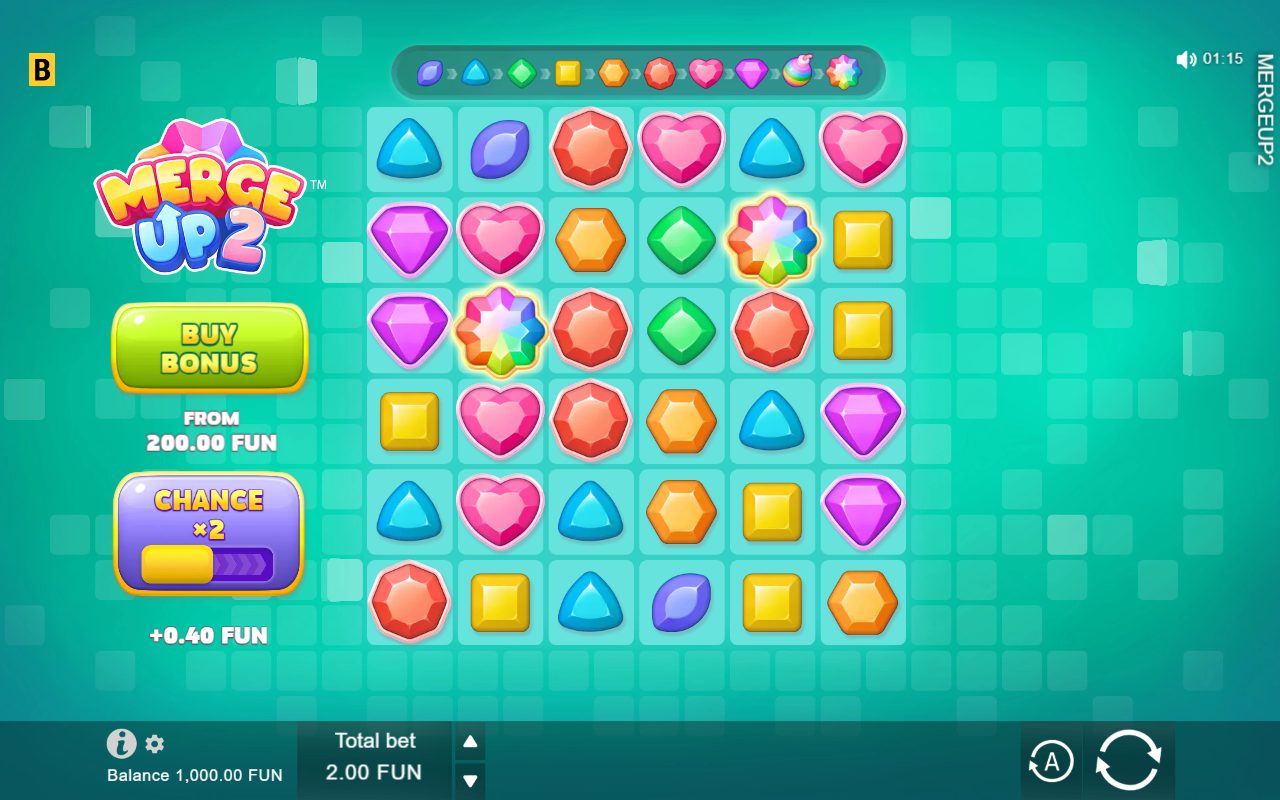
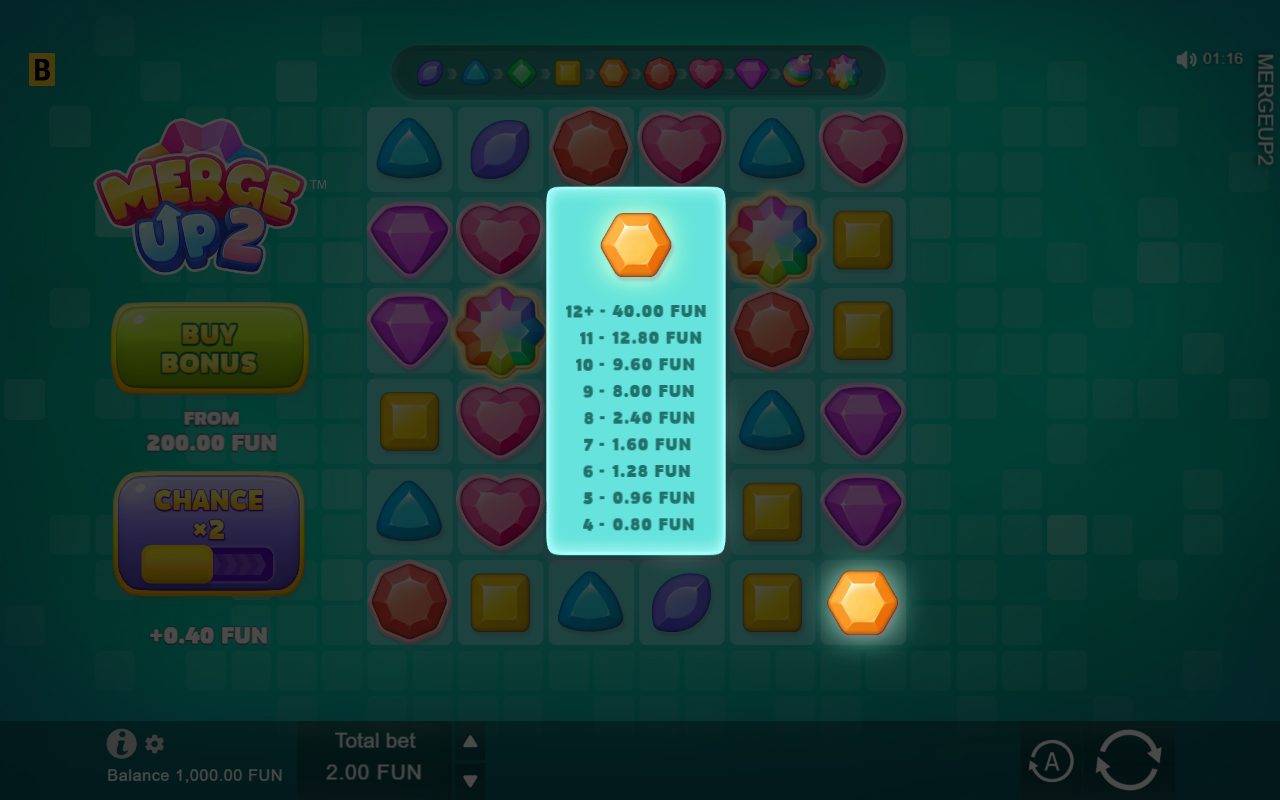
Merge Up 2 runs on a 6×6 grid with no fixed paylines. Wins form when four or more identical symbols connect horizontally or vertically anywhere on the board. Larger clusters pay proportionally more, with groups of 12 or more symbols at the top of the payout scale. After a win resolves, part of the cluster disappears and the remaining symbols merge upward into the next symbol tier — this is the core loop that gives the slot its name.
There are nine symbol levels in total. Levels one through eight are the standard paying symbols ordered by value. The ninth level is the Bomb symbol, which only appears when a cluster of eighth-level symbols forms. When a Bomb detonates, it clears the eight surrounding symbols, fills the empty spaces with new ones, and then converts itself into a Scatter. That Scatter is what feeds the free spins trigger, meaning the highest-value base-game event also advances the bonus simultaneously.
The Cascading and Avalanche mechanics keep the grid in motion after each win, dropping new symbols into vacated spaces and creating opportunities for chain reactions within a single spin. Bet range runs from $0.25 to $25, which is a relatively narrow window — players accustomed to $0.10 minimums or $100 maximums will notice the compression at both ends.
Multiplier System — The Key Upgrade Over the Original
The most meaningful mechanical change from the first Merge Up is the multiplier grid moving into the base game. Previously, multiplier accumulation was gated behind the free spins round. Now it begins from spin one.
The logic works as follows: when a winning cluster forms, the cells involved become marked. If any marked cell participates in a subsequent winning cluster during the same spin sequence, that cell gains a ×2 multiplier. Each additional win adds another step to that cell's multiplier, and all active multipliers within a cluster are summed together before the win is calculated. The ceiling for any individual cell is ×128. Critically, marked cells stay active until the spin fully resolves — meaning a well-chained cascade can stack multipliers across multiple avalanche drops before the total is settled.
The Bomb explosion adds a second escalation path: when a Bomb detonates, every affected cell's multiplier increases by one step. A cell at ×2 moves to ×4; higher values climb accordingly. This creates a compounding dynamic where a single spin containing both a high-level cluster merge and a Bomb detonation can produce multiplier values that would be impossible through cascades alone. For base-game wins, this is the mechanism most likely to produce the outlier results that make the 10,000x ceiling feel reachable rather than theoretical.
Free Spins and Buy Bonus Breakdown
Three or more Scatter symbols in a single spin trigger the free spins round. The entry count scales with how many Scatters land: three awards 12 spins, four awards 15, and five awards 30. The key structural difference from the base game is that the multiplier grid becomes persistent — multipliers accumulated on cells do not reset between free spins, they carry forward and continue building for the entire duration of the feature. That persistence is what makes the free spins round the primary path to the 10,000x ceiling.
Retriggers are available with no cap: landing three or more Scatters during free spins adds five extra spins each time, indefinitely. Additional Free Spins and a Free Spins Multiplier are both confirmed features, reinforcing that the round can extend and escalate significantly from a good starting position.
The Buy Bonus system offers three entry points. Bonus Game 1 costs 100× the bet and delivers the standard free spins round. Bonus Game 2 costs 250× and starts every cell with a ×2 multiplier already applied. Bonus Game 3 costs 500× the bet and opens with three to nine Bombs pre-detonating before the round begins, generating a multiplier foundation that carries into the feature. The tiered structure is genuinely useful — the 100× entry is accessible for most bankrolls, while the 500× option is a high-commitment play for sessions specifically targeting maximum multiplier potential. The Chance ×2 side bet, which increases the base stake by 20% in exchange for a higher frequency of natural bonus triggers, is the lower-cost alternative for players who want better odds without committing to a full buy.
Spindex Live Data — 13K Tracked Bets
Merge Up 2 has logged 13,000 tracked bets across Spindex's five crypto-casino sources over the past 30 days. For a slot released in late October 2025, that's a solid early volume — enough to draw some preliminary observations, though not yet the sample size needed for deep frequency analysis.
The top recorded hit in that window was 2,345×. At a $25 max bet, that translates to a $58,625 single-spin return — a meaningful real-money outcome, though well below the 10,000× theoretical ceiling. The 2,345× result is consistent with what you'd expect from a high-volatility release in early circulation: large wins are appearing, but the full multiplier stacking required for ceiling-level outcomes hasn't been captured yet in our data set.
The current trend signal is normal, meaning bet volume and win distribution aren't showing the kind of unusual clustering that sometimes precedes a cold streak or an anomalous hot run. For players considering Merge Up 2 now, the data suggests the slot is behaving within expected parameters for its volatility profile — no red flags, but also no evidence of an elevated payout cycle. The 98% RTP is a long-run figure; 13K bets is still early-stage tracking.
BGaming and Strmlytics — Why the Collaboration Matters
BGaming is a Malta-based studio that has been building casino content since before its 2018 brand launch. The studio covers video slots, crash games, scratchcards, and casual formats, and is credited as the first provider to integrate Provably Fair technology into its slot portfolio — a distinction that has made it a natural fit for crypto-casino operators.
Merge Up 2 is co-developed with Strmlytics, a live streaming analytics platform. The two have previously collaborated on Aztec Clusters, Snoop Dogg Dollars, and Wild Wick. The Strmlytics involvement is relevant beyond marketing: the premise is that streaming data and player behavior research directly informed the design decisions in this sequel — specifically which elements of the original Merge Up to expand, which to simplify, and where the original experience had friction. The base-game multiplier expansion is the clearest mechanical output of that process, addressing what was likely identified as a pacing gap in the original.
Whether data-driven development produces better slots than traditional design is a fair debate. What's observable here is that the specific changes between Merge Up and Merge Up 2 — multiplier accessibility, doubled max win, tiered bonus buy — are all targeted improvements rather than cosmetic ones. That suggests the collaboration produced actionable conclusions rather than just a marketing narrative.
Who Should Play Merge Up 2
Merge Up 2 is built for high-volatility players who prioritize RTP over hit frequency. The 98% return is exceptional, but it's delivered through infrequent, large-magnitude events rather than steady small wins. A 29.41% hit rate means the majority of spins resolve empty — bankroll management matters here more than in medium-volatility alternatives.
Crypto-casino players in particular will find Merge Up 2 well-suited to their platform preferences. The Provably Fair heritage of BGaming, the crypto-casino distribution tracked in our Spindex data, and the $0.25–$25 bet range all align with how crypto players typically structure sessions. The Buy Bonus at 100× the bet is also accessible at lower stake levels — at $1 per spin, a Bonus Game 1 purchase costs $100, which is a reasonable entry for players who want to skip the 409-spin average trigger wait.
Players who prefer frequent bonus triggers or base-game entertainment between features will likely find the pacing frustrating. The base game, while mechanically interesting due to the multiplier grid, can run long stretches without significant action. The Chance ×2 side bet helps, but it doesn't fundamentally change the bonus frequency — it just tilts the odds marginally in the player's favor during organic play.
Final Verdict
Merge Up 2 makes a strong case on its headline numbers: 98% RTP, 10,000x max win, and a base-game multiplier system that was absent from the original. BGaming and Strmlytics have produced a sequel that is mechanically more complete than its predecessor, and the uniform RTP across all play modes — including bonus buys — is a transparency standard that not enough studios meet.
The trade-off is patience. High volatility, a 29.41% hit rate, and a free spins trigger averaging one every 409 spins mean this slot demands a bankroll sized for variance. The base game pacing drags between bonus triggers for players who aren't actively tracking the multiplier grid — the mechanical depth is there, but it requires engagement to appreciate. Spindex's 13K tracked bets show a top hit of 2,345× in the early window, which confirms the slot is producing meaningful wins without yet approaching its ceiling.
For RTP-focused players, high-volatility cluster-pays enthusiasts, and crypto-casino regulars, Merge Up 2 sits near the top of the 2025 release slate. For players who want frequent feedback or lower variance, the 98% RTP alone won't compensate for the dry spells between big events.
- +98% RTP — among the highest available on any video slot in 2025
- +RTP is consistent across base game, Bonus Bet, and all three Buy Bonus tiers
- +Max win doubled to 10,000x compared to the original Merge Up (5,000x)
- +Base-game multiplier grid is a genuine upgrade over the original's feature-only system
- +Three-tier Buy Bonus system gives flexible entry points from 100× to 500× the bet
- +Unlimited free spins retriggers with no cap
- +Bomb mechanic creates a dual escalation path for multiplier stacking
- -Free spins trigger averages once every 409 spins — long wait for organic bonus access
- -High volatility with 29.41% hit rate means extended dry spells are common
- -Narrow bet range ($0.25–$25) limits accessibility for very low-stakes players and high rollers
- -Bonus Game 3 (500× buy) is expensive for most casual bankrolls
- -Base game pacing can feel slow without active multiplier chain events
Best for
Merge Up 2 is one of the highest-RTP high-volatility slots released in 2025. The 98% return, doubled max win ceiling of 10,000x, and base-game multiplier expansion make a strong case for players who can absorb the variance. The bonus buy at 500x is expensive, but the three-tier entry system gives flexibility. Casual players should be aware the free spins trigger is infrequent — one every ~409 spins on average.