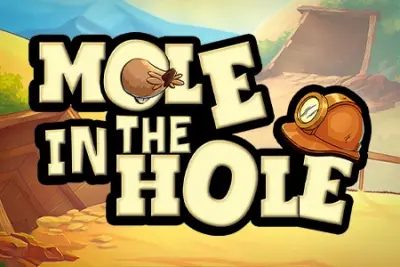

Mole in the Hole Review
A 15,000x max win ceiling is the headline number on Mole in the Hole, Octoplay's 2026 video slot built around a pay-anywhere grid and cascading wins that compound multipliers across every winning drop. The 5×4 layout means 20 active positions at all times, and because wins pay regardless of payline position, even off-center clusters count. That structural generosity matters when the cascades start stacking.
The RTP sits at 92.71%, which is below the industry standard of 96% and noticeably lower than comparable Octoplay titles — that's the first number any serious player should clock before spinning. The trade-off Octoplay is offering here is a high ceiling (15,000x) in exchange for a tighter return rate on aggregate volume. Whether that trade suits you depends entirely on your session goals and bankroll tolerance.
Spindex has tracked 32,000 bets on Mole in the Hole across five crypto-casino sources in the last 30 days, with a top recorded hit of 8,969x. That real-world data point — 8,969x against a 15,000x ceiling — gives us something concrete to work with beyond the spec sheet.
RTP, Volatility, and the Max Win Reality Check
The 92.71% RTP on Mole in the Hole is the most important number in this review and deserves direct treatment. For context, the widely accepted baseline for online slots is 96%, and most major studio releases in 2025–2026 land between 95.5% and 97%. Octoplay's own published average tends to cluster around 95–96%, which makes Mole in the Hole an outlier even within their own catalogue.
What that 92.71% means in practice: for every $100 wagered across a long session, the expected return is $92.71 — a house edge of 7.29%. That's closer to land-casino territory than the competitive online market. Players using the Bonus Bet feature, which increases stake involvement, should factor this into their per-spin cost calculations carefully.
The 15,000x max win is genuine upside, and Spindex's tracked data shows a real-world hit of 8,969x has already been recorded in the first 30 days of tracked volume. That's 59% of the theoretical ceiling achieved in live play, which is a meaningful data point. By comparison, Hacksaw Gaming's Chaos Crew 2 carries a similar high-ceiling structure at 50,000x but with a 96.38% RTP — demonstrating that high max wins and competitive RTPs can coexist. Mole in the Hole asks players to accept a steeper return penalty for its ceiling.
How Mole in the Hole Plays
The 5×4 grid runs on a pay-anywhere system, meaning winning combinations form from any positions across the reels rather than fixed left-to-right paylines. Every one of the 20 grid positions is live on every spin, which increases the frequency of partial hits and keeps the cascade engine fed.
The cascade mechanic — sometimes called the Gonzo mechanic in Octoplay's own terminology — removes winning symbols after each payout and drops new symbols into the vacated spaces. Each successive cascade within a single spin increments the multiplier, so a chain of four or five cascades on a single paid spin can dramatically amplify the base win. This is the core loop of Mole in the Hole: land a cluster, watch it clear, hope the refill extends the chain.
Bet range runs from $0.10 to $30 per spin, which is a relatively compressed ceiling compared to high-roller titles that allow $100+ stakes. The Bonus Bet option sits above the standard stake and increases engagement with the bonus trigger mechanics — useful for players specifically targeting the free spins modes rather than grinding the base game. The 5×4 layout with pay-anywhere coverage is a format that has proven effective in cascade-based slots, and Octoplay's implementation here follows established structural logic rather than reinventing it.
Bonus Features Breakdown
Mole in the Hole carries a full feature stack for a 2026 release: Free Spins, Additional Free Spins, Free Spins Mode Choosing, Free Spins Multiplier, Avalanche/Cascading mechanics, Multiplier, Scatter Symbols, Pay Anywhere, Bonus Bet, and Buy Feature. That's a dense list, and the most strategically interesting element is the Free Spins Mode Choosing mechanic.
Selectable free spins modes give players agency over how the bonus round operates — typically a choice between higher multiplier potential with fewer spins, or more spins with a more conservative multiplier structure. This type of player-choice mechanic has become increasingly common in 2025–2026 releases and generally improves the bonus round's replay value. The Free Spins Multiplier compounds on top of the base cascade multiplier, meaning the bonus round's ceiling is structurally higher than the base game's.
The Buy Feature allows direct purchase of the bonus round, bypassing the base game trigger entirely. Given the 92.71% RTP, players using the Buy Feature should be aware that the effective RTP on purchased bonuses may differ from the base game RTP — this is standard across the industry but worth noting explicitly. Scatter symbols trigger the free spins organically, and Additional Free Spins can extend the bonus round mid-play, which is the mechanism most likely responsible for the 8,969x hit recorded in Spindex's tracked data.
Spindex Live Tracked-Bet Data
Mole in the Hole has accumulated 32,000 tracked bets across Spindex's five crypto-casino data sources in its first 30 days of monitored volume. For a 2026 release with a May launch date, that's a reasonable early-adoption figure — not a breakout performer yet, but generating consistent activity across multiple platforms.
The standout data point is the top recorded hit of 8,969x. Expressed in dollar terms at the $30 maximum bet, that's a $269,070 return on a single spin sequence. At the $0.10 minimum, the same 8,969x hit would return $896.90 — still a meaningful payout relative to stake. The fact that a near-9,000x result has already appeared in live tracked data suggests the high-volatility upper range of the distribution is accessible, not purely theoretical.
The current trend signal from Spindex is normal — no unusual clustering of big wins or cold streaks that would flag anomalous behavior. That's a useful baseline: Mole in the Hole is performing within expected variance parameters for a high-ceiling cascade slot. We'll update this section as volume builds and the distribution fills out further.
Theme and Presentation
Mole in the Hole is a cartoon-style adventure slot in the funny forest animals and nature category, with additional visual elements drawn from gems, tools, and TNT iconography. The sky-blue palette is consistent with the lighthearted cartoon aesthetic Octoplay has applied here.
The Gonzo-style cascade animation — symbols falling into position and exploding on wins — is functional and fits the mechanical structure. There's nothing in the visual presentation that conflicts with the gameplay logic, which is the baseline requirement for this type of slot.
Who Should Play Mole in the Hole
The player profile for Mole in the Hole is specific. The 15,000x ceiling and selectable free spins modes make it genuinely interesting for high-variance chasers who want multiplier-stacking potential and player agency in the bonus round. The Buy Feature makes it accessible to bonus hunters who want direct access to the free spins without grinding base game triggers.
However, the 92.71% RTP creates a hard filter. Players who prioritize long-session value or who play primarily for entertainment volume should look at slots with RTPs closer to 96% — that 3.29% gap compounds significantly over hundreds of spins. The $30 maximum bet also limits appeal for true high-rollers who typically want $100+ stake options.
The $0.10 minimum makes Mole in the Hole accessible for low-stakes players, but the RTP disadvantage applies equally across all stake levels. The sweet spot for this slot is the medium-stakes player — $1–$5 per spin — who is explicitly targeting the bonus round and its multiplier potential rather than expecting base-game returns to carry the session.
Final Verdict
Mole in the Hole is a mechanically well-constructed slot. The pay-anywhere 5×4 grid, cascade multiplier engine, selectable free spins modes, and 15,000x ceiling form a coherent high-variance package. Octoplay has built a feature set that competes with mid-tier releases from larger studios, and the 8,969x real-world hit from Spindex's early tracked data confirms the upper range of the distribution is reachable.
The 92.71% RTP remains the single reason to pause. It's not a disqualifying number for every player — some jurisdictions and bonus structures make lower-RTP slots viable — but it should be an explicit, informed decision rather than an oversight. Players comparing Mole in the Hole against a slot like Pragmatic Play's Big Bass Bonanza (96.71% RTP, 2,100x max win) are trading nearly 4% in return rate for a dramatically higher ceiling. That's a legitimate trade for the right player.
The base game pacing can feel slow before the cascade chain extends — single-drop wins without follow-up cascades don't generate much momentum — which makes the Buy Feature more attractive as a time-efficiency tool. Rated 3.9 out of 5 for mechanics and ceiling, with the RTP pulling the overall score below what the feature set alone would justify.
- +15,000x max win ceiling with real-world 8,969x hit already recorded on Spindex
- +Selectable free spins modes give players meaningful bonus round agency
- +Pay-anywhere 5×4 grid keeps all 20 positions active every spin
- +Cascade multiplier stacking creates compounding win potential in both base game and free spins
- +Buy Feature available for direct bonus access
- +Low $0.10 minimum bet for accessible stake sizing
- -92.71% RTP sits 3+ percentage points below the industry standard of 96%
- -Volatility not officially disclosed by Octoplay
- -Maximum $30 bet limits appeal for high-roller play
- -Base game can feel low-momentum without extended cascade chains
Best for
Mole in the Hole is a mechanically rich slot with a legitimate 15,000x ceiling, selectable free spins modes, and a Gonzo-style cascade engine that keeps the base game active. The 92.71% RTP is the one genuine drawback — it sits well below the 96% benchmark most players should target. Best suited to bonus hunters and high-variance chasers who accept the lower return rate in exchange for the multiplier upside.