
Reactoonz 2 Review
Play'n GO released Reactoonz 2 in October 2020, roughly three years after the original became one of the most-tracked cluster-pays slots in the market. The sequel keeps the 7x7 grid and cluster-pays mechanic intact while layering in additional wild types and a more complex meter system. The max win stands at 5,083x — a number that only landed after community pressure pushed Play'n GO to revise an initially planned ceiling below 3,000x.
What makes Reactoonz 2 worth examining in 2024 isn't nostalgia — it's the math. High volatility rated 8/10 by the developer, an RTP that most operators deploy at 94.2% rather than the headline 96.2%, and a feature set that demands consecutive cascades to unlock its biggest modifiers. That gap between the advertised and effective RTP is the single most important number a player should check before depositing. This review breaks down the mechanics, the meter system, the live data from Spindex's tracked bets, and whether the 5,083x ceiling justifies the ride.
RTP, Volatility, and the Max Win Reality Check
The most critical spec to understand before playing Reactoonz 2 is the RTP structure. Play'n GO built the game with a range — the top value sits at 96.2%, but the version most operators actually configure runs at 94.2%. That 2-percentage-point gap is meaningful over any significant session volume, and it's worth a quick check with the casino's support or game info panel before committing real money.
Volatility is rated high — 8 out of 10 by Play'n GO directly — which aligns with the meter-driven feature design. Long dry spells between bonus triggers are part of the math model, not a malfunction. The 5,083x max win is the headline number, and it's genuinely competitive for a cluster-pays slot in this format. For context, the original Reactoonz topped out at 4,570x, so the sequel adds roughly 500x to the ceiling. That said, 5,083x sits meaningfully below the cluster-pays outliers like Jammin' Jars 2 (20,000x) or even some high-variance Hacksaw titles pushing 50,000x, so the potential is real but not extreme by current market standards.
Players targeting the upper end of that range need to understand the dependency chain: the biggest wins require multiple cascades, charged meters, and active wild multipliers firing in sequence. The math supports it, but the path there is non-linear and session-length dependent.
How Reactoonz 2 Plays on the 7x7 Grid
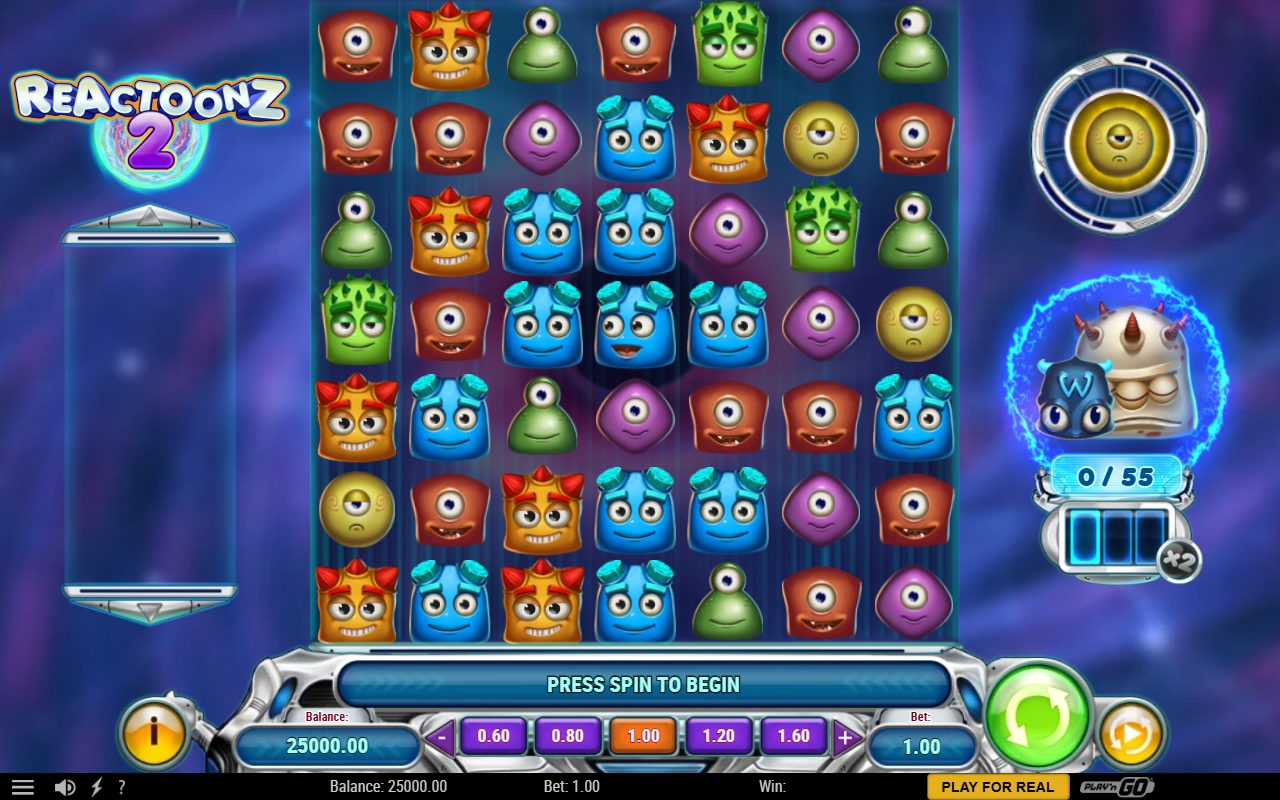
Reactoonz 2 runs on a 7x7 grid using a cluster-pays mechanic — no fixed paylines, no diagonal wins. A minimum of 5 symbols connected horizontally or vertically forms a winning cluster. Larger clusters of 15 or more symbols deliver the most significant payouts, with the paytable running from 3x up to 500x the total bet for a full-grid cluster of the highest-value symbol.
The eight creature symbols split into high and low value groups, a structure carried over from the original. Four distinct wild types — Uncharged Wilds, Energoon Wilds, Electric Wilds, and Gargatoon Wilds — each carry a specific ability rather than acting as generic substitutes. This wild hierarchy is central to how the game escalates during a hot streak.
Avalanches (cascading wins) activate after every winning cluster: matched symbols are removed and new ones fall into the vacated spaces. Chains of cascades are possible as long as new clusters keep forming. This is the engine that drives meter charging and, by extension, all the game's significant bonus activity. The base game without cascades running feels deliberately sparse — the design pushes players toward multi-cascade sequences where the real value concentrates.
Bonus Features and the Meter System
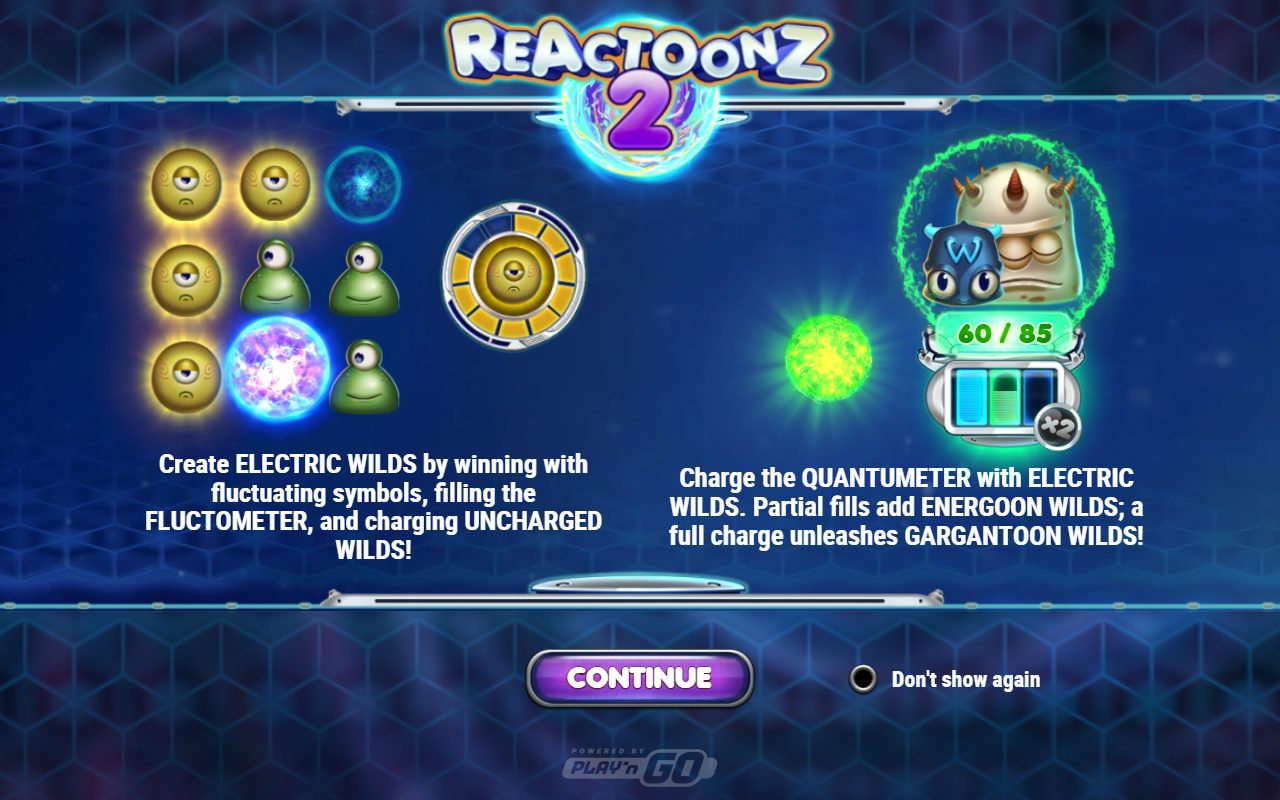
Reactoonz 2's feature architecture revolves around two meters: the Fluctometer and the Quantumeter. Filling them is the primary goal of every spin, and both are charged through specific symbol removal mechanics during cascades.
The Fluctometer charges when fluctuating symbols — randomly designated low-paying symbols on any given spin — are cleared from the grid. A full Fluctometer awards up to three Electric Wilds, which substitute for any regular symbol and trigger a zap effect that destroys all instances of a specific creature across the entire grid. Uncharged Wilds can also appear at the start of a spin or after a cascade; they remain dormant until a winning cluster forms adjacent to them, at which point they convert into Electric Wilds. The Fluctometer can charge multiple times in a single spin sequence, though it goes inactive once Gargatoon Wilds enter play.
The Quantumeter tracks energy collected across wins and cascades through a Level Up mechanic. Progressing through its levels unlocks increasingly powerful modifiers, including Symbol Swap (converting low-value symbols into higher ones), Mega Symbols (3x3 super-symbols that occupy nine grid positions), and multiplier boosts. The Gargatoon Wild — the most powerful of the four wild types — appears when the Quantumeter reaches its final level. The interdependency between these systems means a single long cascade chain can trigger multiple modifiers in sequence, which is where the 5,083x ceiling becomes reachable rather than theoretical.
Spindex Live Tracked-Bet Data
Reactoonz 2 logged 9,000 tracked bets across Spindex's five crypto-casino sources in the last 30 days, with the trend signal currently reading normal — no unusual volatility spike or prolonged cold streak in the aggregated data. That's a solid sample size for a slot of this age, suggesting sustained player interest rather than a nostalgia-driven short-term bump.
The top recent hit recorded on Spindex sits at 1,485x. That's a strong single-session result and sits well within the realistic distribution for a high-volatility cluster-pays slot — it's not a near-max-win outlier, but it confirms the game is delivering meaningful hits at the upper end of typical session variance. The 5,083x ceiling has been documented in verified wins externally, though it hasn't appeared in our current 30-day window, which is consistent with its probability at this bet volume.
The normal trend signal is actually useful context here: Reactoonz 2 isn't running hot in a way that might suggest a short-term RNG cluster, nor is it showing the kind of suppressed hit pattern that sometimes precedes a correction. For players making session decisions based on live data, this is a baseline-performance window — the slot is behaving as its math model predicts.
Reactoonz 2 vs. the Original — What Actually Changed
The core architecture of Reactoonz 2 is deliberately close to its predecessor — same grid size, same cluster-pays minimum, same general creature aesthetic. Play'n GO made no significant visual overhaul; the blue-toned cosmic background and cartoon creature symbols are recognizable to anyone who played the 2017 original.
The substantive changes are in the feature layer. The original Reactoonz had a single Quantumeter driving progression; Reactoonz 2 adds the Fluctometer as a parallel charging system and introduces the four-tier wild hierarchy with distinct abilities per type. The Mega Symbol mechanic (3x3 symbol blocks) and the Symbol Swap modifier are also additions not present in the original's feature set.
The max win increase from 4,570x to 5,083x is modest in absolute terms but was hard-won — Play'n GO's initial pre-release specification reportedly had the ceiling below 3,000x, and the revision came in direct response to community feedback. The RTP, however, moved in the opposite direction: the original Reactoonz ran at 96.51% in its standard configuration, while Reactoonz 2's most commonly deployed version is 94.2%. That's a notable step down, and players switching from the original should factor that into their expectations.
Who Should Play Reactoonz 2
Reactoonz 2 is built for players who are comfortable with high-volatility mechanics and understand that the meter-driven feature system requires multiple cascades to unlock its best modifiers. Casual players expecting frequent small wins will find the base game unrewarding between cascade chains — the design deliberately concentrates value in bonus sequences rather than distributing it across routine spins.
The 7x7 grid and cluster-pays format also suit players who prefer spatial pattern recognition over traditional payline tracking. There are no fixed lines to follow — wins emerge from adjacency clusters, which plays differently from reel-based slots and takes a few sessions to read intuitively.
For players already familiar with the original Reactoonz, the sequel offers a recognizable framework with added mechanical depth. The Fluctometer adds a second progression track that runs in parallel with the Quantumeter, which means more modifier triggers per cascade chain once both meters are active. The base game pacing can feel slow before the first meter fills, which is the one genuine criticism of the design — the gap between an unremarkable spin and a multi-modifier cascade sequence is wide, and not every session bridges it.
Final Verdict
Reactoonz 2 is a competent, mechanically layered sequel that improves on the original in feature depth while taking a step back on RTP. The 94.2% effective rate at most operators is the number players need to anchor their expectations to — not the 96.2% headline figure. At that return rate, combined with high volatility, bankroll management matters more here than in most Play'n GO releases.
The 5,083x max win is achievable through the meter system and has been documented in real-money play. Spindex's 30-day data showing a 1,485x top hit across 9,000 tracked bets suggests the game is delivering at the upper end of normal variance — not extraordinary, but functional. The mechanic itself is one of the more interesting cluster-pays designs in the market, with the dual-meter system and four-tier wild hierarchy creating genuine escalation during hot sequences.
The slot earns its place in the high-volatility cluster-pays category. Just verify the RTP version your casino is running before you start.
- +5,083x max win revised upward from an initially lower planned ceiling
- +Dual meter system (Fluctometer + Quantumeter) creates layered bonus escalation
- +Four distinct wild types each with unique abilities add strategic depth
- +7x7 cluster grid supports large multi-symbol wins in a single cascade chain
- +Mega Symbol (3x3) and Symbol Swap modifiers add significant win multipliers during bonus sequences
- -Effective RTP at most operators is 94.2%, not the headline 96.2%
- -High volatility (8/10) means extended dry spells between significant wins
- -Base game pacing is slow before the first meter charges
- -No bonus buy feature to shortcut to the meter-driven modifiers
- -Max win of 5,083x is competitive but modest compared to leading cluster-pays titles
Best for
Reactoonz 2 is a mechanically dense cluster-pays slot with genuine upside at 5,083x, but the 94.2% RTP deployed by most operators and high volatility make it a grind between big hits. The cascading wild system rewards patience, and the 7x7 grid keeps cluster formation frequent enough to maintain momentum. Best suited to players who understand meter-driven bonus structures and can absorb variance.