
Rust World Review
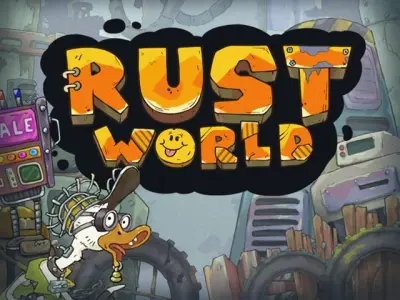
Peter & Sons dropped Rust World in January 2026, and the numbers alone make a case for attention. A 20,000x max win ceiling on a 7x7 cluster grid, sticky wilds that carry multipliers across cascades, and a 96% RTP — this is a high-volatility build designed for players who are willing to absorb variance in exchange for a shot at compounding payout chains. The post-apocalyptic theme is delivered in a hand-drawn cartoon style, not the grim cinematic direction that genre typically takes. What sets Rust World apart mechanically is how its wild multiplier system scales: each wild grows its multiplier based on the size of the cluster it joins, and those values persist into free spins. That architecture means a single well-positioned wild can snowball across multiple cascade layers. At 4,000 tracked bets over the last 30 days on Spindex, this is still an early-data slot — but the structure is worth understanding before you commit real money to it.
RTP, Volatility, and the 20,000x Math
The 96% RTP positions Rust World comfortably above the cluster-slot average — for context, many competing high-volatility cluster titles from studios like Hacksaw and Relax Gaming sit in the 94–95.5% range, so Peter & Sons are giving back slightly more per theoretical cycle. That said, the high-volatility classification means session-to-session variance will be significant, and the RTP is a long-run figure that won't smooth out over short play.
The 20,000x max win is the headline, and it's not an arbitrary ceiling. The way Rust World builds toward it is structural: wilds accumulate multipliers based on cluster size, survive cascades, and carry those values into free spins. A wild that has grown through several cascade layers inside the bonus can apply a double-digit multiplier to a large cluster, and when multiple wilds overlap in the same cluster their individual values are summed. That's the engine behind the top-end number — it requires alignment of several conditions simultaneously, which is why high volatility is the honest descriptor.
Hit frequency is unlisted in the verified data, which is common for cluster mechanics where 'hit' is harder to define than on a fixed-payline slot. What the cascade structure does provide is extended spin duration: a single paid spin can generate multiple payout events before the grid settles, which partially offsets the dry spells that high volatility creates.
How Rust World Plays on the 7x7 Grid
The 7x7 layout gives Rust World 49 symbol positions, which is substantially larger than the 6x6 grids common in cluster-pays slots. More positions mean larger potential clusters, which in turn feeds the wild multiplier scaling system — cluster size directly determines how much a wild's multiplier grows, so the extra real estate is mechanically relevant, not just cosmetic.
Wins require clusters of five or more matching symbols touching horizontally or vertically. Once a cluster pays, those symbols are removed and new ones fall in via the avalanche mechanic. This cascade sequence continues until no new clusters form, meaning a single spin can chain through multiple payout events. Stakes run from $0.20 to $50, giving the slot a reasonable range for both low-stakes testing and meaningful bonus buys at higher denominations.
The base game can feel deliberate between bonus triggers, particularly at high volatility with no listed hit frequency to set expectations. The cascade mechanic adds activity within a paying spin, but dry spins between clusters are a real feature of the experience — worth factoring in when sizing your session bankroll.
Wild Multipliers and Scatter Symbols
The wild multiplier mechanic is the core of what makes Rust World distinct. Every wild on the grid starts at a 1x multiplier. When a cluster forms that includes a wild, that wild gains +1 to its multiplier for each symbol in the cluster. A five-symbol cluster adds +5, a ten-symbol cluster adds +10, and so on. The multiplier then applies to the next win that forms a cluster with that wild — not to every win on the screen simultaneously.
When two or more wilds appear within the same cluster, they each build their multipliers independently, and those values are added together when applied to a win. A grid state where three wilds have each accumulated multipliers of 8x, 6x, and 5x, and all three fall within the same cluster, produces a combined 19x multiplier on that win. That's the compounding logic behind the 20,000x max win — it requires multiple wilds surviving multiple cascades with growing values.
Scatter symbols operate outside the cluster system entirely. Four or more scatters anywhere on the 7x7 grid trigger free spins. Their positioning is irrelevant — they don't need to be adjacent or form a cluster. This makes scatter triggers less dependent on grid state than cluster wins, giving the bonus trigger a different probability profile from the regular payout mechanic.
Free Spins, Power Free Spins, and Bonus Buy
Four scatters award 7 free spins, with each additional scatter adding 2 more. The critical mechanic in the bonus is wild persistence: any wilds active at the end of the triggering spin — along with their accumulated multipliers — carry directly into the free spins round and stay sticky for the duration. Rather than starting each free spin with a clean grid, those wilds remain locked in place, preserving their multiplier values and continuing to grow with each new cascade.
Power Free Spins, available only through the buy menu, begin with two or more guaranteed wilds already placed on the grid. This eliminates the cold-start problem of entering a bonus with no wild infrastructure in place. Standard free spins can be purchased for 100x the total bet and award 7 spins. Random Free Spins cost 200x and grant between 7 and 13 spins. Power Free Spins cost 300x and deliver 7–13 spins with the guaranteed wild placement. At a $50 max bet, that's a $15,000 outlay for the top buy option — this is a feature built for high-stakes players.
The Bonus Bet toggle adds 1.5x to the stake and increases scatter frequency during base-game spins. It has no effect once free spins are triggered — it's purely an access modifier. For players who want to grind toward the bonus organically rather than buy in, it's the middle-ground option between standard play and a direct purchase.
Spindex Live Data: 4,000 Tracked Bets
Rust World has logged 4,000 tracked bets across Spindex's five crypto-casino sources in the last 30 days. That's a thin dataset for a January 2026 release — the slot is genuinely new, and the sample is too small to draw firm conclusions about observed hit patterns or bonus frequency relative to stated specs. The trend signal is currently reading normal, meaning no unusual clustering of big wins or extended cold streaks in the tracked volume.
The top recent hit recorded on Spindex is 676x. That's a meaningful real-money result, but it sits well below the 20,000x theoretical ceiling, which is expected at this sample size — extreme multiplier outcomes on high-volatility cluster slots require specific wild stacking conditions that don't emerge frequently in 4,000 spins. The 676x figure is more useful as a baseline: it confirms the slot is paying at the upper end of normal base-game range without yet showing a bonus-fueled peak.
As tracked volume grows over the next 60–90 days, the Spindex data will become more informative about how often the free spins trigger in practice and whether the wild multiplier system is producing mid-range outcomes (500x–5,000x) at a rate consistent with the high-volatility classification. Check back on the Rust World page for updated figures.
Peter & Sons as a Provider
Peter & Sons operates as a boutique studio with a distinct visual identity — hand-drawn character art, expressive animations, and a preference for themes that lean unconventional. Their catalog consistently prioritizes mechanical depth alongside aesthetic differentiation, which puts them in a different category from studios that reskin the same math model repeatedly.
The studio's mechanical signature tends toward multiplier-driven systems and features that remain active across the full bonus duration rather than triggering once and resetting. Rust World fits that pattern precisely: the wild multiplier carryover into free spins is the same design philosophy applied to a cluster-pays format. Players familiar with Peter & Sons titles will recognize the approach even in a new theme.
For a full view of their catalog and how Rust World sits within it, the Spindex provider page tracks all their releases with individual RTP and volatility data.
Who Should Play Rust World
Rust World is built for players who understand high-volatility cluster mechanics and are comfortable managing bankroll through extended base-game dry spells. The 20,000x ceiling and the wild multiplier architecture are genuine draws, but accessing them requires either patience through organic bonus triggers or a direct buy-feature investment at 100x–300x stake.
The $0.20 minimum bet makes low-stakes exploration accessible, and the demo version is available for anyone who wants to see how the cascade and wild multiplier system behaves before committing real money. That's the right starting point — the mechanics have enough moving parts that a few hands-on spins in free play will clarify the system faster than any written description.
Casual players looking for frequent small wins or a relaxed session pace will likely find the variance uncomfortable. The slot rewards grid awareness and an understanding of how wild positioning affects multiplier growth — that's an experienced-player proposition, not a casual one.
Final Verdict
Rust World delivers a mechanically coherent high-volatility package. The 7x7 cluster grid, the scaling wild multipliers, the sticky-wild free spins, and the 20,000x max win all connect logically — this isn't a feature list assembled for marketing purposes, it's a system where each component feeds the others. The 96% RTP is genuinely competitive for the genre.
The one honest observation: the base game can feel inert in the stretches between bonus triggers. The cascade mechanic adds life within a paying spin, but the gap between meaningful events can be long, and without a published hit frequency figure there's no easy benchmark for how long those gaps typically run. Players buying in at 300x stake for Power Free Spins are bypassing that problem entirely, but at a significant cost.
At 4,000 tracked bets and a 676x top hit, Rust World is still early in its Spindex data life. The structure is sound, the provider has a strong track record, and the math supports the ceiling. For high-variance cluster-slot players, this is worth the demo session.
- +20,000x max win backed by a credible multiplier-stacking mechanic
- +96% RTP is above average for high-volatility cluster slots
- +Wild multipliers carry over from base game into free spins
- +Three buy-feature tiers give flexible bonus entry points
- +7x7 grid supports large clusters that accelerate wild multiplier growth
- +Bonus Bet toggle for players who prefer organic bonus frequency
- -High volatility with no published hit frequency — dry spells can be extended
- -Power Free Spins buy costs 300x stake, limiting accessibility
- -Complex multiplier mechanics have a learning curve
- -Early Spindex data (4K bets) — observed performance still unconfirmed at scale
Best for
Rust World is a technically dense cluster slot with a multiplier system that rewards patience and grid awareness. The 20,000x ceiling is credible given how wild multipliers stack across cascades, but high volatility means sessions can feel inert before the mechanics ignite. Best suited to experienced high-variance players with a buy-feature budget. The 96% RTP is solid, and the bonus buy options at 100x, 200x, and 300x give clear entry points.