





Sword of Ares Review
Pragmatic Play's Sword of Ares arrived in October 2022 as the studio's second major scatter-pay title, following Gates of Olympus. Where its predecessor leaned on random multiplier orbs, this release takes a fundamentally different approach: a structured symbol-collection system that progressively unlocks multipliers the longer a tumble sequence runs. That mechanical shift has real implications for variance and session feel — and it's the central reason players either prefer this over Gates of Olympus or don't.
The numbers are hard to ignore. A 10,000x max win ceiling is twice what Gates of Olympus offers, and the 6x5 Pay Anywhere grid gives the game more surface area to build those tumble chains. The RTP range is worth scrutinising — Pragmatic lists a top-tier figure of 96.4%, but the verified operator-deployed RTP sits at 95.4%, which is the number that matters at most casinos. High volatility, a Buy Feature, and free spins with multipliers up to 500x round out a package that targets experienced players comfortable with long dry spells between significant payouts.
RTP, Volatility, and the Max Win Reality
The most important number to clarify upfront is the RTP. Pragmatic Play publishes a top-tier figure of 96.4% for Sword of Ares, but the operator-deployed RTP — the one actually running at the majority of casinos — is 95.4%. That 1% gap is meaningful over thousands of spins, and it's the figure Spindex uses as the baseline for this review. The game does carry an RTP range feature, so check individual casino terms if this matters to your session bankroll planning.
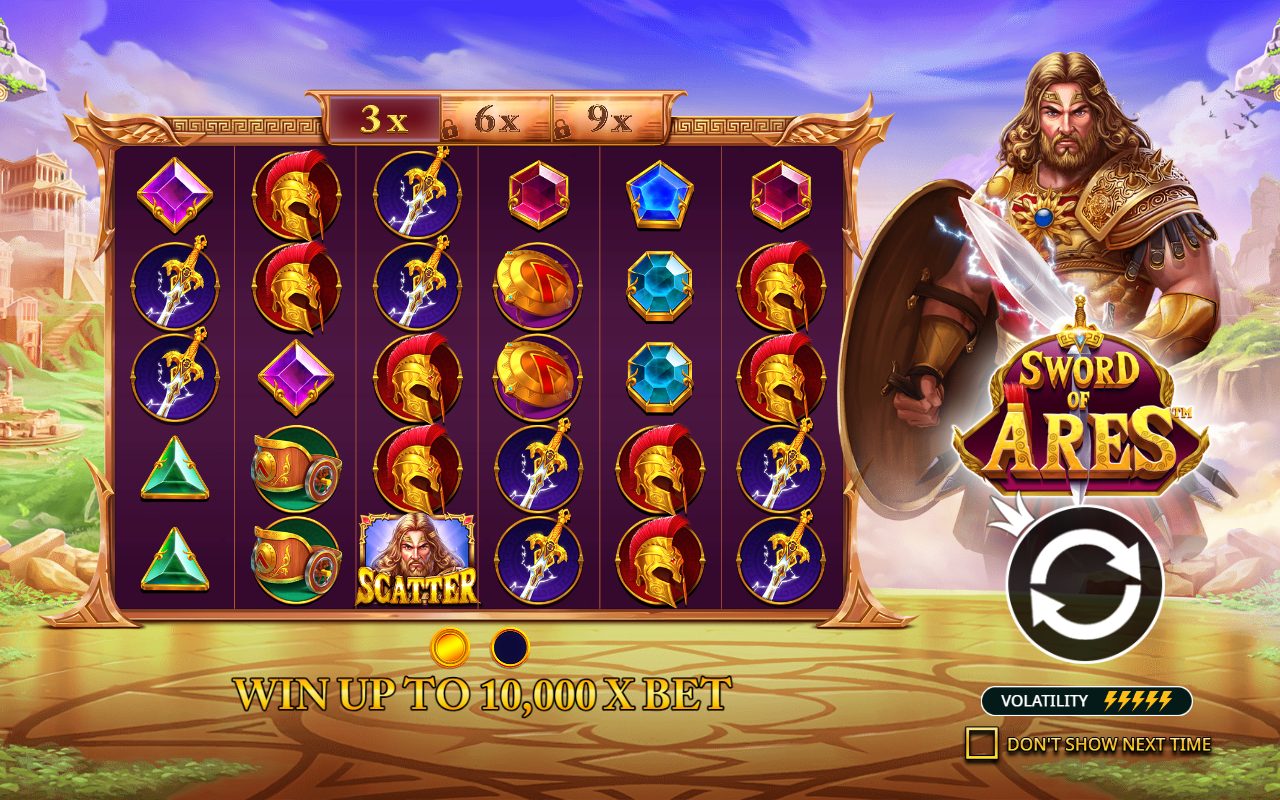
Volatility is rated 5 out of 5 on Pragmatic's own in-game scale, which puts Sword of Ares at the extreme end of the studio's catalogue. For context, Gates of Olympus shares similarly high volatility but caps at 5,000x — Sword of Ares doubles that ceiling to 10,000x. That extra upside comes at a cost: the structured multiplier unlock system means the largest wins require collecting 100 winning symbols within a single tumble sequence, a threshold that demands sustained chain reactions rather than a single fortunate spin.
The 10,000x max win is genuinely competitive by Pragmatic Play standards. Most of the studio's scatter-pay titles settle around 5,000x, making this one of the higher-ceiling releases in their portfolio. Whether a player can realistically approach that figure depends almost entirely on the free spins multiplier climbing toward 500x — base-game multipliers cap at 15x, which limits single-spin exposure significantly.
How Sword of Ares Plays: The 6x5 Grid and Tumble Mechanic
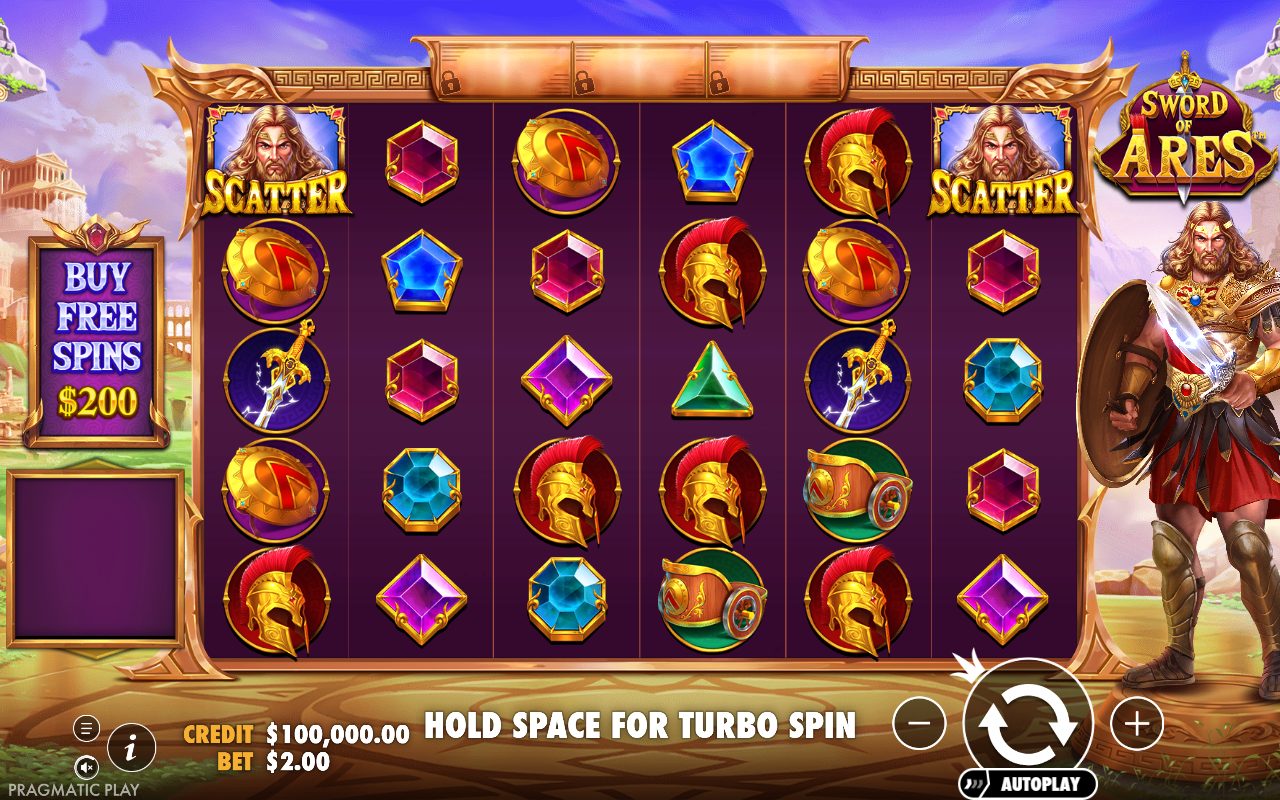
Sword of Ares runs on a 6-reel, 5-row grid with a Pay Anywhere system — no fixed paylines. Wins form when 8 or more matching symbols land anywhere on the grid simultaneously. Premium symbols pay between 5x and 20x stake for 12 or more matching symbols, which is a relatively standard pay table for this format. There are no wild symbols, consistent with most scatter-pay mechanics where the grid density compensates for their absence.
The Avalanche (Cascading) mechanic removes winning symbols and drops replacements from above, repeating until no new wins form. This is the engine that drives the multiplier collection system. Every winning symbol removed from the grid is counted toward the multiplier meter — the longer the cascade runs, the more symbols accumulate, and the higher the multiplier tier that unlocks. The mechanic creates a clear feedback loop: each cascade step either advances the meter or ends the sequence.
The base game features three multiplier tiers above the grid. The first unlocks at 20 collected symbols (x2, x3, or x4 — assigned randomly), the second at 50 symbols (x5 through x7), and the third at 100 symbols (x9 through x15). Only the highest unlocked tier applies to the total sequence win, not each individual cascade step. That distinction matters — a single long chain is far more valuable than several short ones that each reset the counter.
Bonus Features Breakdown
The free spins round is where Sword of Ares separates itself from the base game. Triggered by scatter symbols, it awards 15 free spins and expands the multiplier meter from three tiers to six. The collection thresholds scale up accordingly, but the multiplier values escalate dramatically — the top tier can reach 500x, compared to the 15x ceiling in the base game. That 33x jump in maximum multiplier is what makes the bonus round the primary vehicle for the 10,000x max win.
One notable difference from Gates of Olympus: the multiplier meter resets between free spins in Sword of Ares. In Gates of Olympus, the progressive multiplier carries over through the entire bonus round without resetting. Here, each free spin starts the collection counter from zero. That design choice reduces the probability of a single astronomical multiplier building across multiple spins, but it also means each spin has an equal shot at climbing the meter — a trade-off that feels more volatile in shorter bonus rounds.
The Buy Feature allows players to purchase direct access to the free spins round, bypassing the base game scatter trigger entirely. The Symbol Swap feature adds an additional layer by substituting symbols on the grid, which can accelerate collection counts during cascades. Four different symbol removal bombs are also available across base and bonus stages, providing additional ways to clear the grid and extend tumble sequences. Bets range from $0.20 to $100 per spin, giving the slot reasonable accessibility at the lower end.
Spindex Live Tracked-Bet Data
Sword of Ares has recorded approximately 3,000 tracked bets across Spindex's five crypto-casino data sources over the past 30 days. The current trend signal is cold — below the activity baseline we see for comparable high-volatility Pragmatic Play titles on our network. The top recent hit logged on Spindex came in at 728x stake, which is a solid single-session result but sits well below the theoretical ceiling and reflects the kind of mid-range outcome this volatility tier typically produces in short windows.
The 728x recent high is worth contextualising. At the game's maximum bet of $100, that translates to a $72,800 return — meaningful, but the 10,000x theoretical max at that stake would be $1,000,000. The gap between observed recent hits and the published maximum is expected given the small 30-day sample, but it does illustrate how rarely the top end of the distribution is reached in practice.
The cold trend signal may reflect the slot's age — released in October 2022, Sword of Ares has moved past its peak popularity window. SlotCatalog data shows it reached its highest recorded position of #4 in the Ukrainian market in October 2022, shortly after launch. On Spindex's network, newer Pragmatic Play releases are drawing more volume. Players hunting this title for the 10,000x potential will find it readily available but not currently riding a hot streak in our tracked data.
Multiplier Collection vs. Random Multiplier: The Core Design Trade-Off
The structured collection unlock system is the defining mechanic that distinguishes Sword of Ares from Gates of Olympus and Sweet Bonanza. In both of those titles, multipliers appear randomly — a high-value multiplier orb can land on any spin without warning, creating sudden unpredictable spikes. Sword of Ares removes that randomness entirely. You earn multipliers by accumulating winning symbols, which means the size of your win boost is directly proportional to how well the cascade is performing.
This creates a more legible session experience. You can see exactly how far along the meter you are and how much further you need to progress to unlock the next tier. There is a measurable sense of progression within each spin. The downside is that a cascade that stalls at 45 collected symbols — just short of the second tier threshold — is genuinely frustrating in a way that a random multiplier miss is not, because you can see exactly what you missed.
For players who find random multiplier systems opaque or unsatisfying, the collection mechanic is a genuine improvement. For players who enjoy the pure lottery feel of a random high multiplier dropping out of nowhere, Gates of Olympus will likely remain the preferred option. The 10,000x ceiling in Sword of Ares versus 5,000x in Gates of Olympus is a meaningful data point, but the path to that ceiling is longer and more conditional.
Who Should Play Sword of Ares
Sword of Ares is built for players who are comfortable with extended losing streaks in exchange for high-upside bonus rounds. The 5/5 volatility rating is not marketing language — the base game can run cold for many spins before a meaningful cascade develops, and even a triggered free spins round may not produce a large win if the multiplier meter fails to climb past the first or second tier.
The Buy Feature makes this slot particularly relevant for players who want to skip base-game variance entirely and go directly to the free spins round. At $0.20 minimum bet, the cost of the feature is accessible, though at higher stakes it represents a significant upfront commitment. Players who prefer grinding the base game for a natural trigger will need patience — the Pay Anywhere system provides frequent small wins, but the structured multiplier requires sustained chains to produce meaningful returns.
Players who have already spent time with Gates of Olympus and want to try a mechanically distinct but thematically adjacent slot will find Sword of Ares a natural next step. The doubled max win and the collection system give it a different risk-reward profile, and the 6x5 grid feels slightly more open than some of Pragmatic's earlier scatter-pay layouts. It is not a beginner-friendly slot by any reasonable measure.
Final Verdict
Sword of Ares delivers a technically sound high-volatility scatter-pay slot with a multiplier mechanic that rewards sustained cascade performance rather than random fortune. The 10,000x max win is the studio's highest in this format at time of release, and the six-tier multiplier system in free spins — reaching up to 500x — gives the bonus round genuine upside that justifies the volatility rating.
The 95.4% deployed RTP is the main caveat. It is below the headline 96.4% figure and below the Pragmatic Play scatter-pay average for top-tier configurations. Players should verify which RTP version their chosen casino runs before depositing. The cold trend on Spindex's live data suggests the slot is past its peak engagement window, but the mechanics remain intact and the game is widely available across crypto and fiat casinos.
One honest observation: the multiplier reset between free spins, compared to Gates of Olympus where the progressive multiplier accumulates across the entire bonus, does reduce the ceiling in practice even if the theoretical max is higher. The base game pacing can drag noticeably before a qualifying cascade develops. For players who know what they are buying — a structured, high-variance experience with a clear multiplier progression — Sword of Ares is a well-executed slot that holds up two years after release.
- +10,000x max win — double the Gates of Olympus ceiling
- +Structured multiplier collection system adds session legibility
- +Free spins multiplier reaches up to 500x
- +Buy Feature available for direct bonus access
- +6x5 Pay Anywhere grid with four symbol removal bombs
- +Minimum bet of $0.20 keeps it accessible at lower stakes
- -Deployed RTP of 95.4% is below the published 96.4% top-tier figure
- -Multiplier meter resets each free spin (unlike Gates of Olympus)
- -5/5 volatility means extended base-game dry spells are common
- -No wild symbols
- -Currently trending cold on Spindex tracked-bet data
Best for
Sword of Ares is a high-volatility scatter-pay slot with a genuinely different multiplier mechanic to its Pragmatic Play stablemates. The 10,000x ceiling is the headline, but the structured collection system means big wins require sustained tumble chains rather than a single lucky symbol drop. At 95.4% RTP it sits below the top-tier figure — factor that in before committing real money. Best suited to patient, high-variance players.