


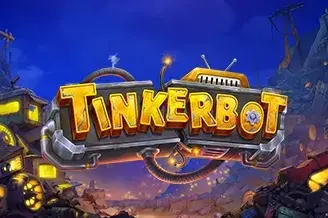


Tinkerbot Review
ELK Studios opened 2025 with Tinkerbot, a cluster-pays slot built around a mechanical robot that dismantles, transforms, and multiplies symbols across an expandable 5x5 grid. Released on 22 January 2025, it follows the studio's late-2024 run of Shadow Shifter and Cygnus 5 — and it brings the same feature-dense philosophy to a post-apocalyptic scrapyard setting.
The headline numbers: a 10,000x max win, medium volatility, and a 29.9% hit frequency that keeps the base game active. The published RTP sits at 94%, which is a known characteristic of ELK Studios titles rather than an outlier. That lower RTP is the trade-off for a feature stack that includes cascading clusters, Botbox modifiers, a progressive multiplier, grid expansion up to 7x7, two distinct free spins modes, and a five-tier X-iter bonus buy menu.
Bets run from $0.20 to $100, making Tinkerbot accessible across bankroll sizes. The cluster-pays engine means there are no fixed paylines — wins form when five or more matching symbols connect horizontally or vertically.
How Tinkerbot Plays
Tinkerbot runs on a 5x5 cluster-pays grid where wins require five or more matching symbols to connect. Every winning cluster triggers a cascade: matched symbols are removed, remaining symbols fall downward, and new ones drop in from above. Cascades chain for as long as new clusters keep forming, which is the core engine that makes the 29.9% hit frequency feel meaningful — it's not just a single win per spin, it's a sequence.
The grid itself is not fixed. An Expand Grid feature can activate up to twice per spin, growing the play area first to 6x6 and then to a full 7x7. That expansion directly increases the number of symbols in play and raises the ceiling for how many clusters can form in a single cascade chain. It's one of the more consequential modifiers in the slot because it doesn't just add a visual flourish — it structurally changes the win potential of every spin it touches.
The base game pacing can feel slow before the Botbox modifiers start firing, particularly in sessions where scatter symbols don't appear early. Once the modifiers activate, though, the game shifts pace quickly. Medium volatility means the swings are manageable, and the 29.9% hit rate keeps dead spins from stacking up for long stretches.
The Botbox System Explained
The Botbox is Tinkerbot's central mechanic. Whenever a cluster explodes in a cascade, a Botbox symbol can appear in one of the vacated positions. These symbols are sticky — gravity doesn't move them. When three or more Botboxes are simultaneously on the grid at the end of a spin resolution, they activate, each triggering one of several distinct features.
The feature set is wide. Botboxes can become Wilds or Hot Wilds, where Hot Wilds carry a blue swirl indicator and convert a random number of additional symbols across the board into wilds. They can generate a Multiplier that stacks additively in a dedicated display on the grid's left side, applying to every winning cluster in that spin. A Button Botbox activates either an Absorb feature — which collects all instances of one connected symbol type into a single Multisymbol — or a Transform feature, which converts all instances of one symbol type into another across the entire grid. There is also a Multisymbol feature that drops multiple instances of a symbol into a single cell, treating them as a potential cluster and then detonating to clear nearby regular symbols.
Separately, an Instant Botbox can appear at any point and activates its feature immediately, bypassing the three-Botbox threshold. This is the mechanism that makes the base game feel genuinely unpredictable rather than formulaic. The interaction between Botbox features, cascades, and the expanding grid creates a system where individual spins can escalate rapidly — or resolve quietly, depending on which features fire and in what order.
RTP, Volatility, and Max Win
The published RTP for Tinkerbot is 94%. That figure is accurate and consistent with ELK Studios' broader catalogue — the same 94% appears across Cygnus 5, Pirots 3, and several other ELK titles. It's a studio-level decision rather than a slot-specific one, and it's worth contextualising against the wider market: the industry standard for video slots sits around 96%, and studios like Play'n GO and Pragmatic Play regularly publish RTPs of 96.2%–96.5% on comparable feature-heavy releases. Tinkerbot's 94% means the house edge is roughly double that of a 96% slot, and that compounds over volume.
Volatility is rated medium, which aligns with the 29.9% hit frequency. Nearly one in three spins produces some kind of return in the base game, which is a notably active rate for a cluster-pays slot — for comparison, many high-volatility cluster games sit in the 20%–25% hit frequency range. The medium volatility and higher hit rate suggest the slot is designed to sustain session length rather than deliver infrequent large payouts.
The max win is 10,000x the total bet. That's a strong ceiling for a medium-volatility slot and is reached via the combination of stacked multipliers, the 7x7 expanded grid, and a sustained cascade chain — most likely during Super Free Drops. It's achievable in theory but requires the full system to align, which is the nature of any slot with a layered modifier structure.
Free Drops and Super Free Drops
Tinkerbot has two free spins modes, triggered by scatter symbols. Landing three scatters simultaneously activates Free Drops, awarding 7 free spins. Any multiplier value accumulated in the base game, the current grid size, and any unactivated Botboxes carry over into the bonus — they persist for the entire duration rather than resetting between spins. That persistence is significant: a multiplier that reaches 5x or 6x in the base game before the bonus triggers starts the free spins already amplified.
Landing four scatters simultaneously launches Super Free Drops, which begins with 9 free spins, starts at the maximum 7x7 grid size, and opens with a boosted multiplier feature. Additional scatters landing during Super Free Drops add further free spins to the remaining count. The combination of the expanded grid, the boosted multiplier, and the carry-over Botboxes makes Super Free Drops the primary route to the slot's highest win values.
The distinction between the two modes is meaningful enough to change how players approach the X-iter menu. Free Drops is the accessible bonus tier; Super Free Drops is the high-ceiling version. Both modes retain the full Botbox feature set, meaning every cascade during free spins can still trigger Absorb, Transform, Wild, and Multiplier effects — the bonus rounds are not simplified versions of the base game.
Who Tinkerbot Is Best For
Tinkerbot is built for players who want a mechanically complex slot with multiple interacting systems rather than a straightforward spin-and-collect experience. The Botbox modifier chain, the expanding grid, the two-tier free spins structure, and the additive multiplier all require attention to follow — the source material notes the game can be difficult to track at first, and that's an honest assessment. First sessions will involve learning which features do what before the full system clicks.
The medium volatility and 29.9% hit frequency make it a reasonable fit for mid-session play where bankroll management matters. It's not a high-volatility grind that demands deep pockets to reach the bonus, but the 94% RTP does mean the theoretical return per dollar wagered is lower than most comparable releases. Players who are sensitive to RTP as a primary criterion may prefer ELK titles with comparable feature sets — though it should be noted that ELK publishes 94% consistently across its catalogue, so this is a studio choice rather than something unique to Tinkerbot.
The $0.20 minimum bet makes the slot accessible at low stakes, and the X-iter menu at 100x–500x stake gives high-stakes players a direct route to the bonus modes without grinding the base game. The slot covers a wide range of play styles within that $0.20–$100 bet range.
Final Verdict
Tinkerbot delivers on ELK Studios' reputation for feature-dense, mechanically inventive slots. The Botbox system is genuinely creative — the combination of symbol transformation, grid expansion, sticky modifiers, and additive multipliers gives the slot a distinct identity within the cluster-pays format. The 10,000x max win is credible given the full system, and the dual free spins modes with persistent multipliers provide a clear escalation path.
The 94% RTP is the primary consideration. It's not a hidden flaw — ELK publishes it openly and it applies across their catalogue — but it is a real cost over volume compared to the 96%+ standard at studios like NetEnt or Relax Gaming. Players who accept that trade-off in exchange for a richer feature set will find Tinkerbot one of the more interesting cluster slots released in early 2025. Players who prioritise RTP above feature complexity should look elsewhere in the catalogue.
For the right player, Tinkerbot is a strong release. The mechanics are well-constructed, the bonus modes have genuine depth, and the X-iter menu adds flexibility that many competing slots lack.
- +10,000x max win with a credible route via Super Free Drops and stacked multipliers
- +Botbox modifier system creates genuine unpredictability on every cascade
- +Grid expands up to 7x7, structurally increasing win potential mid-spin
- +Two distinct free spins modes with persistent multipliers and grid size carry-over
- +Five-tier X-iter bonus buy menu covers entry-level to premium access
- +29.9% hit frequency keeps base game sessions active
- +Wide bet range: $0.20 to $100
- -94% RTP is below the 96%+ standard at many competing studios
- -Feature system has a learning curve — early sessions can be difficult to follow
Best for
Tinkerbot is a mechanically ambitious cluster slot with a lot happening on every cascade. The 10,000x ceiling is competitive, the dual free spins modes with persistent multipliers add genuine replay value, and the X-iter menu gives players direct access to every bonus tier. The 94% RTP is the one number that needs to sit comfortably with you before you commit — it's consistent with ELK's wider catalogue but below the 96%+ standard at many competing studios.