









Dungeon Quest Review
Nolimit City released Dungeon Quest back in October 2018, predating the studio's later high-volatility reputation by several years. What you get here is a 5-reel, 7-row grid running 29 bothway paylines — an unusually tall layout for its era — paired with medium volatility and a 96.27% RTP that sits comfortably above the industry average. The feature set leans on sticky wilds, random wilds, symbol swaps, and a free spins round to do the heavy lifting, rather than the extreme multiplier mechanics Nolimit City would later become known for. Max win data isn't publicly disclosed for this title, which is worth flagging before you set expectations. Spindex has tracked 143 bets on Dungeon Quest across our crypto-casino sources in the last 30 days, with a top recorded hit of 229x — modest numbers that fit the medium-variance profile. The fantasy theme covers elves, wizards, warriors, and gem imagery across that tall grid. This review breaks down exactly how the math model and feature set interact, and whether the slot still earns a session in 2024.

RTP, Volatility, and the Missing Max Win
At 96.27%, Dungeon Quest's RTP sits roughly 0.77 percentage points above the widely-cited 95.5% industry floor, which is a meaningful edge compounded over long sessions. Nolimit City also lists an RTP range feature, meaning some casino operators may deploy a lower variant — always check the in-game paytable or your casino's game info panel before playing.
Volatility is rated medium, which for a 5x7 grid with 29 bothway paylines generally translates to regular small-to-mid returns punctuated by occasional feature-driven spikes. The bothway mechanic means wins pay left-to-right and right-to-left simultaneously, effectively doubling the number of active win directions without requiring additional paylines.
The one significant transparency gap is the max win: Nolimit City has not published a confirmed multiplier ceiling for this title. That matters because modern Nolimit releases like Tombstone RIP (100,000x) and San Quentin xWays (150,000x) have set aggressive benchmarks. Dungeon Quest's 2018 architecture almost certainly operates on a far more conservative ceiling, but players deserve a confirmed number. Until that data is available, treat the top-end potential as unknown rather than spectacular.
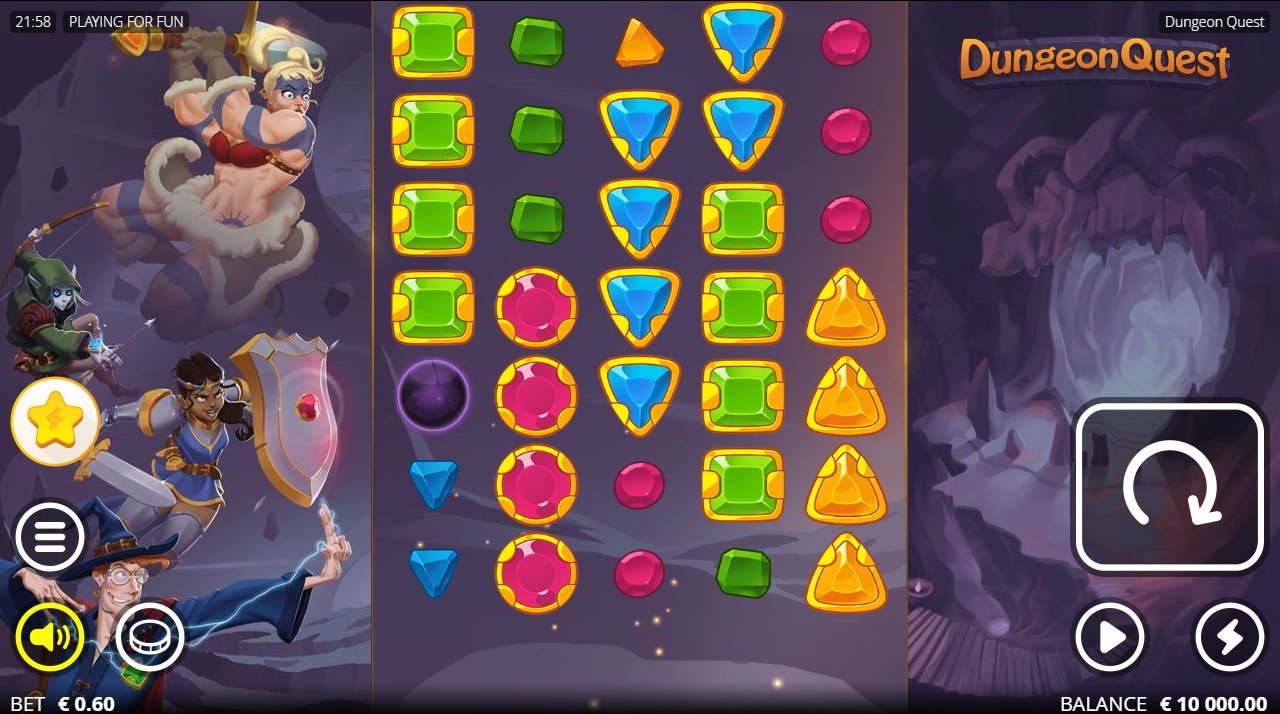
How Dungeon Quest Plays on the 5x7 Grid
The 5x7 layout gives Dungeon Quest 35 symbol positions per spin — significantly more real estate than a standard 5x3 grid. With 29 bothway paylines active, the game generates win opportunities across both directions on every spin, which contributes to the medium-volatility feel: you're rarely spinning through long dead streaks in the base game.
Bet sizing runs from $0.20 to $100 per spin, covering recreational and mid-stakes players comfortably. The $0.20 floor makes it accessible for free-spin bonus hunters who want to stretch session length, while the $100 ceiling is adequate for most casual high-rollers, though serious high-stakes players may find it limiting compared to providers that allow $500+ bets.
The tall grid also means symbol swap mechanics have more positions to work with, and random wild drops across 35 positions carry more weight than they would on a smaller layout. Base-game pacing feels steady rather than volatile — which is either a strength or a weakness depending on what you're after.
Bonus Features Breakdown
Dungeon Quest's feature stack includes wilds, sticky wilds, random or additional wilds, scatter symbols, symbol swap, and a free spins round. That's a reasonably deep toolkit for a 2018 release, and the interaction between sticky wilds and symbol swap is where most of the variance lives.
Sticky wilds lock in place for subsequent spins, building multi-wild configurations across the 5x7 grid. When random wilds drop into positions adjacent to existing stickies, the coverage can expand quickly. Symbol swap adds another layer: specific symbols convert to higher-value targets, which on a 35-position grid can shift payout values substantially within a single feature sequence.
The free spins round is triggered by scatter symbols and is where the sticky wild mechanic becomes most consequential. Wilds that land during free spins remain fixed for the duration of the round, meaning late-trigger wilds in a long free spins sequence contribute less than early ones — a timing element that adds a small degree of variance to otherwise predictable free spins math. There is no published bonus buy option for Dungeon Quest, so free spins access is organic only.
Spindex Live Tracked-Bet Data
Across Spindex's five crypto-casino tracking sources, Dungeon Quest recorded 143 bets in the past 30 days. That's a low-activity footprint — for context, current trending titles on our hot-slots tracker regularly pull 2,000+ monthly bets. Dungeon Quest is a 2018 release competing in a catalog that has grown dramatically, and the numbers reflect its age.
The top recorded hit in that sample was 229x — consistent with medium-volatility expectations and well within what the sticky wild plus free spins structure can produce without an exceptional run. It's not a number that signals a cold or broken game; it simply confirms this isn't a title where players are chasing four-figure multipliers.
For players who prefer verified real-money behavior data over theoretical specs, the 229x ceiling on a 143-bet sample is a useful anchor. It suggests the game is performing within its stated medium-variance profile rather than running above or below expectations. Low tracked volume also means Spindex's hit distribution data for this slot is less statistically robust than for higher-traffic titles — something to factor in if you're using our data to inform session strategy.
Nolimit City Context: Where Dungeon Quest Fits in the Catalog
Dungeon Quest was released in October 2018, a period when Nolimit City was still establishing its identity. The studio's later signature — extreme volatility, xWays mechanics, and cinematic themes with five-figure max wins — wasn't yet fully formed. Dungeon Quest represents an earlier, more conservative design philosophy from the same provider.
Comparing directly: Nolimit City's Deadwood (2020) carries a 138,000x max win and high volatility; Dungeon Quest's undisclosed ceiling and medium volatility occupy a fundamentally different risk tier. If you're coming to Dungeon Quest expecting the mechanical intensity of San Quentin or Tombstone RIP, the experience will feel noticeably subdued. That's not a flaw — it's a different product from a different era of the studio's output.
The 96.27% RTP is actually slightly above Nolimit City's more recent studio average, which tends to cluster around 96.00–96.10% for standard variants. On pure RTP grounds, Dungeon Quest holds its own against newer releases, even if the mechanical complexity doesn't match.
Who Should Play Dungeon Quest
Medium-volatility players who prioritize RTP over max-win potential are the natural audience here. The 96.27% return rate, bothway paylines, and 5x7 grid create a session profile where bankroll erosion is slower than on high-volatility titles, and the sticky wild mechanic gives the base game enough texture to stay engaging between free spins triggers.
Players building familiarity with Nolimit City's catalog may also find Dungeon Quest a useful low-pressure entry point before moving to the studio's more demanding high-variance releases. The feature logic — sticky wilds accumulating across a tall grid — is conceptually similar to mechanics in later Nolimit titles, just without the extreme multiplier architecture.
High-volatility chasers and bonus-buy users should look elsewhere in the Nolimit library. The absence of a confirmed max win, no bonus buy option, and medium variance make this a poor fit for players whose strategy depends on infrequent but massive payouts.
Final Verdict on Dungeon Quest
Dungeon Quest is a competent, honest medium-volatility slot that has aged reasonably well on the strength of its RTP and grid architecture. The 96.27% return, 29 bothway paylines across a 5x7 layout, and a sticky wild plus symbol swap feature set give it a functional identity that doesn't rely on hype or inflated max-win promises.
The two legitimate criticisms are the undisclosed max win ceiling — which is a transparency issue regardless of era — and the lack of a bonus buy feature, which limits flexibility for players who want direct access to the free spins round. Spindex's live data showing a 229x top hit on 143 tracked bets confirms the game is performing as a medium-variance title should, without any unusual behavior in either direction.
For the right player profile, Dungeon Quest remains a worthwhile session. It won't generate the headline wins that newer Nolimit releases chase, but it delivers a stable, above-average RTP experience with enough feature interaction to justify the time.
- +96.27% RTP is above the industry average and above many Nolimit City newer releases
- +5x7 grid with 29 bothway paylines generates frequent win opportunities
- +Sticky wilds plus symbol swap create meaningful base-game texture
- +Wide bet range ($0.20–$100) suits most player budgets
- +Medium volatility keeps session variance manageable
- -Max win ceiling is not publicly disclosed
- -No bonus buy feature available
- -Low tracked-bet volume on Spindex limits statistical confidence in live data
- -Mechanically outclassed by Nolimit City's post-2020 catalog
- -RTP range feature means some casinos may deploy a lower-return variant
Best for
Dungeon Quest is a solid medium-volatility release from Nolimit City's earlier catalog. The 96.27% RTP is genuinely player-friendly, the 5x7 bothway grid creates decent hit frequency, and the sticky wild plus symbol swap combo keeps base-game sessions from going completely cold. The undisclosed max win ceiling is the main caveat — without that number, high-variance chasers should look elsewhere in the Nolimit library.