





Ace Of Spades Review
Play'n GO released Ace of Spades back in November 2012, and it has outlasted dozens of flashier titles simply by doing very little — deliberately. This is a 3-reel, single-payline classic slot with a card-suit theme, a bet range of $0.25 to $15.00, and a mechanic built almost entirely around one symbol: the ace. That ace acts as a wild, doubles your payout when one appears in a winning combination, quadruples it when two appear, and pays a flat 2,500 credits when three land together on a maximum coin bet. There is no free spins round, no scatter, no cascading grid — just a single line and a multiplier system that has aged better than most of its contemporaries. The RTP sits at 93.99%, which is below the modern industry standard of 96%, and medium volatility means neither extreme patience nor extreme bankroll is required. Whether this stripped-back format still earns its place in 2024 depends heavily on what you want from a session — and this review breaks that down with live Spindex tracking data included.
RTP, Volatility, and What the Numbers Actually Mean
The headline number to flag immediately is the 93.99% RTP. For context, the current Play'n GO portfolio average sits closer to 96.20%, and most modern classic slots from competing studios — Relax Gaming's Money Train series aside — target 96% or above. That 2+ percentage point gap is not trivial over extended play; on a $10 session it represents roughly $0.20 more expected cost per $10 wagered compared to a 96% game. Players should go in with eyes open.
Volatility is rated medium, which is a reasonable fit for a single-payline structure. Without scatter pays or multi-line coverage, a low-volatility classification would require hit rates that are nearly impossible to sustain on one line. Medium here means wins arrive at irregular but not punishing intervals, and the ace multiplier system creates natural variance spikes without pushing the game into high-volatility territory.
The max win is not publicly disclosed, which is unusual by modern standards — most providers now publish a certified ceiling. The 3-aces combination pays 2,500 credits at max coins, which at the $15 maximum bet translates to a concrete but modest absolute payout. For comparison, Play'n GO's own Book of Dead carries a 5,000x max win ceiling, making Ace of Spades a significantly lower-ceiling product even within the same provider's catalogue. That is not a flaw for the audience it targets, but it is worth understanding before you sit down.
How Ace of Spades Plays
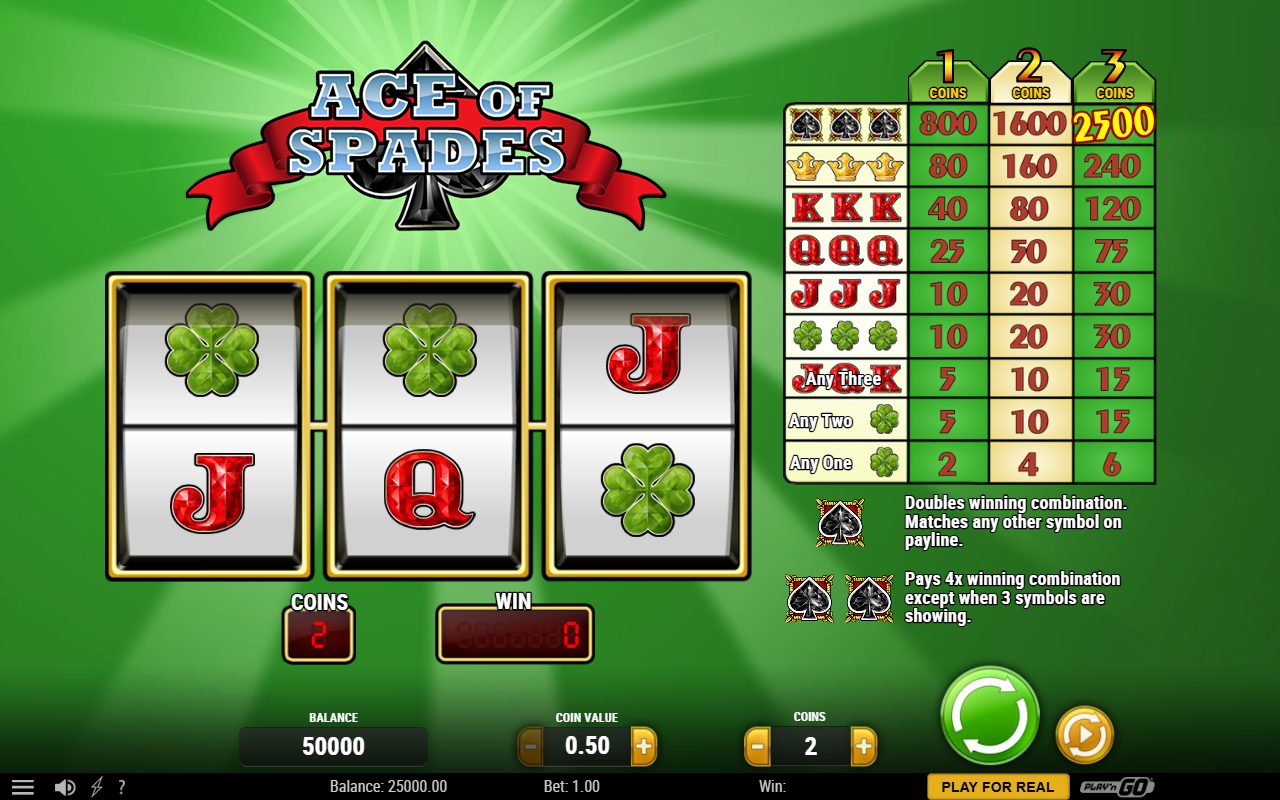
The layout is as minimal as it gets: three reels, one row, one payline. Symbols are drawn from classic card-suit and casino iconography — clubs, diamonds, hearts, crowns, clovers — with the ace of spades sitting above all of them as the wild. Bets run from $0.25 to $15.00 per spin, and the coin structure affects the 3-aces jackpot payout, so betting maximum coins is relevant if that combination is your target.
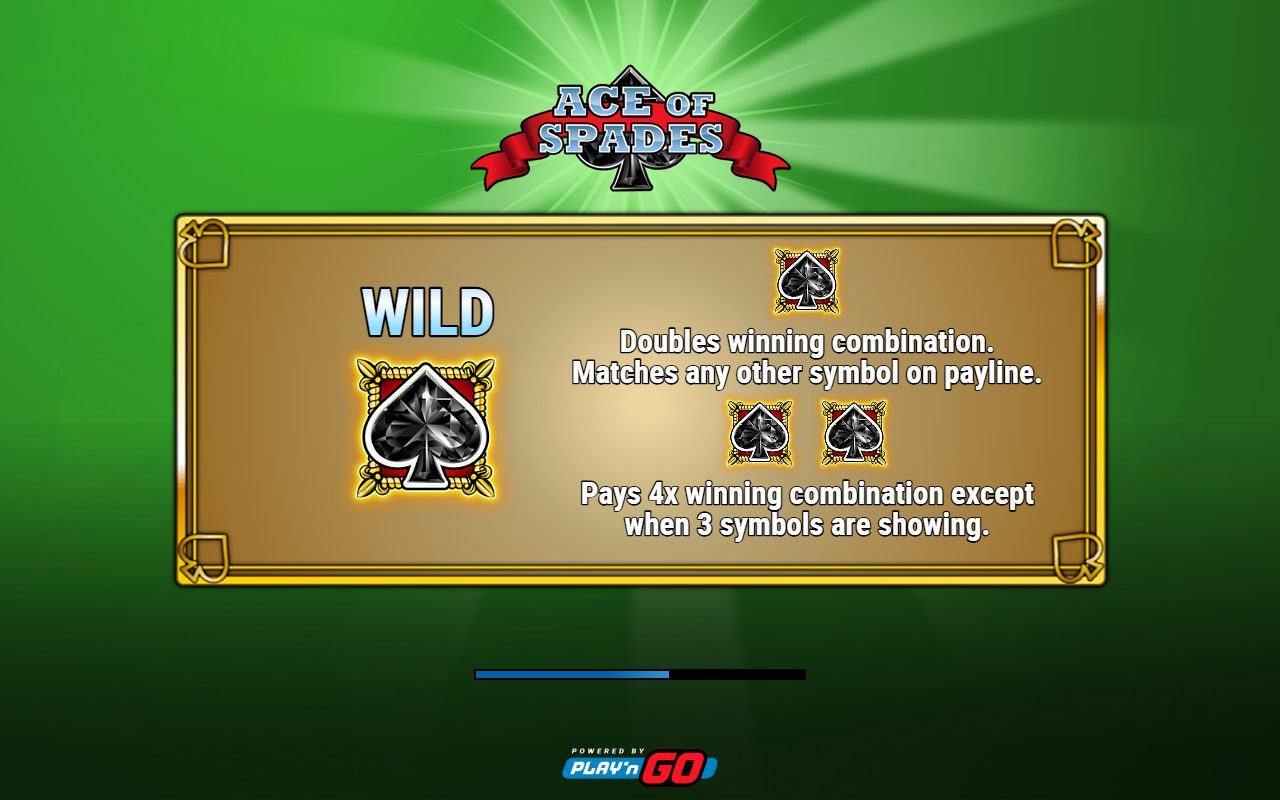
The wild mechanic is where all the game's personality lives. A single ace substituting into a winning combination doubles the standard prize for that line. Two aces substituting into the same combination quadruple it. Three aces on the payline pay the 2,500-credit jackpot outright rather than applying the multiplier formula. It is a clean, internally consistent system — one that a player can fully understand in about 30 seconds, which is precisely the point.
Base game pacing is slow by modern standards, and without a bonus trigger there is no secondary objective pulling you through dry spells. Sessions are essentially a pure test of whether the multiplier mechanic fires often enough to stay interesting. For some players that focus is a feature; for others it will feel flat after a few hundred spins.
Bonus Features: The Wild Ace Multiplier System
Ace of Spades has two listed features: substitution symbols and an RTP range mechanic. The substitution system is the ace wild described above — it is the game's only bonus mechanic, and it carries the full weight of the feature set.
One ace in a winning combination: prize doubled. Two aces in a winning combination: prize quadrupled. Three aces: flat 2,500-credit jackpot at maximum coins. The escalation is proportional and easy to track. There is no ambiguity about what fires or when, which is refreshing compared to modern slots where bonus rules sometimes require a second read of the paytable.
The RTP range listing suggests the return figure may vary depending on the casino's configuration — a common Play'n GO practice where operators can select from a range of certified RTP settings. The published 93.99% is likely the lower end of that range. Some casinos may offer a higher setting, though this is rarely advertised openly. It is worth checking the in-game paytable or casino's game rules page if you want to confirm which RTP version is active at your specific site.
Live Spindex Tracking Data
Ace of Spades has logged 126 tracked bets across our five crypto-casino sources over the past 30 days. That is a low-volume figure — most active slots on Spindex generate several thousand tracked bets per month — but it is not zero, and for a 2012 three-reel classic it signals a persistent niche audience rather than genuine player interest fading out.
The top recent hit recorded on Spindex is 25x. At the $15 maximum bet that represents a $375 return on a single spin — a solid session win, but far from the headline numbers that high-volatility modern slots generate on our tracker. The 25x ceiling observed in live data is consistent with a medium-volatility single-payline structure where the multiplier system caps natural variance.
The low bet volume does have one practical implication: Ace of Spades is not a slot where Spindex's trend signal is strong enough to call a hot or cold streak with confidence. The sample is thin. What the data does confirm is that real money play is still happening, primarily from players who appear to favour simplicity and low minimum bets — the $0.25 floor makes it one of the more accessible entries on our tracked list.
Bet Range and Bankroll Considerations
The $0.25 minimum bet is genuinely accessible and suits short, low-stakes sessions well. At that level, a $20 deposit gives you 80 spins at minimum bet — enough to see the wild mechanic fire a reasonable number of times before making a judgment on the session.
The $15 maximum bet is modest by modern standards. High-roller players who routinely bet $50–$100 per spin on titles like Wanted Dead or a Wild will find the ceiling limiting. But for the audience this slot actually serves — casual players and classic-slot enthusiasts — the range is appropriate.
One structural note: the 2,500-credit jackpot for three aces is tied to a maximum coin bet, so there is a mild incentive to play at higher stakes if chasing that specific outcome. At $15 maximum, the payout is fixed at 2,500 credits regardless of how that translates to your currency denomination, so confirm the coin value in the paytable before assuming the jackpot figure in dollars.
Who This Slot Is Best For
Ace of Spades has a clearly defined audience: players who prefer mechanical simplicity over feature complexity. If a 20-minute session of spinning a single line with one clear wild mechanic sounds preferable to navigating a bonus buy, a scatter system, and three different free spins modes, this slot delivers exactly that.
It also works as a palate cleanser. After extended sessions on high-volatility titles — where the gap between bonus triggers can run into hundreds of spins — a game with no trigger to wait for removes that particular tension entirely. You are just playing the line.
The 93.99% RTP is the main reason to hesitate. Players who are disciplined about RTP and typically stick to 96%+ titles are giving up meaningful expected value here. The slot is not recommended for extended grinding sessions at any bet level for that reason. Short, low-stakes play is where the format makes the most sense mathematically.
Final Verdict
Ace of Spades is a competent, honest classic slot that has not pretended to be anything other than what it is since 2012. The wild ace multiplier system — double for one, quadruple for two, jackpot for three — is clean design that holds up. Play'n GO built something that does its job without excess.
The 93.99% RTP is the number that shapes the recommendation. It is 2+ percentage points below the Play'n GO portfolio average and below what most serious players accept as a baseline. That cost compounds over time. For short sessions and low bets, it is manageable. For regular play, it is a real drawback.
Spindex tracking puts this at 126 bets over 30 days and a top hit of 25x — low volume, modest ceiling, but genuine ongoing activity. It still has an audience. That audience knows exactly what they are getting, and for them, Ace of Spades still delivers.
- +Wild ace multiplier system is mechanically clean and easy to understand
- +Minimum bet of $0.25 makes it accessible for low-stakes play
- +No complex bonus triggers — straightforward single-payline structure
- +Medium volatility suits the single-line format well
- +Still actively played across crypto casinos per Spindex tracking
- -93.99% RTP is notably below the modern 96% industry standard
- -No free spins, bonus round, or scatter mechanic
- -Max win ceiling is undisclosed and observed live data tops out at 25x
- -Maximum bet of $15 limits high-roller appeal
- -Low Spindex bet volume means trend data is thin
Best for
Ace of Spades is a no-frills 2012 classic that trades feature depth for mechanical simplicity. The wild ace multiplier system is genuinely elegant, but the 93.99% RTP is a real cost over time. Best suited to low-stakes sessions or players who find modern slots overstimulating. Spindex tracking shows modest but steady activity — it still has a loyal audience.