





Contact Review
Play'n Go launched Contact on 28 March 2019, and it remains one of the studio's more mechanically distinct releases. Built on a 5x7 grid with cluster pays rather than fixed paylines, it layers an avalanche mechanic on top of a progressive level-up system that rewards players who can build winning clusters across multiple rows. The result is a slot where a single spin can cascade into a multi-row event with stacked multipliers — but those moments are genuinely rare given the high volatility rating.
The tension between the game's ambition and its 1517x max win ceiling is the central story here. High-variance slots typically justify the dry spells with ceiling-busting potential, and 1517x is modest by that standard. For context, Play'n Go's own Reactoonz — a broadly comparable cluster-pays title — reaches 4,570x, making Contact's cap look conservative for the risk level it demands. Whether the dual free spins structure and escalating multiplier rows compensate for that gap is what this review addresses.
How Contact Plays: Grid, Clusters, and the Avalanche Twist
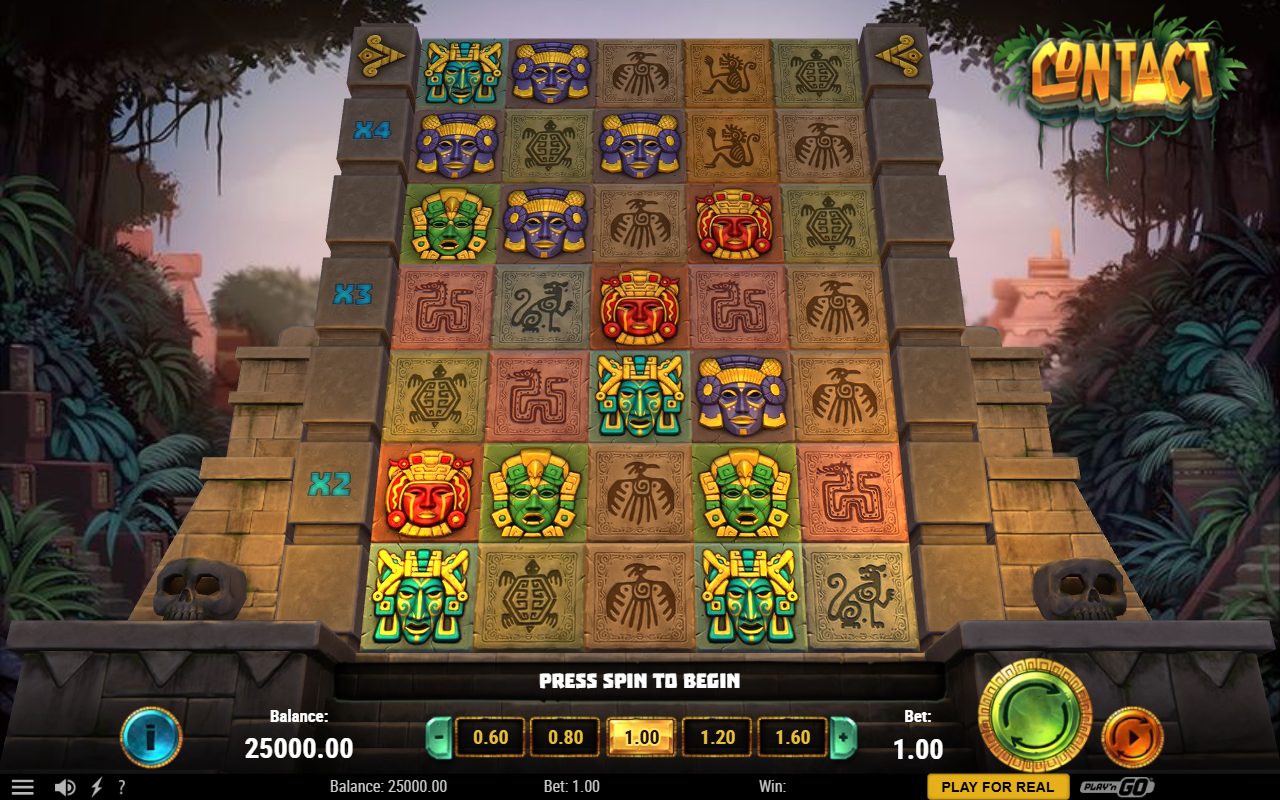
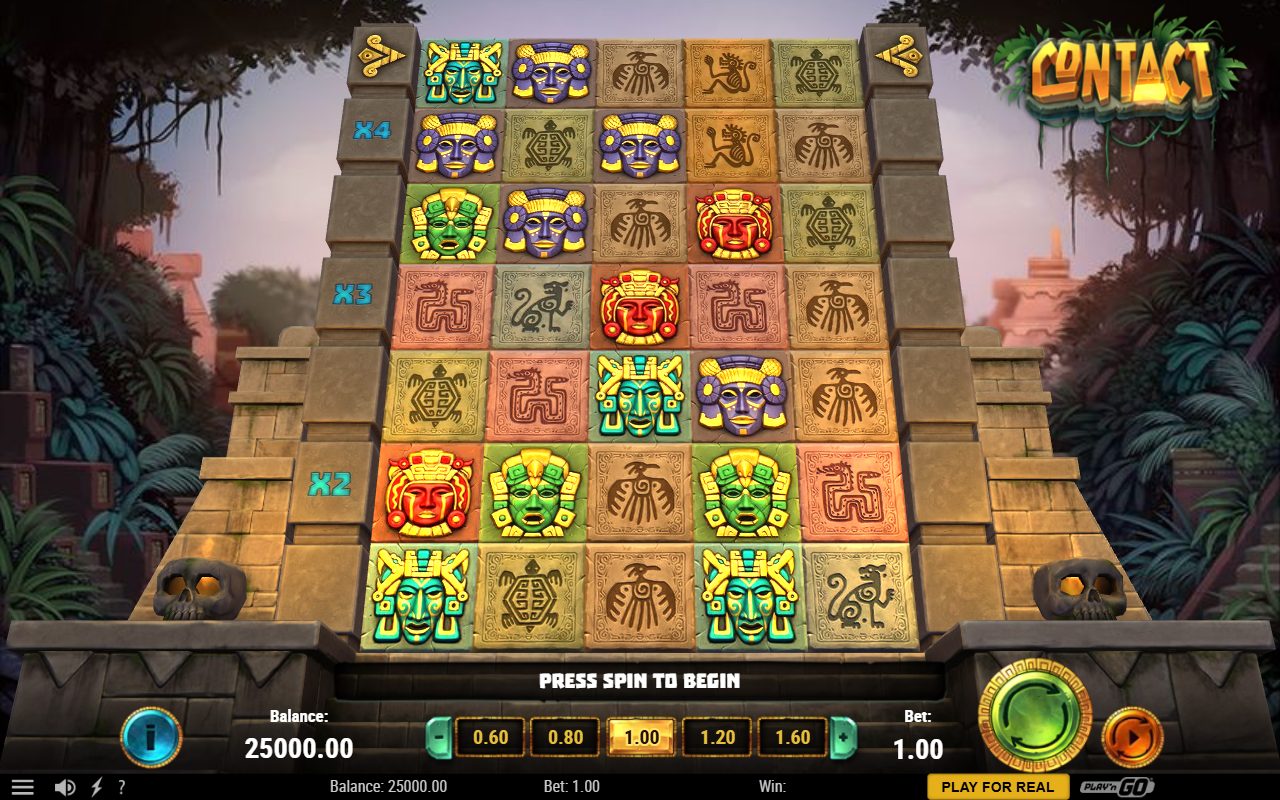
Contact runs on a 5-reel, 7-row grid using cluster pays rather than traditional paylines. A winning cluster forms when five or more matching symbols connect horizontally or vertically anywhere on the grid. That part is familiar territory for anyone who has played cluster-pays titles.
Where Contact departs from the standard avalanche template is in what happens after a win. Most avalanche slots remove winning symbols and drop new ones into the gaps. Contact inverts that logic: the winning symbols stay locked in place, while the non-winning symbols are cleared away. New symbols then fall into the vacated positions, giving the locked winners a chance to grow into larger clusters. This continues as long as new connections keep forming, making each cascade feel more like a construction project than a simple refill.
The 7-row height is not cosmetic. The grid's vertical depth is what makes the level-up mechanic meaningful — rows 2, 4, and 6 each carry multiplier thresholds that only become relevant if a cluster climbs high enough to fill them. On shorter grids this kind of progression system would have nowhere to go. Here, a single sustained cascade can travel the full height of the board, which is the core fantasy the game is selling.
RTP, Volatility, and Max Win: The Numbers That Matter
Contact carries a 94.55% RTP, which sits below the industry standard of 96%. Play'n Go operates an RTP range on this title, meaning some casino configurations may offer a higher return — the spec data confirms an RTP range feature is present. Players should check their specific casino's published RTP for Contact before committing significant session budgets, since the difference between the floor and ceiling configurations can meaningfully affect long-run return.
Volatility is rated high, which aligns with the cluster-pays structure. Winning clusters large enough to trigger the level-up rows are not frequent occurrences, and the base game can run through extended quiet stretches before a meaningful cascade develops. Hit frequency data is not publicly available for this title, which makes it harder to quantify the dry-spell risk precisely.
The 1517x maximum win is the figure that deserves the most scrutiny. High-volatility cluster-pays slots from the same era routinely offer 3,000x to 5,000x ceilings — Play'n Go's own Reactoonz reaches 4,570x on a comparable mechanic. Contact's cap at 1517x means the worst-case scenario (long losing streaks) is not offset by the best-case scenario (a grid-filling cascade) to the degree players might reasonably expect. It is the game's clearest structural weakness.
Bonus Features: Level-Up Rows, Multipliers, and Two Free Spins Modes
The multiplier system is tied directly to the grid's row structure. Filling rows 2, 4, or 6 entirely with locked winning symbols triggers multiplier boosts of 2x, 3x, and 4x respectively. These stack across a single cascade sequence, so a cluster that climbs through all three multiplier rows accumulates a combined boost — the kind of chain that produces Contact's larger base-game wins.
The level-up mechanic extends into two distinct free spins modes. Filling the grid enough to activate the top row triggers the standard Bonus Round, which awards 3 free spins. Filling the entire 5x7 grid with winning symbols — a considerably harder task — triggers the Super Bonus Round, which awards 6 free spins. Both modes carry their own multiplier row configurations: in the Bonus Round, rows 2, 3, 5, and 6 offer 2x, 3x, 4x, and 5x boosts respectively, while rows 1, 4, and 7 each unlock one of three additional reel modifiers. The Super Bonus Round presumably carries the same structure with the advantage of double the spins.
The distinction between the two bonus entry points is meaningful in practice. The standard Bonus Round is reachable in a solid cascade; the Super Bonus Round requires a near-perfect grid fill, which is a rare event. Players should calibrate expectations accordingly — most bonus activations will land in the 3-spin tier rather than the 6-spin version.
Theme and Presentation
Contact carries an Aztec/Mayan jungle theme, a category that is well-populated across the slot market. The visual palette runs through greens, blues, and earth tones consistent with a pyramid-and-jungle setting.
The theme does not add mechanical weight to the game — the level-up and cluster systems would function identically under any skin. For players who prioritize thematic originality, this is a noted limitation. For players focused on the mechanics, the setting is background noise.
Bet Range and Accessibility
Exact minimum and maximum bet figures in USD are not confirmed in the available spec data. The source material references a bet range of 0.20 to 100 in base currency, which positions Contact as accessible to casual players at the low end while offering meaningful stake levels for higher-volume sessions.
Contact is a video slot available across desktop, mobile, and tablet. Play'n Go's cross-platform build quality is consistent, and the 5x7 grid renders cleanly on smaller screens without losing the row-level detail that makes the level-up mechanic legible.
Who Contact Is Best For
Contact is built for players who find satisfaction in mechanical systems rather than pure volatility chasing. The cascade-lock mechanic, the row-by-row multiplier progression, and the dual bonus entry points give the game a strategic texture that many cluster-pays titles lack — watching a cluster build row by row toward a multiplier threshold is genuinely engaging in a way that passive spin-and-wait slots are not.
High-volatility hunters looking for ceiling-breaking potential will likely find better options elsewhere. A 1517x max win does not justify extended losing streaks the way a 5,000x or 10,000x ceiling might. Players on tighter bankrolls should also factor in the 94.55% base RTP, which is below average and compounds the variance risk over longer sessions.
The sweet spot is a player who enjoys cluster-pays mechanics, has enough bankroll to ride out the high-volatility swings, and is not fixated on the theoretical maximum payout as the primary measure of value.
Final Verdict on Contact
Contact is a genuinely original mechanical design wrapped in a theme that offers nothing new. The inverted avalanche — locking winners rather than clearing them — is a smart inversion of a familiar concept, and the row-based multiplier progression gives each cascade a sense of escalating stakes that most cluster-pays slots do not achieve.
The structural problem is that the max win ceiling and the base RTP both underperform relative to the risk profile. High volatility demands either a high ceiling or a high RTP to justify the variance, and Contact delivers neither at the level the market now expects. Released in 2019, it was a more competitive proposition at launch; the cluster-pays space has since produced titles with deeper multiplier potential and more generous return configurations.
For players who want to engage with an interesting mechanic and are not primarily motivated by max-win potential, Contact holds up. For everyone else, the risk-reward math is a harder sell.
- +Inverted avalanche mechanic is a genuine design innovation — winning symbols lock, not clear
- +Row-based multiplier progression (2x, 3x, 4x) creates meaningful build-up tension
- +Two distinct free spins modes with separate multiplier row configurations
- +5x7 grid gives the level-up system real vertical room to operate
- +RTP range feature means some casino configurations may offer above-floor returns
- -1517x max win is low for a high-volatility title — Reactoonz reaches 4,570x on a comparable mechanic
- -Base RTP of 94.55% is below the industry standard of 96%
- -Aztec/Mayan theme adds no mechanical distinction in a crowded category
- -Hit frequency data unavailable, making bankroll planning harder
- -Super Bonus Round (6 free spins) requires a full grid fill — a rare trigger in practice
Best for
Contact is a technically inventive cluster-pays slot from Play'n Go with a genuinely interesting avalanche variant and a level-up multiplier system that creates real build-up tension. The problem is that a 1517x max win is a hard sell for a high-volatility game. Players who enjoy mechanical depth over raw ceiling will find plenty to appreciate; those chasing big-number outcomes may find the risk-reward balance off.