
Honey Rush Black and Yellow Review
A 20,000x max win on a high-volatility cluster slot is a serious number — and Play'n Go backs it up with a layered feature set that goes well beyond a standard Avalanche reskin. Honey Rush Black and Yellow runs on a hexagonal 4-5-6-7-6-5-4 grid, meaning the widest column holds seven symbols and clusters can form in any direction, including diagonally. That layout alone separates it from the studio's more conventional output.
Released in March 2026, the game carries a 96.25% RTP and a 42.55% hit frequency — a combination that signals plenty of small cascade activity punctuated by long dry spells before the bigger features fire. The bet range runs from $0.10 to $100, putting the theoretical top payout at $2,000,000 at max stake. Three interlocking bonus systems — Walking Wilds with multipliers, the Bee Feature, and the Colony Feature's three charge levels — give this slot real mechanical depth. Whether the patience required to reach that depth is worth it depends heavily on your bankroll tolerance, and we break that down fully below.

RTP, Volatility, and What the Numbers Actually Mean
The 96.25% RTP sits comfortably above the Play'n Go studio average, which typically lands around 96.00% across its catalogue. High volatility is the dominant stat here, and with a 42.55% hit frequency, roughly four in ten spins produce some kind of return — but the distribution is heavily skewed toward small cascade wins rather than consistent mid-range payouts.
The 20,000x max win is the headline figure, and it deserves context. Reactoonz 2, Play'n Go's cluster benchmark from 2020, caps at 5,000x — meaning Honey Rush Black and Yellow's ceiling is four times higher. That gap reflects the Colony Feature's upper tier, which can fill the majority of the grid with a single symbol type. Without that feature firing at maximum charge, hitting anything close to the theoretical ceiling is extremely unlikely.
For bankroll planning: the combination of high volatility and no bonus buy means variance will be felt across sessions. Players on tight budgets should start at $0.10 and accept that the Rush Meter charges slowly. The $100 max bet is there for high-stakes operators who want meaningful absolute payouts from that 20,000x multiplier, but the risk profile scales accordingly.

How Honey Rush Black and Yellow Plays
Clusters require a minimum of five connected matching symbols, and connections count horizontally, vertically, and diagonally. That diagonal eligibility is significant on a hexagonal grid — it increases the number of valid connection paths compared to a standard rectangular layout and makes cluster formation more frequent than the grid size might suggest. Multiple qualifying clusters on the same spin are each evaluated and paid independently.
The Avalanche and Cascading mechanics mean that winning symbols clear from the grid and new ones drop in, allowing chain reactions within a single spin. This is where the 42.55% hit frequency becomes relevant: many spins will trigger at least one small cascade, keeping engagement steady even during the longer stretches between major feature activations.
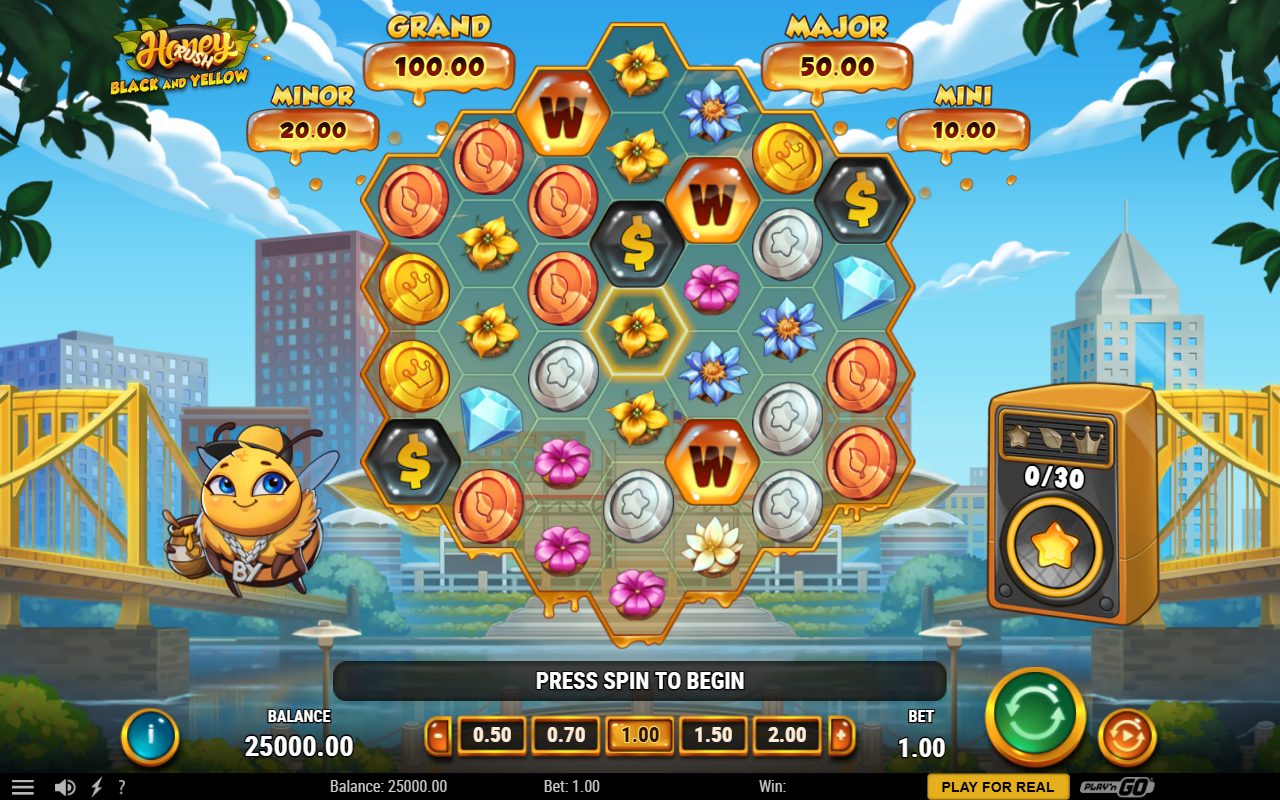
The layout itself — 4-5-6-7-6-5-4 across seven columns — creates a diamond-shaped play area with 36 symbol positions at its widest. This is the same structural logic as a honeycomb cell, and it directly influences how the Colony Feature's large clusters fill the grid. Understanding the shape of the grid is useful before you start, because cluster-building logic here is genuinely different from a standard 5x3 or 6x4 setup.
Bonus Features Breakdown
The Walking Wild is the feature with the highest day-to-day impact. The Wild symbol substitutes for regular symbols and, unlike standard wilds, survives a winning cascade rather than disappearing with it. After each cascade or spin, it moves to a new random position and gains a +1 multiplier, stacking up to a maximum of x3. Once that x3 cap is reached, the Wild exits the grid after the next cascade or spin. Wilds can also form their own clusters, paying x375 for a cluster of 35 or more — a scenario that requires near-full grid coverage but represents a substantial payout when it occurs.
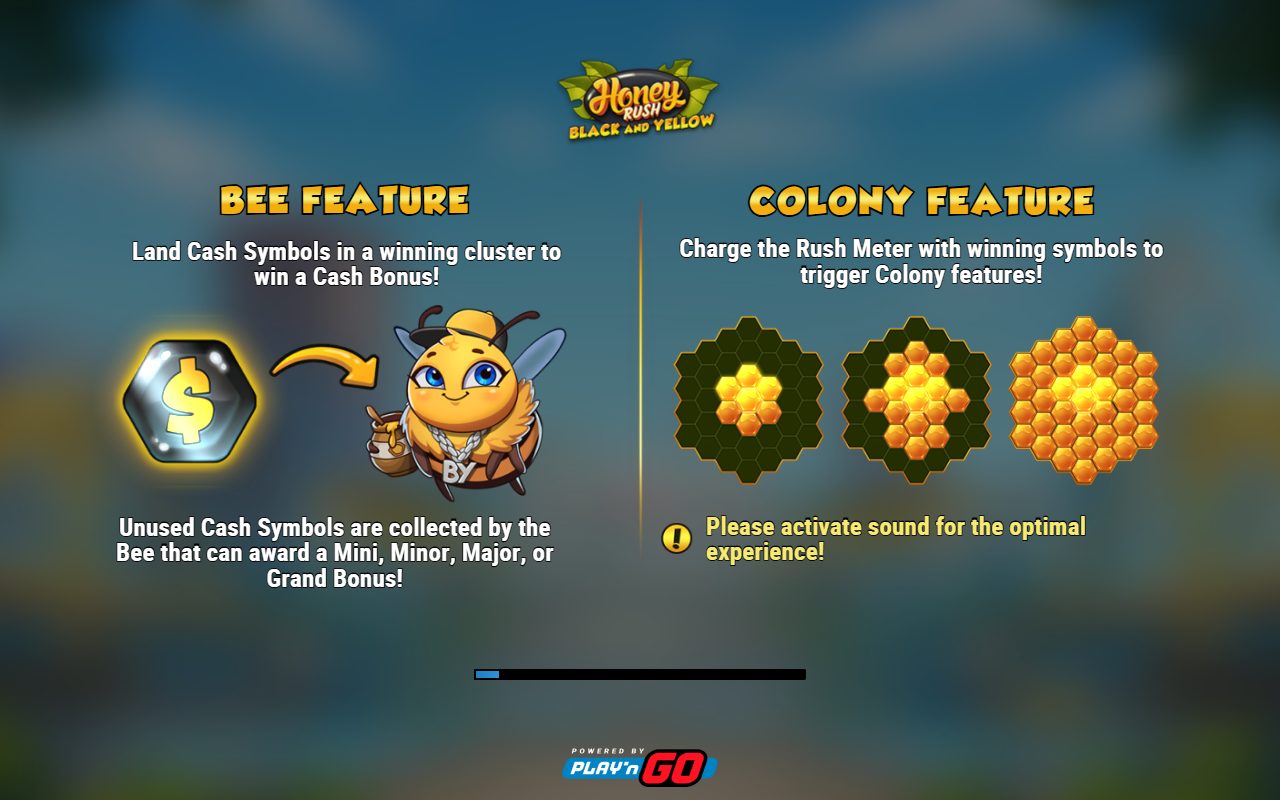
The Bee Feature operates through Cash Symbols. When a Cash Symbol lands as part of a winning cluster, it pays its face value (ranging from x0.2 to x100 of the bet) in addition to the cluster win. When it lands outside a winning cluster, the bee character absorbs it, growing in size toward one of four prize levels. The top prize level reaches x100 the bet — a meaningful secondary income stream that doesn't require the Rush Meter to be charged.
The Colony Feature is the high-ceiling mechanic. The Rush Meter fills as icons land during play, and at three distinct charge levels it triggers one of three versions: Drone Colony (a cloned central symbol placed in a 7+ cell cluster), Worker Colony (the same logic but with a 10–15 symbol cluster), and Queen Colony (a 20–37 symbol cluster that can dominate the grid). These trigger sequentially when no further wins remain in the current round. The Queen Colony level is the primary path to the 20,000x max win, and it charges slowly — the absence of a bonus buy means no shortcut exists.
Spindex Live Data: 873 Tracked Bets
Honey Rush Black and Yellow has logged 873 tracked bets across our five crypto-casino sources in the past 30 days. For a slot released in March 2026, that's a moderate early-adoption volume — enough to draw preliminary conclusions but not yet the deep sample that would let us characterize the hit distribution with confidence.
The top recent hit recorded on Spindex is 180x. That's a meaningful real-world data point: it confirms the cascades are producing wins, but 180x is well below the 20,000x ceiling and well below even the Queen Colony's theoretical contribution. This is consistent with high-volatility behavior — the distribution is long-tailed, and the upper range of the payout curve requires specific feature stacking that won't appear in a sample of under 1,000 bets.
The trend signal is worth watching as the sample grows. If the 30-day tracked volume climbs past 2,000 bets without a hit above 500x, that would reinforce the case for treating this as a grind-and-wait slot rather than a frequent-fireworks one. We'll update this section as Spindex accumulates more data. For now, the 180x ceiling on observed hits aligns with what the 42.55% hit frequency and slow Rush Meter charge rate would predict for early sessions.
Fixed Jackpots and the RTP Range
Honey Rush Black and Yellow includes Fixed Jackpots as a listed feature, tied to the Bee Feature's four prize levels. These are fixed multiplier awards rather than progressive pools, meaning the top Bee prize of x100 is a defined ceiling within that mechanic — not a figure that grows over time. This keeps the jackpot component transparent and predictable, which is a reasonable design choice given the Colony Feature already handles the high-variance upside.
The RTP range feature indicates that the game's return-to-player percentage is not fixed at a single value across all casino configurations. Operators can select from a range of RTP settings, with 96.25% being the standard published figure. Players should verify which RTP setting is active at their chosen casino, as lower configurations are possible. This is standard practice across Play'n Go's catalogue but worth flagging explicitly for players who prioritize confirmed RTP before depositing.
The combination of fixed jackpots and a configurable RTP range means the game's actual return profile can vary by venue. The 96.25% figure referenced throughout this review reflects the standard configuration.
Who Should Play Honey Rush Black and Yellow
High-volatility cluster specialists are the primary audience. If you have experience with Play'n Go's Reactoonz series or similar grid-based cluster titles and you're comfortable with sessions that run cold before a feature chain fires, Honey Rush Black and Yellow is a natural next step — with a significantly higher ceiling than Reactoonz 2's 5,000x.
The $0.10 minimum bet makes it accessible for lower-stakes players who want to explore the mechanics without significant exposure, but the slow Rush Meter charge means the Colony Feature's upper tiers will require extended sessions. Budget-conscious players should treat the demo version as essential preparation rather than optional, specifically to understand how the meter charges and how often the Walking Wild contributes to cascade chains before committing real funds.
Players who prefer frequent bonus triggers or slots with a bonus buy option will find this frustrating. The absence of a bonus buy is the single largest friction point for players accustomed to on-demand feature access. If that's a dealbreaker, the game isn't likely to change your mind — the Colony Feature is the reason to be here, and it arrives on its own timeline.
Final Verdict
Honey Rush Black and Yellow is a technically strong cluster slot with a feature architecture that justifies the high-volatility label. The three-tier Colony Feature, Walking Wilds that accumulate multipliers across cascades, and the Bee Feature's cash-absorption mechanic create a system where multiple things can compound simultaneously — and that's exactly what produces 20,000x outcomes.
The trade-off is patience. Without a bonus buy, reaching the Queen Colony level requires genuine session investment. Spindex's tracked data — 873 bets with a top hit of 180x — reflects early play that hasn't yet captured the tail end of the distribution. That's not a criticism of the slot; it's the nature of high-volatility, high-ceiling mechanics. The 96.25% RTP and 42.55% hit frequency provide a reasonable foundation for the wait.
For players who understand what they're signing up for, this is one of Play'n Go's more rewarding cluster releases. For everyone else, the demo is the right starting point.
- +20,000x max win — four times higher than Reactoonz 2's 5,000x ceiling
- +96.25% RTP above Play'n Go's typical studio average
- +Three-tier Colony Feature with clusters up to 37 symbols
- +Walking Wilds that persist across cascades and stack multipliers up to x3
- +Bee Feature adds a secondary prize layer up to x100 the bet
- +Diagonal cluster connections increase win path count on the hexagonal grid
- +$0.10 minimum bet with full demo access
- -High volatility with a slow-charging Rush Meter means extended dry spells
- -No bonus buy feature — Queen Colony access cannot be fast-tracked
- -RTP range configuration means actual return may be below 96.25% at some casinos
- -20,000x ceiling is highly theoretical without Queen Colony firing at peak
Best for
Honey Rush Black and Yellow is Play'n Go's most mechanically ambitious cluster slot to date. The 20,000x ceiling, 96.25% RTP, and three-tier Colony Feature make it genuinely rewarding for high-volatility specialists willing to grind through slow base-game stretches. Casual players should treat the demo as mandatory preparation rather than optional. No bonus buy means the big features arrive on the game's schedule, not yours.