




House of Doom 2: The Crypt Review
Play'n Go's decision to revisit the House of Doom franchise raised eyebrows — the original never cracked the mainstream — but House of Doom 2: The Crypt arrives with a meaningfully upgraded math model and a feature set that's considerably more layered than its predecessor. The 6,000x max win ceiling is the headline number, and it's backed by a high-volatility engine built around three distinct base-game domains, each with its own wild modifier and bonus structure. The RTP sits at 94.25%, which is the figure operators are running on our tracked sources — worth knowing before you spin. Spindex has logged 140 bets across seven crypto-casino platforms in the last 30 days, with a top recent hit of 1,142x, giving us a concrete read on how this game actually behaves in live conditions. This is a 5x3 video slot with 20 fixed paylines, classified as high volatility, and released in March 2021. The feature list is long — expanding wilds, respins, multipliers, symbol swaps, and a multi-domain free spins structure — so there's real substance to unpack here.
RTP, Volatility, and Max Win
The 94.25% RTP is the operative number here — that's what Play'n Go has published and what our tracked crypto-casino sources are running. It's worth noting that the game supports a customizable RTP range, meaning operators can adjust this value downward, so the figure you see at any given casino may differ. The 94.25% mark is below the current industry midpoint of roughly 96%, and that gap compounds over long sessions at high volatility.
The max win of 6,000x is a meaningful upgrade over the original House of Doom and represents a solid ceiling for a branded, niche-market slot. To put it in context, Play'n Go's Testament — another entry in their metal-band series — pushes up to 20,000x, which makes House of Doom 2's 6,000x look conservative by comparison. The non-multiplier single-spin maximum is capped at 200x, so the path to the top end runs almost entirely through the bonus round. Hit frequency is not published, so we can't quote a percentage, but the high-volatility classification and live data both suggest base-game dead spells are the norm rather than the exception.
For players choosing between slots in this volatility bracket, the RTP is the clearest differentiator. At 94.25%, you're accepting a higher house edge in exchange for the feature complexity and 6,000x upside. That's a trade-off, not a flaw, but it should factor into session length and stake sizing decisions.
How House of Doom 2 The Crypt Plays
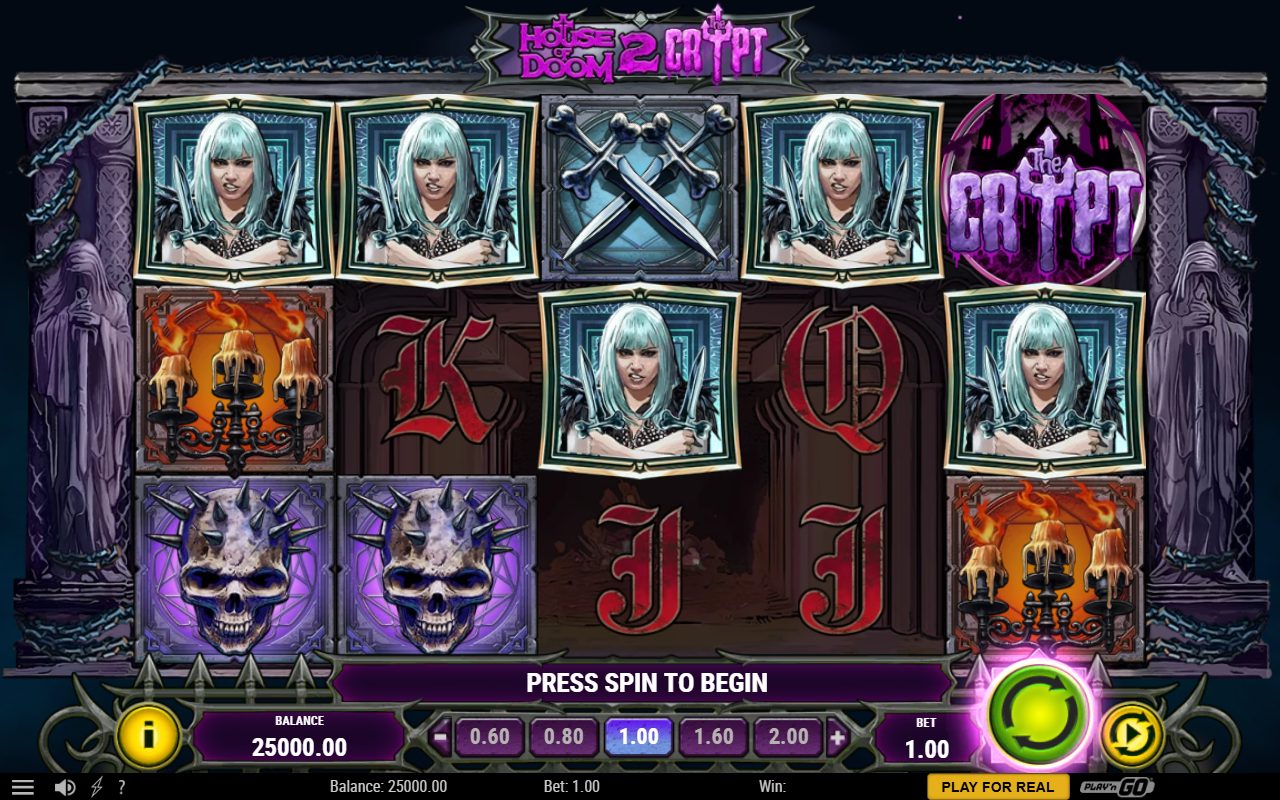
The game runs on a 5x3 grid with 20 fixed paylines. The structural backbone is a three-domain system — the base game operates in one of three zones, each tied to a distinct female character wild, a unique soundtrack, and a domain-specific modifier. The domain you're in changes after each bonus round completes, which means the game's character shifts as you play rather than staying static.
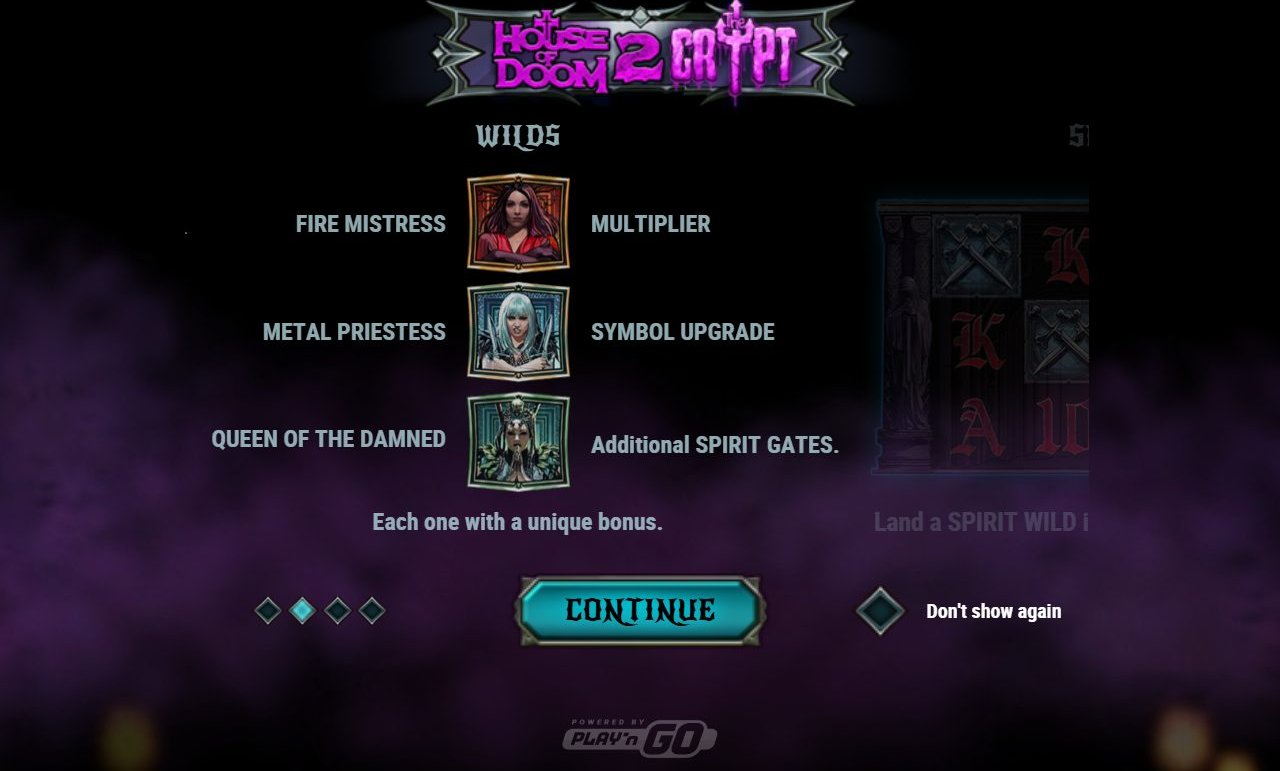
Four female character wilds are in play, and each substitutes for standard pay symbols. A five-of-a-kind wild combination pays 25x stake. The Spirit Gate Frame mechanic is the primary base-game event: reels can become framed at random, and if a wild lands inside that frame, it expands to cover the full reel and triggers a respin with a domain-specific modifier applied. The modifier type depends entirely on which of the three domains is active, so the respin behavior isn't uniform across sessions.
The layering of features — Spirit Gates feeding into domain respins, which feed into the Crypt Spins bonus, which can activate the Spirit of Unity Wild — creates a chain where each element unlocks the next. It reads more complex than it plays once you've been through a bonus cycle, but the first few sessions do require active attention to the paytable. The theme is gothic/dark with skull, candle, and floral visual elements on a dark palette.
Bonus Features Breakdown
The feature list for House of Doom 2: The Crypt is one of the longer ones in Play'n Go's catalog: Expanding Symbols, an Expanding Wild with Re-spin, Free Spins, a Multiplier, Respin Wild, Respins, Scatter Symbols, a Starburst-style mechanic, Symbol Swap, and a standard Wild. The architecture connects these elements rather than treating them as independent triggers.
The Spirit Gate Frames activate the expanding wild respin in the base game. Each of the three domains has its own version of this modifier, so the respin you get in Domain 1 behaves differently from the one in Domain 3. Triggering the domain-specific bonus round — Crypt Spins — makes the Spirit Gate modifier easier to activate, which creates a feedback loop where the feature becomes more accessible the deeper you get into the bonus. The Spirit of Unity Wild is exclusive to the Crypt Spins feature and can only appear there; it combines elements from all three domains simultaneously.
The Symbol Swap and Multiplier mechanics add further variance to bonus-round outcomes. A session where four of five reels fill with the active character wild — as demonstrated in the source's 200-spin test — represents the kind of near-full-board coverage that drives the larger payouts. The structure rewards players who understand which domain they're in and what the active modifier does, rather than those who spin passively.
Spindex Live Data: 30-Day Tracked Performance
Across Stake, Gamdom, Roobet, Rainbet, Duelbits, Shuffle, and MyPrize, Spindex recorded 140 bets on House of Doom 2: The Crypt in the last 30 days. That's a low volume figure — for reference, front-page titles on these same platforms regularly log thousands of tracked bets per month — which tells you something about where this slot sits in the current rotation. It's an active title, but not a high-traffic one.
The top recent hit of 1,142x is a useful data point. It's a real result from live tracked play, and it sits well below the 6,000x theoretical ceiling, which is consistent with what you'd expect from a high-volatility game over a limited sample. The 6,000x max requires the Crypt Spins feature to fire in a favorable domain configuration with the Spirit of Unity Wild contributing — a sequence that's structurally possible but rare.
For players on crypto platforms specifically, the 140-bet sample suggests House of Doom 2 is not a slot that's being mass-played for volume. It's more likely being picked by players who know the title. That's relevant context: the live data here reflects a self-selecting audience rather than broad casual traffic, which may skew the hit distribution compared to what you'd see on a mainstream operator.
The Three-Domain System: What It Means in Practice
The domain mechanic is the most distinctive structural element in House of Doom 2: The Crypt and the feature that most separates it from standard high-volatility slots. Each of the three domains assigns a different character wild, a different Spirit Gate modifier, and a different bonus-round behavior. The domain rotates after each completed bonus round, so a long session will cycle through all three.
In practical terms, this means no two bonus rounds in House of Doom 2 are mechanically identical. The modifier active during a Spirit Gate respin in one domain will not apply in another. This is meaningful variance beyond the standard free-spins-with-multiplier model, but it also means the game's behavior is harder to internalize quickly. Players who prefer knowing exactly what a bonus round will do before they trigger it will find the domain system initially opaque.
The Spirit of Unity Wild — which only appears during Crypt Spins and draws on all three domain modifiers simultaneously — is the game's highest-ceiling mechanic. Getting there requires the bonus round to fire in a configuration that activates it, which adds another layer of conditional probability to the max-win path. Understanding the domain you're currently in is the single most useful piece of knowledge a player can have while spinning.
Who Should Play House of Doom 2 The Crypt
This slot is built for a specific player type: someone comfortable with high volatility, willing to read a multi-layered paytable, and not expecting frequent base-game feedback. The 94.25% RTP means the math works against you faster than on a 96%+ title, so shorter, higher-stakes sessions are a more defensible approach than extended low-stake grinding.
The branded doom-metal angle — three original Candlemass songs, one per domain — adds genuine atmosphere for players who care about that. It's not a feature in the mechanical sense, but it does differentiate the experience from generic dark-theme slots. Players who found the original House of Doom too thin on features have a legitimate reason to revisit the franchise here; the math model is materially stronger.
High-volatility slot regulars who prioritize feature complexity and a 6,000x ceiling over RTP efficiency will get the most from House of Doom 2: The Crypt. Casual players or those who prefer consistent hit rates should look elsewhere in Play'n Go's catalog — the base game can run cold for extended stretches before the Spirit Gate fires.
Final Verdict
House of Doom 2: The Crypt is a more ambitious slot than its predecessor on every measurable axis: higher max win, more features, more domain-specific variance, and a richer bonus structure. The three-domain system is genuinely interesting mechanically, even if it takes a session or two to fully map out. Play'n Go has done the harder thing here — building a sequel that justifies its existence rather than simply re-skinning the original.
The 94.25% RTP is the primary caveat, and it's a real one. It sits below the Play'n Go catalog average and below what most high-volatility players have come to expect from modern releases. The 6,000x ceiling is strong, but the lower RTP means the expected return per session is compressed. That's not a dealbreaker for the right player, but it should be priced into your stake decisions.
Spindex's live data shows modest but consistent activity — 140 tracked bets, top hit of 1,142x — which positions this as a title with a dedicated audience rather than broad appeal. That's probably accurate. House of Doom 2: The Crypt is an acquired taste, and the players who acquire it tend to stay with it.
- +6,000x max win is a significant upgrade over the original House of Doom
- +Three-domain system creates genuine mechanical variety across sessions
- +Extensive feature set: expanding wilds, respins, multipliers, symbol swap, and more
- +Spirit of Unity Wild adds a high-ceiling bonus-within-bonus mechanic
- +Each domain has a unique Candlemass soundtrack — three original songs total
- -94.25% RTP is below the Play'n Go catalog average and below the industry midpoint
- -Feature nesting is complex and takes multiple sessions to fully understand
- -Hit frequency not published; high volatility means extended base-game dry spells are expected
- -Bet range limits not publicly available — check your operator before playing
Best for
House of Doom 2: The Crypt is a high-volatility niche title that rewards patience and a tolerance for complexity. The nested feature structure takes time to read, but the 6,000x ceiling and domain-specific bonus mechanics give it genuine depth. At 94.25% RTP, bankroll management matters more than usual. Best suited to players who want mechanical variety over straightforward spins.