






Jewel Box Review
Play'n Go launched Jewel Box back in November 2012, and while the slot industry has changed dramatically in the fourteen years since, this 5-reel, 3-row, 15-payline video slot still draws a steady stream of players at crypto casinos tracked by Spindex. The headline mechanic is a set of multiplier wilds that can boost a single win by up to 5x, paired with a pick-em bonus round built around — fittingly — jewel boxes. Stacked symbols and an adjacent-pay rule that lets wins trigger regardless of which reel a chain starts on give the base game more texture than a standard 15-line setup would normally deliver. The published RTP sits at 93.96%, which is below the modern Play'n Go average and worth factoring into your session bankroll. Medium volatility means the ride should be reasonably steady, though the max win figure is not publicly listed by the provider. Bets scale from $0.01 to $18.75, keeping it accessible across stake levels. This review breaks down every spec and mechanic so you can decide whether Jewel Box still earns table space in 2026.
RTP, Volatility, and What the Numbers Actually Mean
The 93.96% RTP is the most important number on Jewel Box's spec sheet, and it deserves honest treatment. For context, Play'n Go's more recent releases — titles like Reactoonz 2 and Rise of Olympus 100 — are certified at 96.20% or higher. That roughly 2.3-percentage-point gap translates to a meaningful difference in theoretical return over any extended session. If you're moving budget between slots, that cost is real.
Volatility is rated medium, which aligns with the slot's mechanical profile: 15 paylines, stacked symbols that create multi-symbol clusters, and multiplier wilds that can amplify wins without requiring a rare bonus trigger. You're unlikely to face long dry streaks, but you're equally unlikely to see the kind of single-spin eruptions that high-variance titles produce. It's a session-friendly rhythm rather than a boom-or-bust one.
Play'n Go has not published a maximum win figure for Jewel Box. Our 30-day tracked data shows a top recent hit of 125x, which is modest — Spindex-tracked Play'n Go titles from the same medium-volatility tier typically log top hits in the 200–500x range over a comparable window. That single data point doesn't define a ceiling, but it's consistent with a slot that was designed before megaways-era max-win inflation became the industry norm.
How Jewel Box Plays
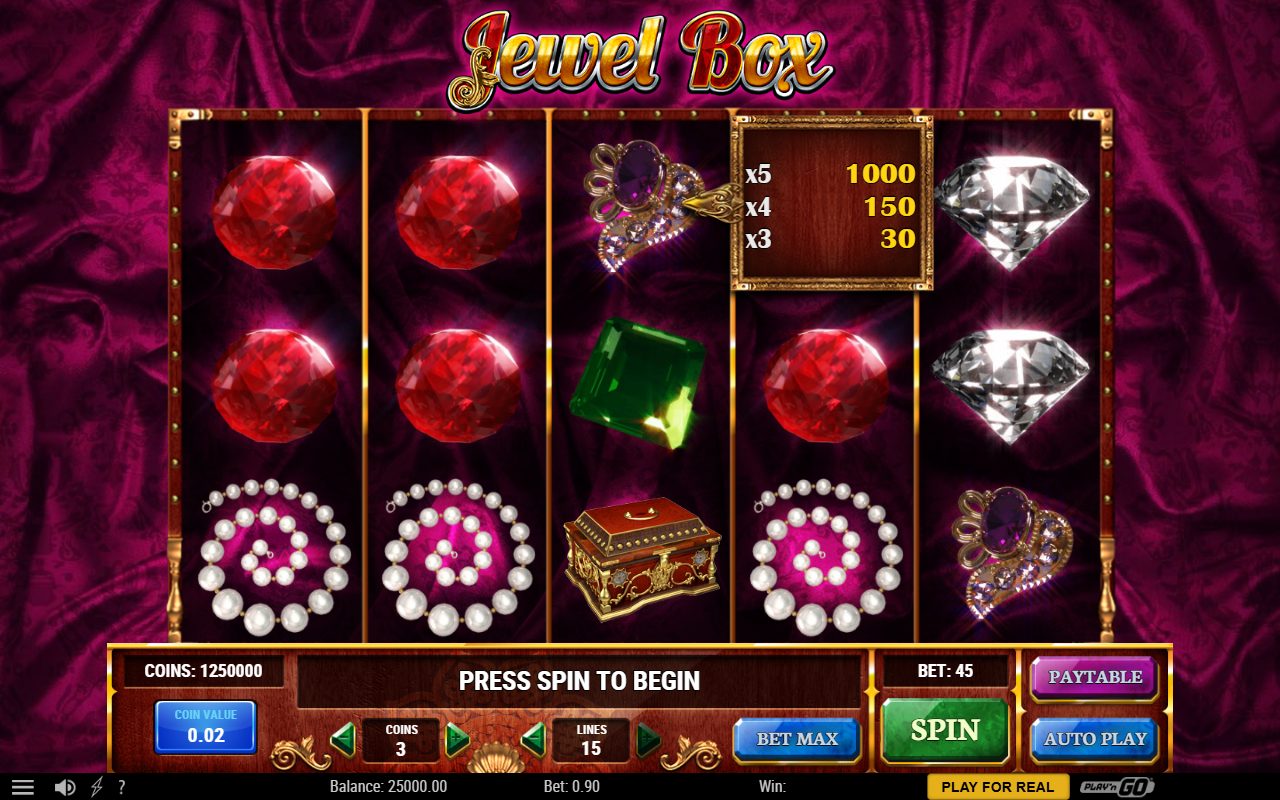
The 5x3 grid runs 15 fixed paylines, but the pay mechanic has a notable twist: wins pay for adjacent matching symbols on a line regardless of whether the chain begins on reel one. That rule meaningfully increases the number of qualifying combinations compared to a strict left-to-right setup, and it's one reason the base game feels more active than the payline count alone would suggest.
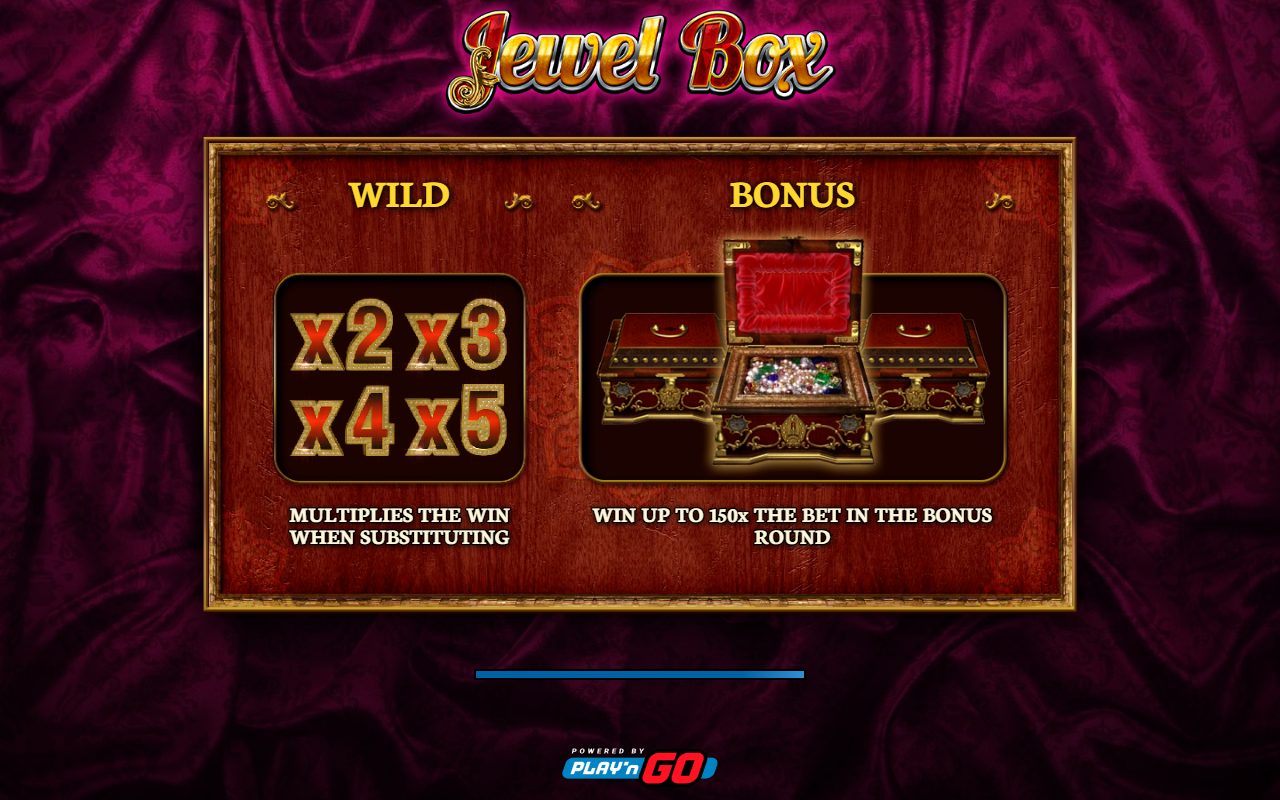
Symbols are stacked across the reels, so a single spin can fill large portions of the grid with the same icon. When that overlaps with the adjacent-pay rule, multi-line clusters become common. The wilds add another layer — they carry multipliers ranging from 2x to 5x, applied directly to any win they contribute to. A 5x wild landing inside a decent-sized cluster can push a base-game payout well above what the paytable's face value implies.
The overall pace is straightforward. There are no cascades, no expanding reels, and no persistent meter to track between spins. For players who prefer to focus on a clean spin-by-spin rhythm without managing multiple bonus states simultaneously, that simplicity is a feature rather than a limitation.
Bonus Features Breakdown
Jewel Box has four listed features: a Bonus Game, a Risk/Gamble (Double) game, an RTP range mechanic, and Wilds. The wild is the workhorse of the base game — its 2x–5x multiplier range means its value fluctuates depending on which variant lands, and a 5x wild on a multi-symbol line is the slot's most impactful single-spin event outside of the bonus round.
The Bonus Game is a pick-em format. Players select from a set of jewel boxes to reveal prizes, making it a decision-based break from the spinning reels rather than a free-spins sequence. Pick-em bonuses are deterministic in outcome but offer a moment of player agency that free-spins rounds don't. The prizes revealed depend on the selection, so the round's value varies each time it triggers.
The Risk/Gamble (Double) feature is an optional post-win mechanic that lets players attempt to double a win — a standard gamble ladder that Play'n Go included across many of its 2012-era releases. It's worth noting that the RTP range feature in the spec list suggests the slot may operate across a spectrum of return percentages depending on the casino configuration, which is common for older Play'n Go titles deployed across varied markets. The published 93.96% should be treated as the baseline figure.
Spindex Live Data: 30-Day Tracked Performance
Spindex tracked 116 bets on Jewel Box across seven crypto-casino sources — Stake, Gamdom, Roobet, Rainbet, Duelbits, Shuffle, and MyPrize — over the past 30 days. That's a low-activity count by platform standards; a slot like Gates of Olympus typically logs several thousand tracked bets across the same window. Jewel Box is a niche pick in the current ecosystem, not a volume title.
The top recent hit recorded in that window was 125x. For a medium-volatility slot, that's a modest ceiling on observed performance. It doesn't rule out higher hits — 116 bets is a small sample — but it does suggest that players seeking frequent large multipliers are not gravitating to this slot, and the data doesn't contradict that instinct.
The practical takeaway: Jewel Box is still alive on crypto casino floors and attracts a small, consistent audience. It's not trending upward, but it hasn't disappeared either. Players who encounter it in a lobby and want a low-stakes, mechanics-focused session have a real base of activity to reference — this isn't an abandoned title.
Bet Range and Session Planning
Jewel Box runs from $0.01 to $18.75 per spin, a range that reflects its 2012 origins — the upper limit is conservative by the standards of modern Play'n Go releases, which often cap at $100 or higher. For high-stakes players, the ceiling will feel restrictive. For recreational players at crypto casinos, the lower end makes it one of the more accessible titles on a lobby.
Given the 93.96% RTP, session bankroll planning matters more here than on a 96%+ title. At medium volatility with a modest observed max hit, the expected return per dollar wagered is lower than most current alternatives. Short sessions at minimum stakes are where this slot makes the most sense financially — it's not built for the kind of extended high-bet grind that a higher-RTP title can absorb.
The $0.01 minimum also makes Jewel Box a reasonable candidate for demo play or low-stakes exploration at crypto casinos that support it, particularly for players new to Play'n Go's older catalogue.
Who Should Play Jewel Box
Jewel Box suits players who want a mechanically clean, low-complexity session without managing cascades, persistent meters, or multi-stage bonus systems. The adjacent-pay rule and stacked symbols keep the base game from feeling static, and the multiplier wilds provide genuine upside moments without requiring bonus triggers.
Players who prioritize RTP above other factors should look elsewhere. At 93.96%, Jewel Box sits well below the current Play'n Go average, and there are dozens of alternatives from the same provider at 96%+. The lower return is a concrete cost, not a minor footnote.
The slot has a natural home among players who specifically enjoy the 2012-era Play'n Go aesthetic and design philosophy — a jewelry theme with a straightforward feature set and a pick-em bonus rather than a free-spins cascade. It's a period piece in the best sense: it does exactly what it was designed to do, without pretending to be something it isn't.
Final Verdict
Jewel Box is a well-constructed slot for its era. The adjacent-pay mechanic, stacked symbols, and 2x–5x multiplier wilds give it more base-game depth than a 15-payline grid typically delivers, and the pick-em bonus provides a clean, low-complexity bonus experience. Play'n Go clearly put craft into the original design.
The 93.96% RTP is the honest obstacle. Compared to Play'n Go's own modern output — where 96.20% is a reasonable baseline expectation — Jewel Box asks players to accept a higher house edge for a slot that also doesn't offer a published max-win ceiling or a high-variance jackpot to justify the trade-off. Spindex's 30-day data, with a top hit of 125x across 116 tracked bets, reinforces that this is a steady, moderate-return experience rather than a high-upside one.
Score: 3.5 out of 5. Worth a short session at low stakes if you enjoy the format, but not a slot to build a regular rotation around given the RTP gap versus newer alternatives.
- +Adjacent-pay mechanic increases base-game win frequency beyond standard 15-line setups
- +Multiplier wilds (2x–5x) can meaningfully amplify base-game wins without requiring a bonus trigger
- +Stacked symbols create frequent multi-line cluster opportunities
- +Minimum bet of $0.01 makes it accessible at all stake levels
- +Medium volatility delivers a steady, manageable session rhythm
- -93.96% RTP is below the current Play'n Go average by roughly 2+ percentage points
- -Max win is not published by the provider
- -Maximum bet of $18.75 is restrictive for higher-stakes players
- -Spindex 30-day top hit of 125x is modest for a medium-volatility title
- -No free spins — players who prefer free-spins bonuses won't find one here
Best for
Jewel Box is a compact, mechanics-first slot from Play'n Go's early catalogue. The multiplier wilds and adjacent-pay stacked-symbol setup keep the base game genuinely active, and the pick-em bonus adds a brief change of pace. The 93.96% RTP is a real drawback by current standards — most modern Play'n Go titles sit closer to 96% — but low minimum bets and medium volatility make it workable for casual sessions at low stakes.