





Journey to Paris Review
Play'n GO's Journey to Paris is a 5x5 Cluster Pays slot released in April 2024 with one of the more eye-catching max-win ceilings in the studio's recent catalogue — 18,566x the bet. That figure alone puts it in conversation with some of the provider's higher-variance titles, yet the game sits at medium volatility, which is an unusual pairing worth examining closely.
The published RTP is 94.74%, which is below the industry standard of 96% and below Play'n GO's own typical range on flagship releases. The slot uses an RTP range feature, meaning individual casinos can configure the return differently, so the figure you encounter may vary by platform. On a 5x5 grid with Cluster Pays mechanics, wins form by grouping adjacent matching symbols rather than across fixed lines. Bonus symbols, Scatter symbols, Wilds, Free Spins, and a Bonus Game round out the feature set. For players weighing up whether the 18,566x ceiling justifies the base RTP, this review breaks down exactly how the math and mechanics interact.
RTP, Volatility, and the 18,566x Max Win
The headline number is 18,566x, which is a legitimately substantial ceiling. For context, Play'n GO's widely played Reactoonz 2 tops out at 5,000x, and even the original Reactoonz caps at 4,570x — making Journey to Paris's potential payout more than three times larger than those cluster-pay stablemates from the same provider. That kind of ceiling on a medium-volatility game is uncommon and is arguably the slot's defining selling point.
The RTP of 94.74% requires honest discussion. It sits roughly 1.3 percentage points below the 96% benchmark most players use as a baseline, and it's lower than Play'n GO's own average across its portfolio. However, the slot uses an RTP range mechanic, which is standard practice — the 94.74% figure represents one configured point within a range. Casinos licensing the game can set a higher return, so the actual RTP you play at depends on the operator. Checking the in-game info panel before committing real money is the simplest way to confirm the live rate.
Medium volatility means the hit pattern should be more consistent than a high-variance release, even if individual wins are smaller on average. The tension between a 94.74% base return and an 18,566x max win suggests the math is built around infrequent but large bonus contributions rather than steady base-game payouts. That profile rewards patience and an adequate session bankroll.
How Journey to Paris Plays
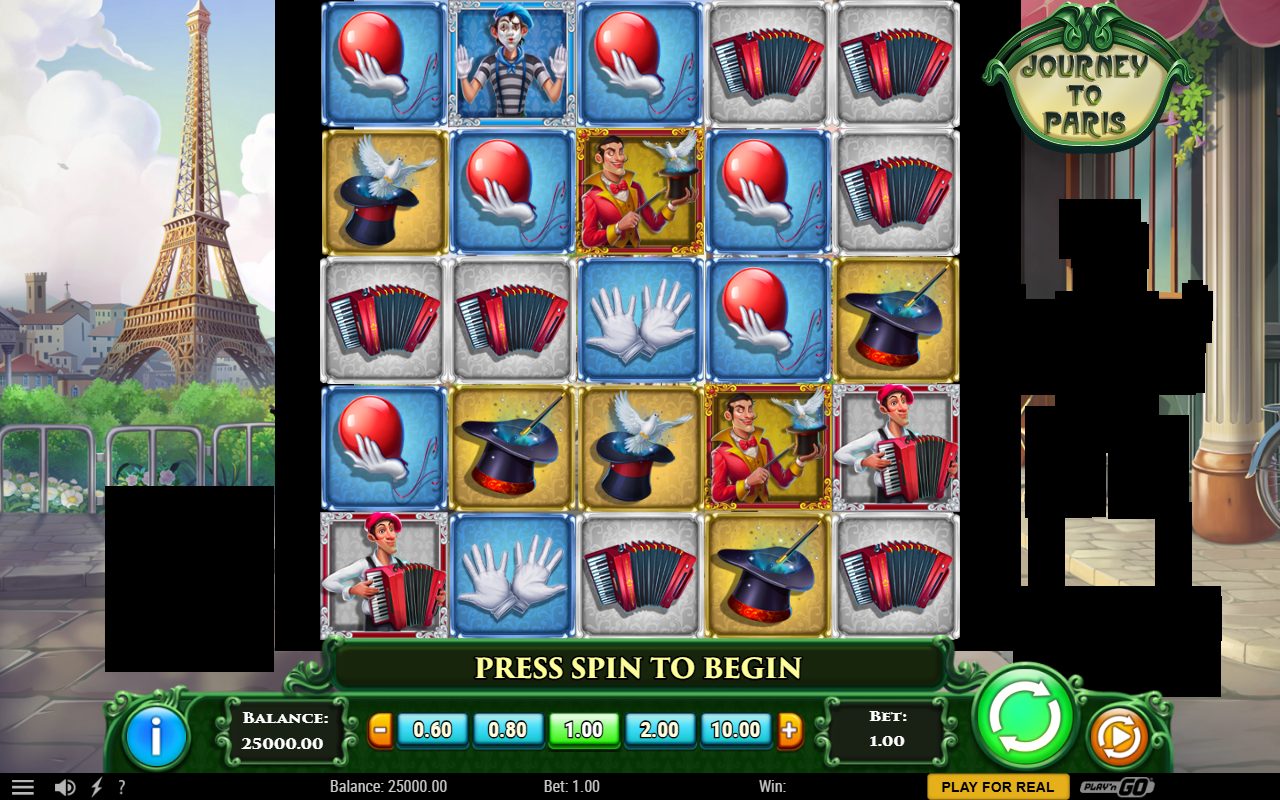
The game runs on a 5x5 grid with Cluster Pays, meaning there are no fixed paylines. Instead, wins trigger when five or more matching symbols connect horizontally or vertically across the grid. This mechanic naturally produces a different rhythm from reel-and-line slots — smaller clusters can land frequently, while larger ones generate cascading potential.
Bonus symbols and Scatter symbols both have mechanical roles beyond decoration. Bonus symbols are tied to column-based triggers that unlock the Bonus Game and Free Spins, making their placement on the grid strategically significant rather than incidental. Wilds substitute in the standard way, helping complete or extend clusters. The Free Spins round introduces a Scatter paying mechanic that operates differently from the base-game Cluster Pays system, effectively giving the bonus round its own win logic.
A multiplier that increases with each win is active during play, which is the primary driver behind the extreme max-win figure. In practice, this means the slot's ceiling is only reachable through a chain of escalating wins — the kind of run that is rare by design but mathematically possible. For day-to-day sessions, the medium volatility should keep the experience from feeling like an extended drought, though the base RTP means the house edge is slightly steeper than average.
Bonus Features Breakdown
Journey to Paris has five distinct mechanical components: Bonus Game, Bonus symbols, Cluster Pays (the base mechanic), Free Spins, Scatter symbols, and Wilds. The RTP range is also listed as a feature, which is a configuration setting rather than a player-facing mechanic, but it's worth knowing it exists.
The Bonus Game is the primary escalation point. It's triggered via Bonus symbol accumulation across the grid's columns, and it gates access to the Free Spins round. This two-stage structure — Bonus symbols unlock the Bonus Game, which unlocks Free Spins — means the path to the highest-value outcomes requires clearing both thresholds. That layered trigger is common in Play'n GO cluster titles but can make the bonus feel further away than in slots with a single scatter trigger.
During Free Spins, the game switches from Cluster Pays to Scatter paying, which is a meaningful mechanical shift. Scatter paying awards wins based on the total number of matching symbols anywhere on the grid, regardless of adjacency. This tends to produce larger individual win values than cluster mechanics because symbol placement constraints are removed. Combined with the multiplier that builds through the session, the Free Spins round is where the 18,566x theoretical maximum becomes a realistic — if still rare — outcome.
Theme and Presentation
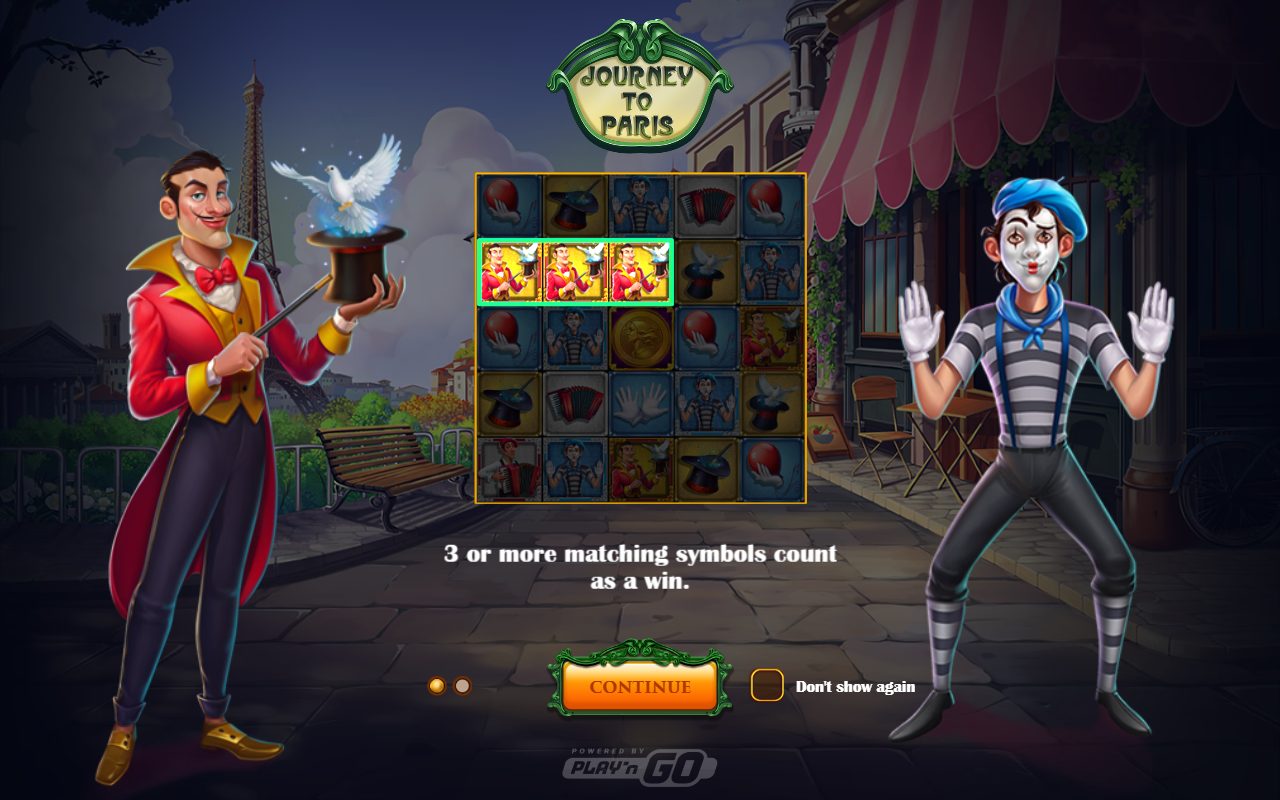
Journey to Paris is a France-themed slot built around a magician and illusionist concept, blending tourism and leisure imagery with magic-wand iconography. The thematic combination of Parisian setting and stage-magic performer is the visual hook Play'n GO has used to differentiate it from straightforward travel-themed releases.
The 5x5 grid layout is standard for cluster-pay titles and gives the game a clean, symbol-dense presentation. Beyond the categorical theme, the visual execution is functional — the symbol set supports the mechanic without introducing unnecessary complexity.
Who Journey to Paris Is Best For
Medium-volatility cluster-pay slots attract a specific type of player: someone who wants meaningful win potential without committing to the long dry spells that define high-variance titles. Journey to Paris fits that profile, with the added draw of an unusually large max-win ceiling for its volatility class.
The 94.74% base RTP is the primary filter. Players who prioritise return rate above other factors should verify the casino-specific RTP before playing, since the RTP range feature means some platforms may offer a higher configured return. For players who are less RTP-sensitive and more focused on the bonus structure and max-win potential, the slot is a reasonable choice within the cluster-pay genre.
Play'n GO fans who have run through Reactoonz or Reactoonz 2 and want a cluster title with a higher theoretical ceiling will find Journey to Paris a logical next step. The mechanic is familiar enough to feel accessible, and the two-stage bonus trigger adds a layer of anticipation that straightforward scatter-triggered free spins don't provide.
Final Verdict
Journey to Paris does something genuinely interesting: it delivers an 18,566x max-win ceiling at medium volatility, a combination that most cluster-pay titles from any provider don't attempt. The Cluster Pays base game, the two-stage bonus trigger, and the Scatter-paying Free Spins round form a coherent mechanical package with a clear escalation path.
The honest caveat is the 94.74% base RTP. It's not a disqualifying number, but it's below average, and the RTP range feature means the actual rate varies by casino. One mild observation worth noting: the two-stage path to Free Spins — Bonus symbols first, then the Bonus Game, then Free Spins — can make the bonus feel slow to arrive in shorter sessions, which is a pacing trade-off for the higher max-win architecture.
For players who understand the RTP situation and are drawn to cluster mechanics with serious upside, Journey to Paris earns its place in Play'n GO's 2024 lineup. Check the in-game info at your chosen casino, confirm the configured RTP, and go in with a session bankroll that can absorb the medium-variance swings.
- +18,566x max win is exceptionally high for a medium-volatility cluster slot
- +Two distinct win mechanics — Cluster Pays in base game, Scatter paying in Free Spins — add variety
- +Escalating multiplier creates a clear path to large wins during bonus
- +Medium volatility keeps session variance manageable compared to high-volatility alternatives
- +Play'n GO's established reliability in cluster-pay game design
- -Base RTP of 94.74% is below the 96% industry benchmark
- -RTP range feature means the rate varies by casino — requires manual verification
- -Two-stage bonus trigger (Bonus Game → Free Spins) can slow access to the highest-value round
Best for
Journey to Paris pairs a genuinely large max-win ceiling with medium volatility — a combination that should appeal to players who want meaningful upside without the punishing dry spells of high-variance slots. The 94.74% base RTP is the main trade-off; always verify the rate at your chosen casino since the RTP range feature means it can differ by platform. A solid mid-stakes option from Play'n GO's 2024 lineup.