





Tomb of Gold Review
Play'n Go launched Tomb of Gold in January 2023, and three years on it still holds a firm place in the provider's Egyptian catalogue. The setup is a 6x4 grid with 4,096 ways to win, high volatility, and a 7,000x maximum win — a ceiling that sits comfortably above mid-range releases but below the studio's most extreme titles like Legacy of Dead. Two distinct bonus mechanics drive the action: Lock'N Gold, a Hold and Win-style respin round, and a Free Spins feature anchored by a spin-the-wheel entry that sets both the spin count and a starting multiplier. The bet range runs from $0.10 to $100, making it accessible to both cautious and aggressive bankrolls. One number demands attention before anything else: the RTP figure attached to this slot varies depending on the casino operator, and the version you are most likely to encounter carries a 94.29% return — not the headline 96.29% figure that sometimes appears in promotional material.
RTP, Volatility, and the Version Problem
The single most important thing to understand about Tomb of Gold is that Play'n Go supplies it in multiple RTP configurations. Operators can select from five tiers: 96.29%, 94.29%, 91.28%, 87.27%, and 84.26%. The verified base spec used on Spindex — and the version most widely deployed — is 94.29%. That is nearly two full percentage points below the top-tier build, which matters materially over any meaningful session volume.
For context, Play'n Go's own Book of Dead runs at 96.21% in its standard configuration, and even the studio's mid-tier releases typically sit above 95%. At 94.29%, Tomb of Gold is one of the lower-returning slots in the provider's active catalogue. That does not make it unplayable, but it does mean the house edge is steeper than the Egyptian-themed competition. If your casino displays the game's RTP in the help screen, check it — a 96.29% version of Tomb of Gold is a meaningfully different proposition.
High volatility completes the picture. Wins will cluster unevenly, and base-game dry spells between bonus triggers are a real feature of the experience, not an anomaly. The 7,000x max win is the reward on offer for enduring that variance — and it is a credible ceiling, reachable via the multiplier mechanics in the Free Spins round rather than just theoretical.
Grid, Layout, and How the Base Game Works
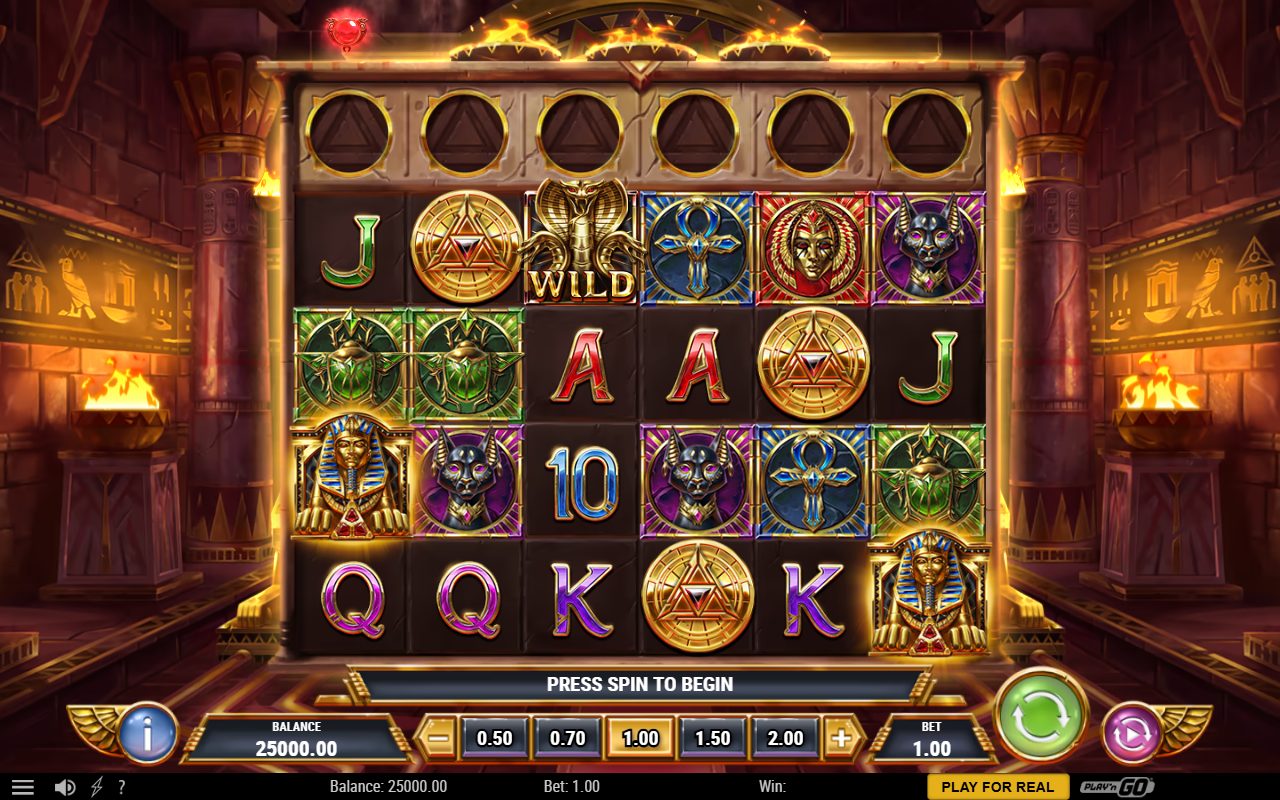
Tomb of Gold runs on a 6-reel, 4-row grid generating 4,096 ways to win. Winning combinations must begin on the leftmost reel and run across adjacent reels to the right — standard ways-to-win logic. There is an additional fifth row visible above the main grid, reserved exclusively for Scatter symbols; it does not participate in regular payline evaluation but is what makes the bonus trigger geometry work.
The paytable splits into four high-value Egyptian-themed symbols and five lower-value standard symbols. Wilds substitute for all regular symbols and carry their own pay values at the top end of the table. Scatters pay from any position, including that elevated fifth row, which increases the effective frequency of scatter appearances compared to a flat-grid layout.
There is no Bonus Buy option and no ante-bet mechanic. Players who prefer to purchase direct access to the feature rounds will need to look elsewhere — Play'n Go has not included that shortcut here. Autospin is available with configurable loss limits and win caps, and a Quickspin mode is present for faster base-game cycling. The $0.10 to $100 bet range is wide enough to suit most bankroll sizes.
Lock'N Gold: The Hold and Win Round
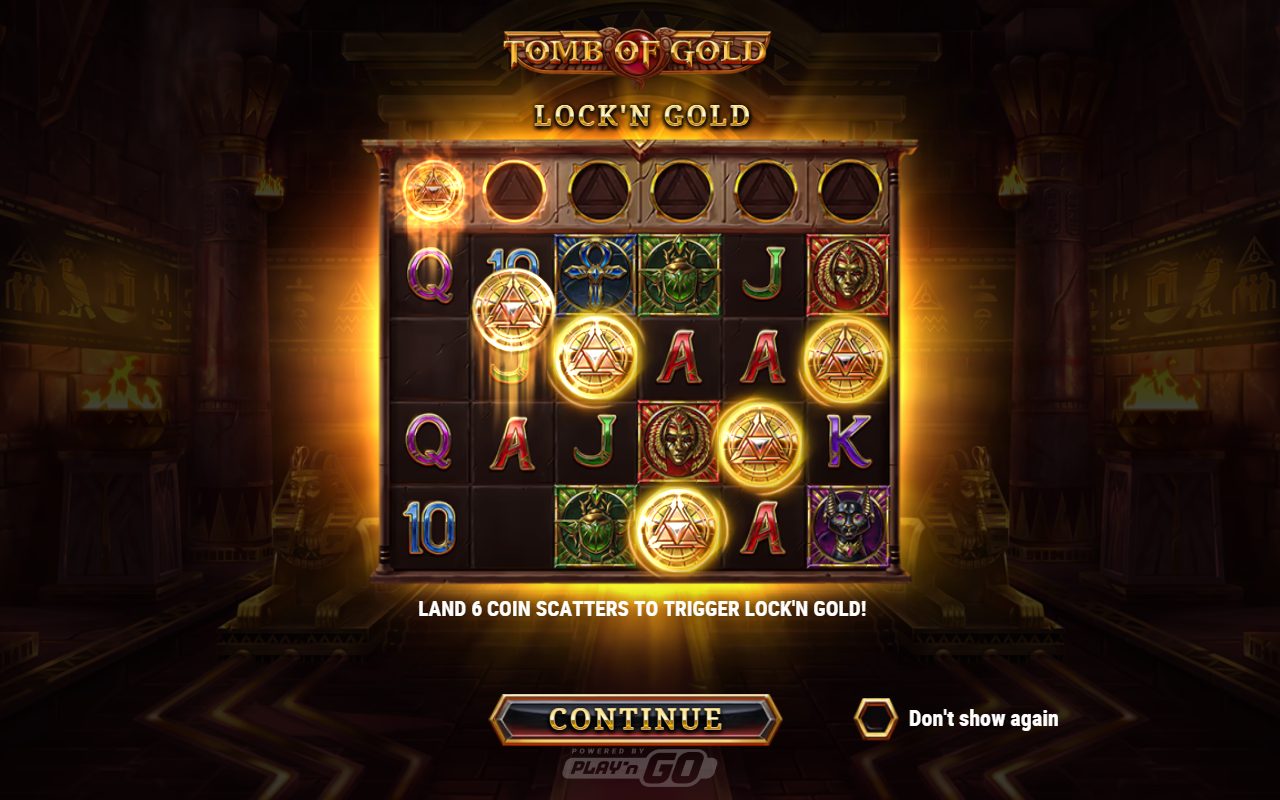
Lock'N Gold is the first of Tomb of Gold's two bonus mechanics, and it is the one players will encounter most frequently. It activates when six or more Coin symbols land simultaneously across the reels. At that point, the game switches to a dedicated 6x5 grid of 30 positions, and the player receives three respins. Each time a new Coin lands during the respin phase, the counter resets to three — a standard Hold and Win structure.
Coin values range from 1x to 100x the total bet per individual coin. The higher-value coins are rarer, as expected, but the 100x single-coin value means a well-populated board can build meaningful totals before the multiplier mechanics in Free Spins even come into play. A Second Chance mechanic adds a layer of protection: if exactly four or five coins land on any spin — falling short of the six needed to trigger Lock'N Gold outright — the reels holding a coin-free position are respun automatically, giving a second opportunity to reach the activation threshold.
This Second Chance element is what drives the perceived trigger frequency of the round. It does not guarantee activation, but it meaningfully reduces the number of near-misses that result in nothing. Lock'N Gold can also activate during the Free Spins round, which creates the possibility of stacking both bonus mechanics in a single session.
Free Spins and the Multiplier Wheel
Three or more Sphinx Scatter symbols trigger the Free Spins round. Landing four, five, or six scatters at once provides the same entry point but also awards immediate cash payouts on top of the feature activation — a meaningful distinction at higher bet levels. Before the spins begin, a wheel determines two variables: the number of free spins awarded (anywhere from 10 to 30) and the starting multiplier (1x to 5x). Both outcomes are randomised at the wheel spin, so the entry conditions vary considerably from one trigger to the next.
During the free spins themselves, two mechanics build on that starting state. Each Sphinx Scatter that appears adds one additional free spin to the remaining count — there is no cap on how many extra spins can accumulate. Each Wild symbol that lands increases the progressive multiplier by 1x, also without a hard ceiling. The combination of an uncapped spin count and an uncapped multiplier is what makes the 7,000x maximum win achievable in practice rather than just on paper.
The bonus ends either when the spin count reaches zero or when the total win hits the slot's win cap — whichever comes first. In high-multiplier runs, the win cap can terminate the round earlier than the remaining spin count would suggest, which is worth understanding before a session.
Theme and Presentation
Tomb of Gold sits squarely in the Ancient Egypt category, drawing on hieroglyphs, scarabs, sphinxes, snakes, and coins as its core visual vocabulary. It is Play'n Go's third major Egyptian-themed release in recent memory, following Book of Dead and Rise of Dead, and the studio has positioned it as a mechanics-forward entry in that lineage rather than a visual reinvention.
The game is built on HTML5 and performs consistently across desktop and mobile without requiring additional software or downloads.
Who Tomb of Gold Is Built For
High-volatility players who are comfortable with extended base-game variance and want two distinct bonus mechanics to target will find Tomb of Gold structurally sound. The Lock'N Gold round provides a more frequent, lower-ceiling payout layer, while the Free Spins with its uncapped multiplier is the route to the 7,000x maximum. Having both in the same game gives the session a rhythm that pure free-spins-only slots sometimes lack.
The RTP situation is the primary filter. Players at casinos running the 94.29% version are operating at a steeper house edge than the slot's mechanics alone would suggest. Recreational players spinning at $0.10 to $0.50 per round may not feel this acutely, but anyone playing at $10 or above per spin should confirm which RTP variant their operator has deployed. The difference between 94.29% and 96.29% at $20 per spin across 500 spins is roughly $200 in expected theoretical loss — not a trivial gap.
Players who require a Bonus Buy option to engage with a slot will need to look elsewhere. Tomb of Gold has no shortcut to either bonus round, and the base game must be played through to reach them organically.
Final Verdict
Tomb of Gold is a technically competent high-volatility slot with a well-designed dual-bonus structure. The Lock'N Gold respin round and the multiplier-driven Free Spins complement each other in a way that keeps the session moving even when neither feature is triggering. The 7,000x max win is realistic given the uncapped multiplier mechanic, and the 6x4 grid with 4,096 ways gives the paytable enough width to generate meaningful base-game wins when the symbol alignment cooperates.
The obstacle is the RTP. At 94.29% — the verified deployed figure — Tomb of Gold asks players to accept a house edge that is higher than most comparable Play'n Go titles. Book of Dead at 96.21% and Rise of Dead at 96.18% both offer the same Egyptian theme and comparable volatility at a considerably better return rate. Tomb of Gold's mechanics are arguably more elaborate than either of those, but mechanics do not compensate for a structural RTP gap over the long run.
The slot earns its place in a session rotation for players who have confirmed their casino is running the 96.29% variant, or for those who prioritise feature complexity over optimised return. At 94.29%, it is a slot to approach with clear expectations rather than as a default Egyptian-theme choice.
- +7,000x maximum win with a credible path via uncapped Free Spins multiplier
- +Two distinct bonus mechanics — Lock'N Gold and Free Spins — provide session variety
- +Second Chance mechanic increases Lock'N Gold trigger opportunities
- +Free Spins spin count and multiplier both uncapped, enabling large run-ups
- +Wide bet range ($0.10–$100) suits most bankroll sizes
- +6x4 grid with 4,096 ways to win gives broad base-game coverage
- -Default deployed RTP of 94.29% is below the Play'n Go catalogue average
- -No Bonus Buy or ante-bet option for players who prefer direct feature access
- -High volatility means extended dry spells between bonus triggers are common
- -RTP varies by operator — the top 96.29% version is not universally available
Best for
Tomb of Gold delivers a well-constructed high-volatility experience with two genuine bonus rounds and a 7,000x ceiling. The Lock'N Gold mechanic triggers at a reasonable clip and feeds naturally into the Free Spins. The main caveat is the RTP — at 94.29% in its most common operator configuration, it is below the Play'n Go average, and players who care about long-run return should verify which version their casino runs before committing real money.