
Twenty-One Review
Hacksaw Gaming released Twenty-One in December 2023, and it sits in a different category from the studio's usual reel-based output. This is a card game format — not a slot in the traditional sense — built around a blackjack-adjacent scoring mechanic. The objective is to draw cards that land your hand total between 16 and 21 points, with multipliers awarded based on where your total falls in that range. Hit the target zone and you collect; miss it and you lose the round.
The multiplier range runs from 1.5x up to 10x your bet, giving the game a clear reward gradient rather than a binary win/loss outcome. You can reveal up to seven cards in a single round, which introduces a genuine decision layer that most slot formats don't offer. The RTP sits at 96%, and volatility is rated high — a combination that points toward infrequent but potentially meaningful payouts. With no traditional reels or paylines, Twenty-One is best understood as a skill-adjacent card title rather than a passive spin-and-wait experience.

How Twenty-One Plays
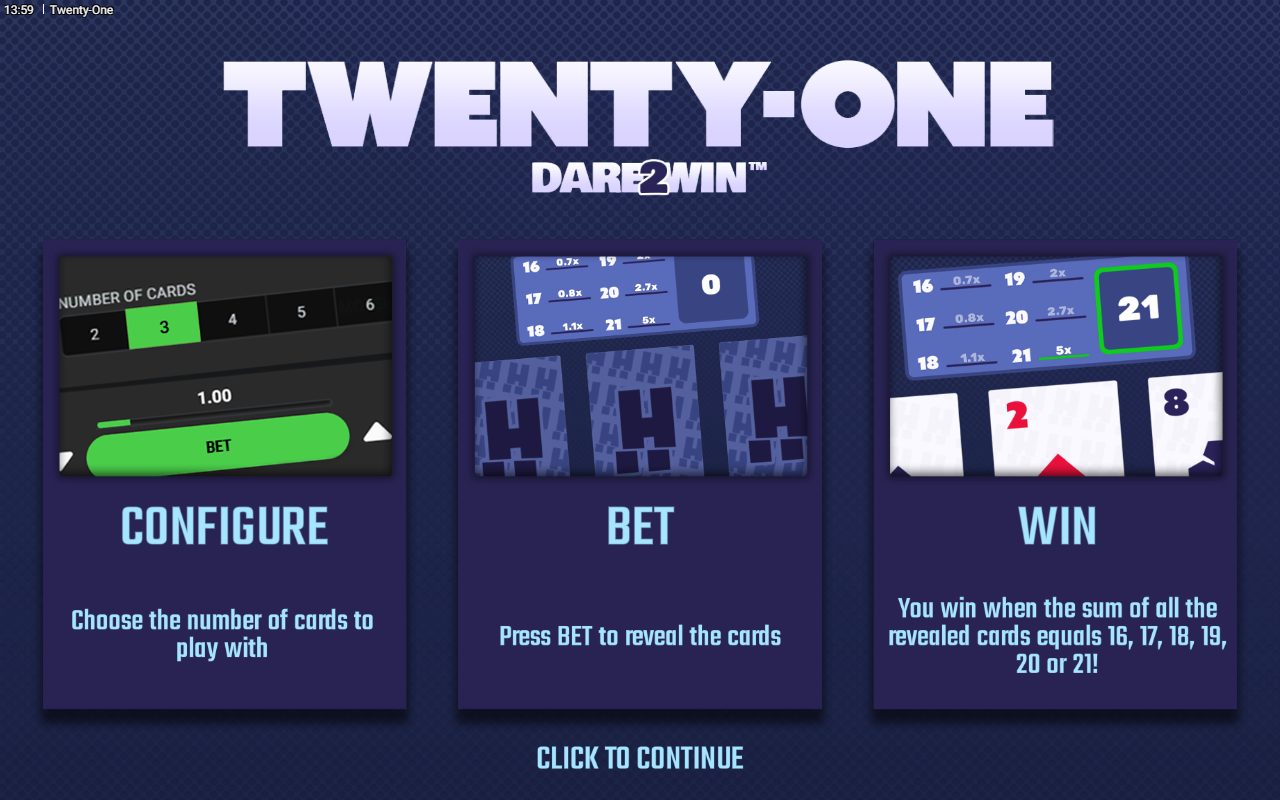
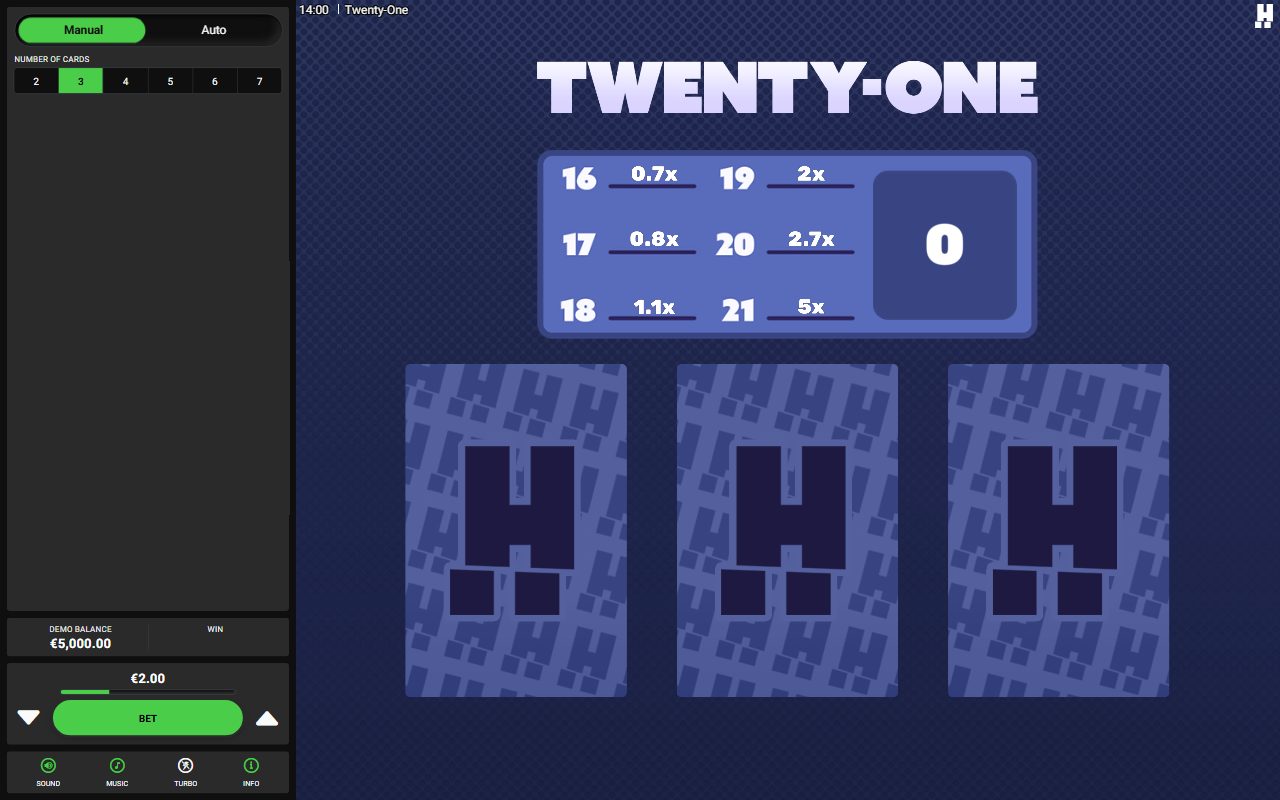
Twenty-One operates on a card-draw mechanic rather than a reel grid. Each round, you draw cards with the aim of reaching a hand total between 16 and 21. That target window is the entire scoring system — land inside it and a multiplier is applied to your bet; fall short or bust past 21 and the round is a loss.
The multi-card reveal option is the central strategic element. You can choose to reveal anywhere from one to seven cards per round, which means you're actively managing risk with each decision. Drawing more cards increases your chances of reaching the 16–21 window but also increases the chance of busting. Drawing fewer limits your exposure but may leave your total short of the qualifying range. It's a tension that plays out quickly and makes each round feel distinct from the last.
Because the format has no reels, rows, or paylines, the usual slot review framework doesn't map cleanly onto Twenty-One. There's no base-game symbol grid to describe, no scatter triggers, and no free spins round. What you get instead is a stripped-back card game loop that Hacksaw has structured around two confirmed mechanics: a multiplier system and an RTP range selector.

RTP, Volatility, and the Multiplier Range
The published RTP for Twenty-One is 96%, which sits at the lower end of Hacksaw Gaming's typical range. For context, titles like Wanted Dead or a Wild carry a 96.38% RTP, and the studio's average tends to cluster around 96.20%. Twenty-One's 96% figure is still competitive against the broader market but is slightly below what Hacksaw players may be used to seeing.
Volatility is rated high, which aligns with the multiplier structure. The 1.5x floor is modest — barely above break-even on a winning hand — but the 10x ceiling is where the meaningful variance lives. A 10x return on a single round is a strong short-session outcome, though high volatility means those rounds will be spaced out by stretches of losses or low-multiplier returns.
One notable gap in the available data is the absence of a published max win figure. Most Hacksaw releases come with a defined ceiling — Chaos Crew 2, for example, caps at 50,000x — which allows players to assess expected upside before committing. Without that number for Twenty-One, it's difficult to place the game on the risk/reward spectrum that experienced Hacksaw players typically use to choose between titles. The RTP range feature (listed in the confirmed mechanics) suggests some operator-level RTP variation may be available, which is standard practice across Hacksaw's catalog.
Bonus Features: Multipliers and RTP Range
Twenty-One's confirmed feature set is deliberately lean: a multiplier system and an RTP range selector. There are no free spins, no bonus buy option, no expanding wilds, and no cascading mechanic. The multipliers are built directly into the core game loop — they're not a bonus state you trigger, but the primary reward structure for every qualifying hand.
The multiplier gradient runs from 1.5x at the lower edge of the 16–21 window up to 10x at the peak. This implies that not all winning hands pay equally — a total of 21 likely returns more than a total of 16, creating a scoring hierarchy within the target range. That internal structure adds a layer of anticipation to each card reveal that a flat win/loss binary wouldn't provide.
The RTP range feature is an operator-facing tool that allows casinos to configure the game's return rate within a defined band. From a player perspective, this means the effective RTP at any given casino may differ slightly from the headline 96% figure. It's worth checking the in-game information panel at your specific casino to confirm which RTP variant is active — this is standard practice for any Hacksaw title that carries this feature.
Theme and Presentation
Twenty-One is a card game title with a dark blue visual palette. The aesthetic is minimal and functional, which suits the format — there's no narrative or character layer to distract from the card-draw mechanic at the center of each round.
The dark blue theme is consistent with a serious, table-game-adjacent presentation rather than the high-energy visual style Hacksaw applies to its action-oriented reel slots. For players who find heavy animation and sound design distracting during strategic play, that restraint is a practical advantage.
Who Twenty-One Is Best For
Twenty-One is most suited to players who prefer an active decision-making role in each round. The multi-card reveal mechanic means you're not simply watching a result unfold — you're choosing how much risk to take on with every hand. That appeals to players with a blackjack or poker background who find standard slot play too passive.
High-volatility tolerant players are the natural audience. The 96% RTP and high variance combination means bankroll swings will be significant, and sessions can run cold for extended periods before a meaningful multiplier lands. Players who need frequent small returns to stay engaged will likely find the pacing frustrating.
Conversely, low-stakes casual players may find the format too sparse. Without free spins, bonus rounds, or progressive jackpots, there's no secondary excitement layer to sustain interest between winning hands. Twenty-One is a focused product — it does one thing with a clear mechanic, and it's best appreciated by players who value that clarity over feature volume.
Final Verdict
Twenty-One is a deliberate departure from Hacksaw Gaming's reel-slot catalog, and it works best when evaluated on its own terms. The card-draw format, multi-card reveal mechanic, and 1.5x–10x multiplier range create a coherent and genuinely interactive experience that most reel slots can't replicate. The 96% RTP is competitive, and the high volatility is appropriate for the format.
The missing data points — no published max win, no confirmed bet range — make it harder to recommend with full confidence for players who benchmark titles carefully before depositing. The absence of a bonus buy is also worth noting for high-stakes players who prefer to access variance-heavy rounds directly.
For card game enthusiasts and high-volatility players who want something structurally different from the standard slot format, Twenty-One is worth a session. For players who rely on feature-rich bonus rounds to drive engagement, Hacksaw's reel-based catalog will serve them better.
- +Genuine decision-making mechanic via multi-card reveal (up to 7 cards per round)
- +Multiplier range of 1.5x–10x built into the core loop, not gated behind a bonus trigger
- +96% RTP is competitive for a card game format
- +Minimal visual design suits focused, strategic play
- +RTP range feature allows operator-level configuration
- -No published max win figure makes risk/reward benchmarking difficult
- -No free spins, bonus buy, or secondary feature layer
- -Bet range not publicly confirmed
- -High volatility with a 1.5x multiplier floor means many rounds return very little
- -Slightly below Hacksaw's typical RTP average of ~96.20%
Best for
Twenty-One is a focused, high-volatility card game from Hacksaw Gaming that rewards deliberate play over passive spinning. The 1.5x–10x multiplier structure is straightforward, and the multi-card reveal mechanic gives players a real decision to make each round. At 96% RTP it's competitive, though the absence of a published max win figure makes it harder to benchmark against the studio's reel-based titles.