






Fruit Party Dice Review
Pragmatic Play dropped Fruit Party Dice in March 2025, expanding its fruit-slot catalog with a 7x7 cluster-pays grid that leans hard into random multipliers and cascading mechanics. The setup is familiar territory for anyone who has played the original Fruit Party series, but the dice angle reshapes how multipliers land and stack during both the base game and free spins.
The headline numbers are solid: a 96.47% RTP sits comfortably above the industry average of 96%, and a 5,000x max win ceiling gives high-volatility hunters a legitimate reason to sit down. Spindex has tracked 380 real-money bets on this title across seven crypto-casino sources over the past 30 days, so there is enough live data to say something meaningful about how it actually behaves in the wild — not just on paper. The biggest verified hit logged on our network in that window was 385x, which is notable context given the 5,000x theoretical ceiling. Read on for the full breakdown.
RTP, Volatility, and Max Win
At 96.47%, Fruit Party Dice sits above the current Pragmatic Play studio average, which tends to cluster around 96.00–96.20% across their broader video-slot catalog. That extra quarter-percent matters over thousands of spins, and it gives the game a meaningful edge over genre peers like Pragmatic's own Sweet Bonanza (96.48% in its standard version — nearly identical) while outpacing most of the studio's lower-RTP variants.
The high-volatility rating is the defining variable here. Pragmatic doesn't publish a hit-frequency figure for Fruit Party Dice, so the official spec table has a gap there — but the volatility classification alone tells you to expect a session profile built around dry spells punctuated by larger cluster bursts rather than a steady drip of small returns. The 5,000x max win is a legitimate ceiling for a high-vol slot in this class; for comparison, the original Fruit Party 2 tops out at 5,000x as well, so Pragmatic has maintained the ceiling rather than inflating it for the dice edition.
For bankroll planning, the high variance demands a buffer. A 5,000x max win means a €1 spin could theoretically return €5,000, but the path there runs through the free-spins multiplier chain — and those sessions can be infrequent. Players targeting that ceiling should size bets accordingly rather than max-betting and burning out before the bonus triggers.
How Fruit Party Dice Plays
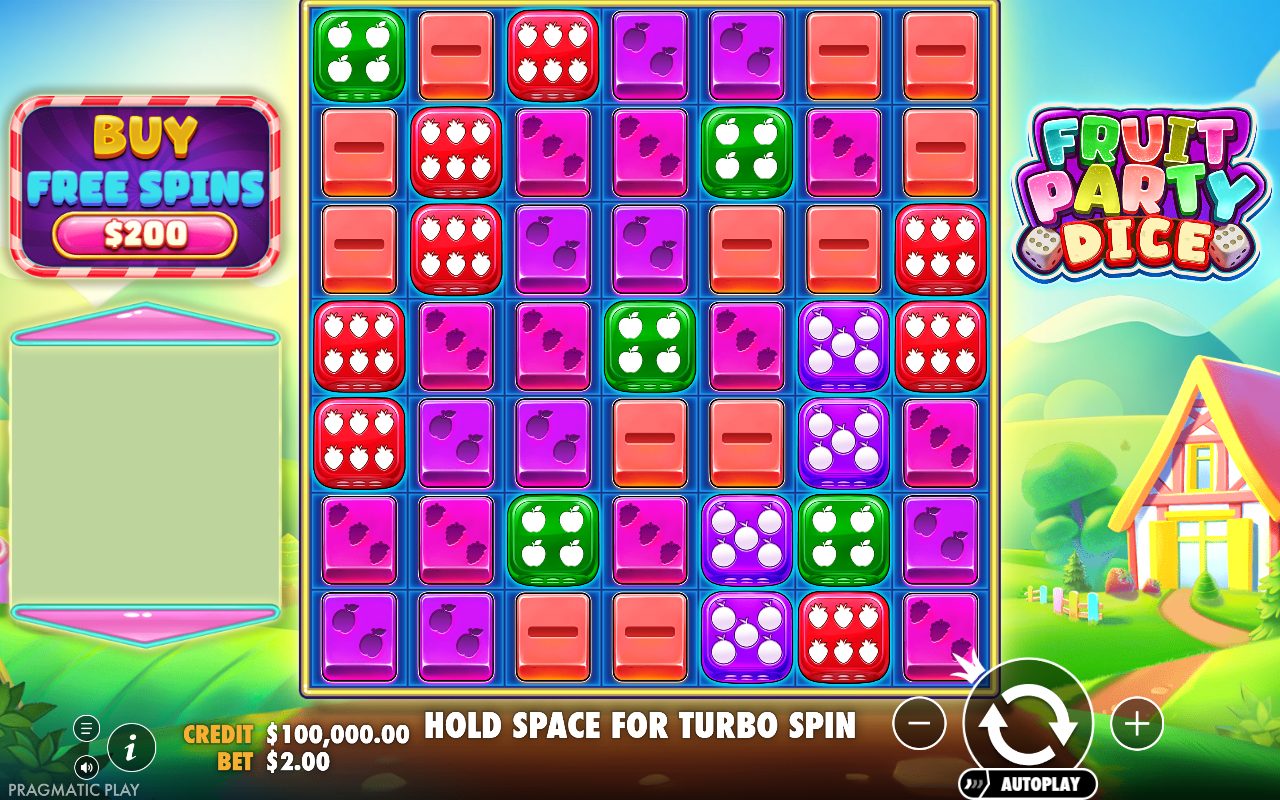
The grid is 7x7 — 49 symbols in total — running on a cluster-pays mechanic rather than fixed paylines. A win requires a cluster of five or more matching symbols touching horizontally or vertically. After each winning cluster, the Avalanche mechanic removes those symbols and drops new ones from above, giving every spin the potential to chain into multiple consecutive wins without an additional wager.
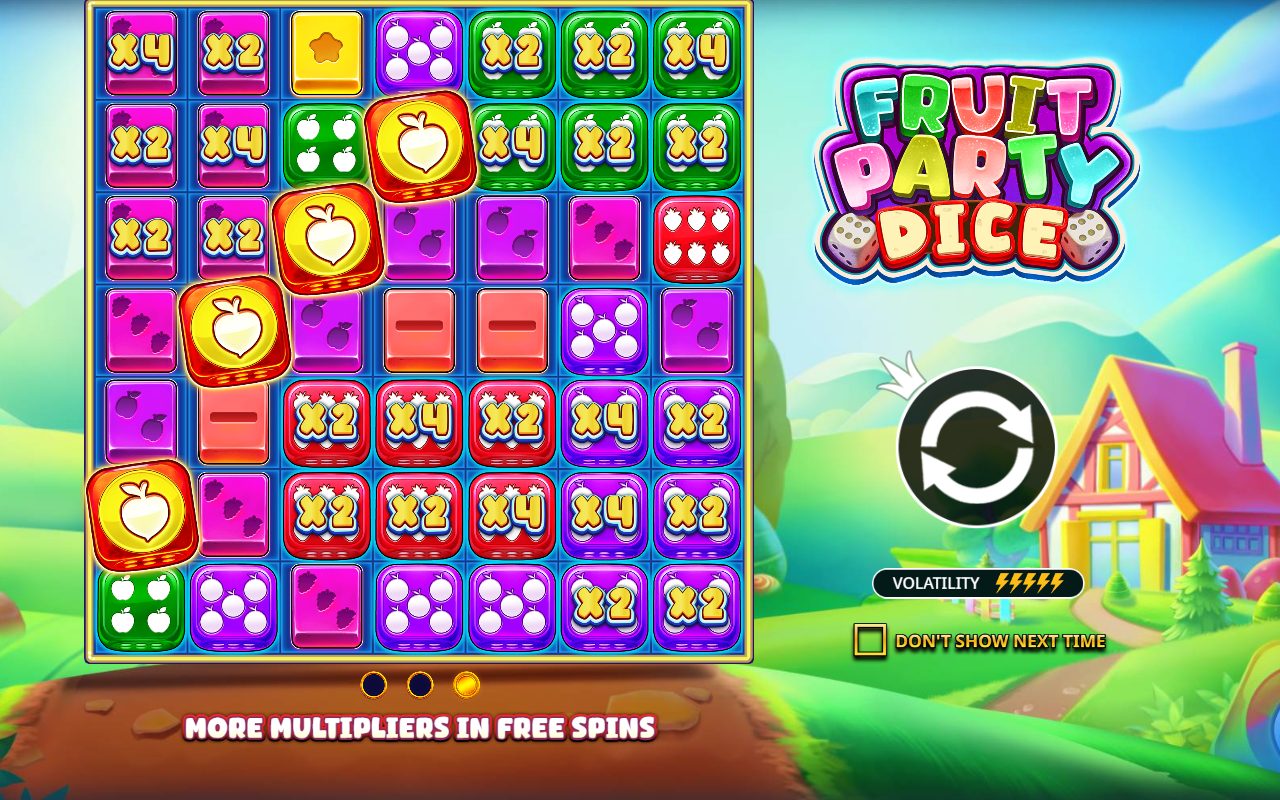
The dice element feeds directly into the random multiplier system. Multipliers can appear on the grid during both regular play and the free-spins round, attaching to cluster wins and scaling payouts in a way that is not predetermined — the randomness is the point. A single cascade sequence can accumulate several multiplier values if the grid cooperates, which is the core mechanism driving the slot's high-volatility profile.
The 7x7 layout gives the cluster engine more room to breathe than a standard 5x5 grid. More symbols on screen means larger potential cluster sizes, which in turn increases the ceiling on any single cascade sequence. It also means the base game can feel relatively quiet between bonus triggers — the grid's size works against frequent small clusters forming as reliably as they would on a tighter layout.
Bonus Features Breakdown
Scatter symbols trigger the free-spins round, which is where the multiplier system fully opens up. During free spins, the Free Spins Multiplier mechanic means multipliers that land during the bonus round carry more weight than their base-game equivalents — they accumulate across cascades rather than resetting between drops, which is the primary route to the upper end of the 5,000x max win.
Additional Free Spins can be awarded during the bonus round itself, extending the session and giving the multiplier chain more opportunities to compound. This retrigger mechanic is meaningful in a high-volatility context because it means a single bonus trigger can evolve into a much longer sequence than the initial spin count suggests. The random multiplier element applies here too, so no two free-spins rounds play out identically.
The Cascading and Avalanche mechanics run throughout both the base game and the bonus, meaning every win — however small — has the potential to chain. In practice, the base game cascades tend to be modest without a multiplier attached; the real weight of the slot sits in the free-spins round where the multiplier accumulation and additional spins interact. Players who find the base game pacing slow before the bonus triggers are reading the slot correctly — that tension is by design in a high-variance cluster format.
Spindex Live Data: 380 Tracked Bets
Fruit Party Dice has generated 380 tracked bets across our seven crypto-casino sources — Stake, Gamdom, Roobet, Rainbet, Duelbits, Shuffle, and MyPrize — over the past 30 days. The trend signal is currently reading normal, meaning no unusual volatility clustering or win-rate deviation from what the high-variance profile would predict.
The most significant data point from that sample is the top recent hit: 385x. That figure deserves context. With a 5,000x theoretical ceiling, a 385x top hit across 380 bets indicates the slot has not yet produced a bonus-round blowout on our tracked network — the upper multiplier chain simply hasn't connected at scale in this window. That is not unusual for a high-volatility title with a relatively small sample; 380 bets is enough to establish a behavioral baseline but not enough to expect ceiling-level hits to appear reliably.
For players using Spindex to time their sessions, the normal trend signal means there is no current evidence of an above-average win cluster or a cold streak anomaly. The slot is behaving within expected parameters for its volatility class. As the tracked-bet volume grows, we will update this section with a clearer picture of how the free-spins multiplier accumulation is performing in live play across the network.
Theme and Presentation
Fruit Party Dice is a fruit-and-party themed video slot. The visual palette runs across apple, grapes, orange, and strawberry symbols on a sky-blue and pink background — standard for the genre, executed cleanly on Pragmatic's current engine.
The dice mechanic is reflected in the presentation without overcomplicating the symbol set. Pragmatic has kept the grid readable at 7x7, which matters practically: on a 49-symbol layout, clarity of cluster formation is a usability concern as much as an aesthetic one.
Who Should Play Fruit Party Dice
Fruit Party Dice is built for high-volatility players who want a cluster-pays mechanic with a credible max-win ceiling and a competitive RTP. The 96.47% return rate means the math is working in the player's favor relative to most alternatives in this volatility tier, and the 5,000x ceiling is high enough to make the free-spins round genuinely consequential rather than cosmetic.
Players coming from the original Fruit Party or Fruit Party 2 will find the 7x7 grid and cascading structure familiar, with the dice-driven random multipliers adding a layer of unpredictability that the earlier titles didn't have in the same form. If the base-game patience requirement of a high-variance cluster slot is a known tolerance, this is a well-specced entry in the format.
Casual players or those who prefer frequent small wins should look elsewhere. The high-volatility rating combined with a 7x7 grid that requires clusters to form organically means session variance will be pronounced. This is a slot that rewards bankroll discipline and bonus-round patience — not one designed to keep the balance relatively flat between triggers.
Final Verdict
Fruit Party Dice is a competently designed high-volatility cluster slot that earns its 96.47% RTP and 5,000x max win on paper. The combination of the Avalanche cascade engine, accumulating free-spins multipliers, and the 7x7 grid gives the bonus round genuine mechanical depth — the multiplier chain is the real product here, and it is built to deliver meaningful payouts when it connects.
The Spindex live data — 380 bets tracked, top hit at 385x, trend normal — suggests the slot is performing within expected parameters for its volatility class. The 5,000x ceiling has not been approached on our network yet in this sample, which is consistent with a high-variance title that concentrates its payout mass in infrequent, high-multiplier bonus rounds.
At 96.47% RTP, Fruit Party Dice is priced fairly for what it delivers. The hit-frequency figure remains unpublished by Pragmatic, but the volatility classification and live data together provide a workable picture of the session experience. For high-variance cluster-pays players, this is a well-specced slot with real upside. For everyone else, the wait between meaningful triggers may test patience.
- +96.47% RTP sits above the Pragmatic Play studio average
- +5,000x max win ceiling is legitimate for a high-volatility cluster slot
- +7x7 grid gives the Avalanche cascade engine more room than standard layouts
- +Free-spins multipliers accumulate across cascades rather than resetting
- +Additional free spins retrigger extends bonus-round potential
- +Random multipliers add genuine unpredictability to each session
- -High volatility means pronounced dry spells between bonus triggers
- -Hit frequency not published by Pragmatic Play
- -Base-game pacing can feel slow before the free-spins round activates
- -Bet range not publicly confirmed — check your casino's lobby
Best for
Fruit Party Dice is a technically well-built high-volatility cluster slot with a competitive 96.47% RTP and a 5,000x max win. The cascading avalanche engine combined with free-spins multipliers gives it genuine upside, though the high variance means patience is required. Best suited to players comfortable with swing-heavy sessions who want a modern grid mechanic without sacrificing a respectable return rate.