
Gemix Review
Play'n Go launched Gemix in December 2014, and a decade later it still draws a consistent player base — a rare achievement in a market where most slots fade within a year. The reason isn't mystery: a 7x7 grid, cluster pays, cascading symbols, and four distinct reel modifiers give the game a mechanical depth that straightforward payline slots can't match.
The headline numbers are 94.78% RTP, medium volatility, and a 6025x maximum win. That RTP sits below the current industry standard of 96%, which is worth flagging upfront. But the three explorable worlds, each with its own set of reel modifiers, add enough strategic texture that the slightly lower return rate doesn't fully define the experience.
This review breaks down exactly how the cluster engine works, what each Crystal Charge modifier does, where Gemix sits in Play'n Go's broader catalog, and what Spindex's own tracked-bet data says about how it's performing right now.

RTP, Volatility, and Max Win
The 94.78% RTP is the most important number to absorb before playing Gemix. For context, Play'n Go's more recent cluster title Sweet Alchemy runs at 96.51%, and the studio's own Book of Dead sits at 96.21%. Gemix's return rate reflects its 2014 origins, when operator-favorable RTPs were more common across the industry. That gap costs players roughly £1.22 per £100 wagered compared to a 96% baseline.
On the volatility side, medium is accurate. The cluster engine produces frequent small wins from the cascade mechanic, which smooths out session variance considerably. The 6025x maximum win is achievable only through stacked cascade sequences combined with the 3x Super Charge multiplier — it's a realistic ceiling for a good run rather than a theoretical outlier. For comparison, Play'n Go's Reactoonz 2 tops out at 5,000x, making Gemix's upside slightly stronger within the same cluster-pays format.
Bets range from $0.50 to $100 per spin, which covers both casual and mid-stakes players. At max bet, a 6025x hit would return $602,500 — though the medium volatility profile means most sessions will produce modest, incremental wins rather than single explosive payouts.

How the 7x7 Cluster Engine Works
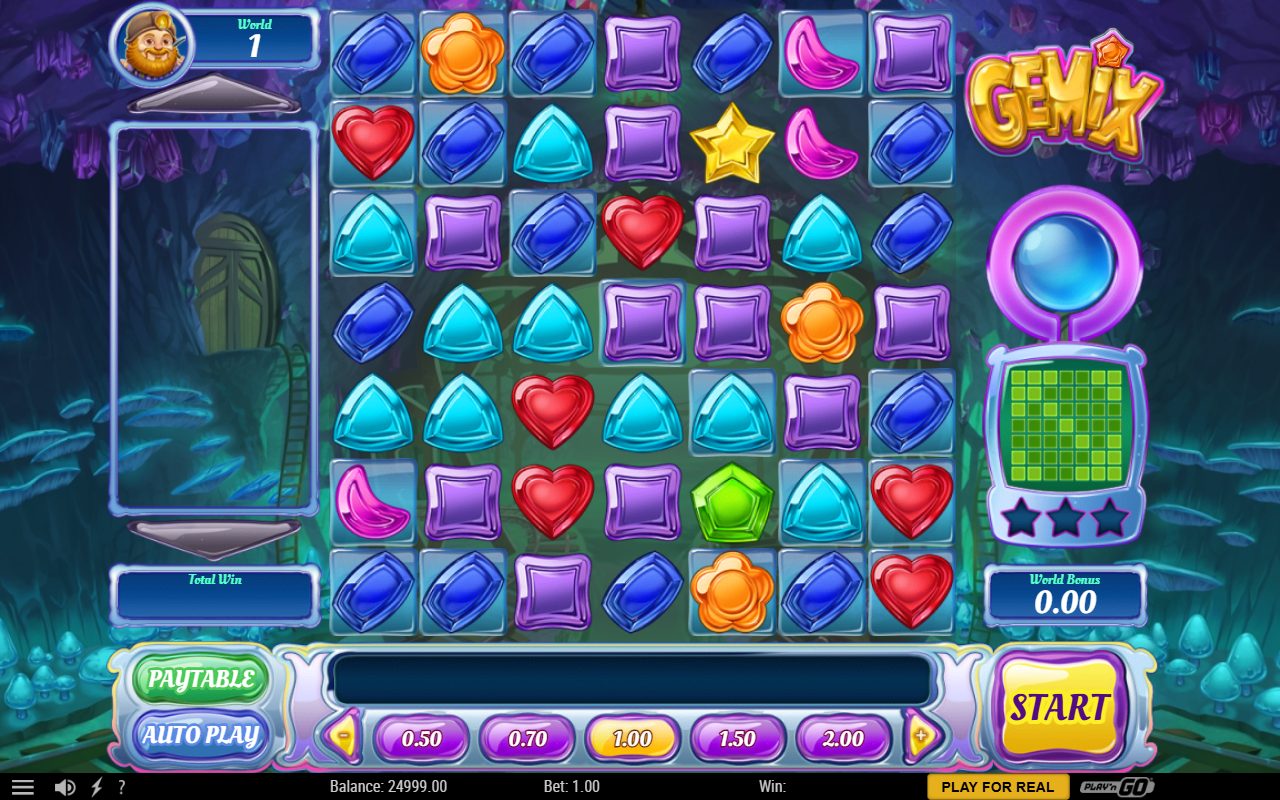
Gemix operates on a single 7x7 grid with no traditional paylines. Instead, wins are formed by landing clusters of at least 5 identical symbols touching horizontally or vertically. Once a winning cluster lands, those symbols are removed and new ones drop in from above — a cascade mechanic that can chain multiple wins from a single spin.
The paytable is gem-based with eight symbol types. The Star gem pays 1,000x for a cluster of 15 or more, the Heart pays 500x, the Half Moon 200x, and the Flower 100x. The four lower-value gems pay between 7.5x and 30x at the 15+ cluster threshold. Practically, clusters of exactly 15 are uncommon; most winning spins will resolve at smaller cluster sizes with proportionally lower returns.
The single payline listed in the spec refers to the cluster-pays structure rather than a traditional line — there's no multi-line configuration to manage. This simplifies the betting interface significantly: one stake, one grid, and the cascade does the rest.
Crystal Charge and the Three Worlds
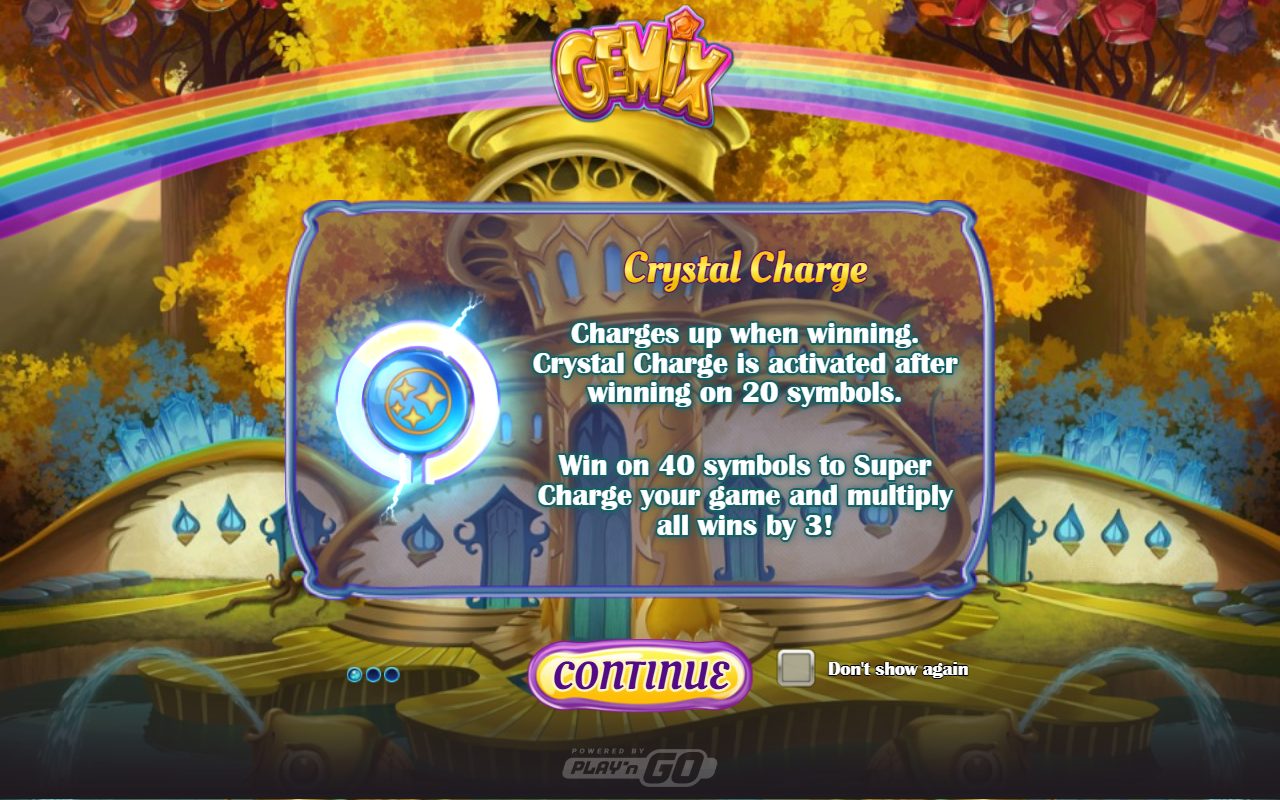
The core feature mechanic in Gemix is the Crystal Charge, which activates when cascades remove at least 20 symbols from the grid in a single spin sequence. At that threshold, one of four modifiers fires depending on which of the three worlds is currently active.
The four Crystal Charge modifiers are: Nova Blast, which detonates a symbol and destroys adjacent ones; Crystal Warp, which converts all instances of one symbol type into another; Light Beam, which fires from a single symbol and transforms others in its path; and Chain Lightning, which connects two corner symbols via a lightning arc and transforms every symbol the arc touches into one of those two types. Each modifier has a different strategic value — Chain Lightning and Crystal Warp tend to produce the largest symbol-count transformations, while Nova Blast is more localized.
The three worlds each have their own assigned modifier set and visual theme, which means the specific features available to you shift as you progress. A Super Charge upgrade applies when cascades remove 40 or more symbols in a sequence: all wins generated during the Crystal Charge are boosted by a 3x multiplier. That multiplier is the primary driver of the slot's upper win range and is the mechanism most responsible for the 6025x ceiling becoming attainable.
Wilds and the Random Modifier
Gemix includes a Wild symbol that substitutes for all regular gem symbols within clusters. Wilds function as standard connectors within the cluster engine — they extend cluster sizes rather than forming independent wins, which is appropriate for a grid-based format.
Each world also carries a random modifier that can trigger on non-winning spins, converting what would otherwise be a dead spin into a potential winner. The specific form this modifier takes varies by world, which ties the random feature directly to the world-progression system rather than operating as a universal safety net.
This combination of a reactive cascade system, a threshold-based Crystal Charge, and a random loss-mitigation modifier gives Gemix a layered feature structure that is denser than most 2014-era slots. The base game rarely feels entirely inert — even below-threshold cascades generate enough symbol movement to keep the grid dynamic.
Live Tracked-Bet Data on Spindex
Spindex has recorded 717 bets on Gemix across our five crypto-casino sources over the past 30 days. That's a modest but steady volume — enough to confirm the game maintains an active player base a full decade after release, though it trails higher-traffic titles like Book of Dead or Sweet Bonanza by a significant margin in our dataset.
The top recent hit logged on our network came in at 203x. That figure is well below the 6025x theoretical ceiling, which is consistent with the medium-volatility profile — large multiplier events require sustained cascade chains with Super Charge activation, and those combinations are relatively rare. Most tracked sessions appear to resolve in the 10x–80x range based on the distribution we're seeing.
The steady rather than surging volume suggests Gemix is a retention play for existing fans rather than a trending discovery title right now. If you're deciding between Gemix and a newer Play'n Go cluster slot, the live data doesn't point to any unusual recent performance that would tip the balance — it's playing true to its long-term character.
Bet Range and Accessibility
The $0.50 minimum bet makes Gemix accessible to low-stakes players, and the $100 maximum covers most recreational high-rollers. There is no bonus buy feature in Gemix's confirmed feature set, which means players cannot pay a premium to access the Crystal Charge directly — every feature must be earned through the cascade mechanic organically.
For casual players, the absence of a bonus buy is actually a structural advantage: the base game cascade system provides regular engagement without requiring feature-round purchases that can drain a bankroll quickly. The medium volatility reinforces this — sessions tend to be longer and more gradual than high-variance titles.
Play'n Go built Gemix with mobile compatibility from the outset, and the 7x7 grid translates cleanly to smaller screens. The cluster interface requires no payline tracking, which further simplifies mobile play.
Who Should Play Gemix
Gemix suits players who prefer mechanical depth over cinematic presentation. The three-world progression system, four Crystal Charge modifiers, and cascade engine give experienced players enough variables to engage with strategically, even if the outcomes remain RNG-determined.
The medium volatility and $0.50 minimum make it a reasonable choice for players who want extended sessions without the bankroll pressure of high-variance titles. The 6025x ceiling is meaningful upside for that volatility tier — it's not a capped low-win game dressed up with features.
However, the 94.78% RTP is a genuine drawback for mathematically conscious players. Anyone prioritizing return rate above feature variety should look at Play'n Go's newer cluster releases or comparable titles from other studios with RTPs above 96%. Gemix rewards players who value the feature system enough to accept the return-rate trade-off.
Final Verdict
Gemix holds up better than most decade-old slots because its cluster-cascade mechanic and world-based modifier system were genuinely ahead of their time in 2014. The four Crystal Charge modifiers, Super Charge multiplier, and three-world structure give it a feature density that many newer titles still don't match.
The 94.78% RTP remains the slot's most significant weakness. It's not disqualifying, but players should go in aware that the return rate is roughly 1.2–1.5 percentage points below what Play'n Go and the broader market now deliver as standard. That gap compounds over longer sessions.
At medium volatility with a 6025x ceiling and no bonus buy, Gemix is best treated as a session-play slot where the cascade chains and Crystal Charge activations are the entertainment, not a vehicle for chasing single large hits. On that basis, it still earns its place in Play'n Go's catalog and in any serious player's rotation.
- +6025x max win is strong for medium volatility
- +Four distinct Crystal Charge modifiers add genuine mechanical variety
- +Three-world progression system keeps the feature set from feeling repetitive
- +3x Super Charge multiplier provides a clear path to upper win range
- +No bonus buy means base game engagement is the full experience
- +$0.50 minimum bet is accessible for low-stakes play
- -94.78% RTP is below current Play'n Go and industry standards
- -No bonus buy option for players who prefer direct feature access
- -Hit frequency data is not publicly confirmed
- -Top recent Spindex hit of 203x suggests the ceiling is rarely approached
Best for
Gemix is a mechanically rich cluster-pays slot that has aged well. The 6025x ceiling and four Crystal Charge modifiers give medium-volatility players genuine upside, though the 94.78% RTP is a real concession compared to newer Play'n Go titles. Best suited to players who enjoy cascade mechanics and don't mind a slightly below-average return rate in exchange for feature variety.