






Pearls of India Review
Play'n Go released Pearls of India back in October 2014, and over a decade later it still circulates across casino lobbies as one of the studio's enduring catalog entries. Built around Rich Wilde — the provider's signature explorer character — this 5x3, 20-payline video slot carries a 94.87% RTP, medium volatility, and a 10,000x max win ceiling. That RTP sits noticeably below the modern industry benchmark of 96%, which is worth knowing upfront, but the bonus structure is genuinely layered: a free spins round with escalating multipliers and a separate progressive Golden Temple bonus that unlocks through symbol collection give the game more mechanical depth than a typical mid-2010s release. Bets run from $0.01 to $100, making it accessible across bankroll sizes. This review breaks down exactly how those mechanics work, what the math profile means for your session, and whether the slot still earns a place in your rotation in 2026.

RTP, Volatility, and Max Win
The headline number to address first is the 94.87% RTP. For context, Play'n Go's more recent releases — such as Legacy of Dead (96.58%) or Reactoonz 2 (96.20%) — sit roughly 1.3–1.7 percentage points higher. Over thousands of spins that gap compounds meaningfully, so players who track their theoretical return should factor it in before committing to longer sessions on Pearls of India.
Volatility is rated medium, which aligns with a game designed to deliver a mix of smaller base-game hits alongside the bigger swings that come from the bonus rounds. The 10,000x max win is the upper limit of what the Golden Temple and free spins mechanics can combine to deliver — a ceiling that was competitive in 2014 and remains respectable even measured against today's catalog.
The bet range of $0.01 to $100 per spin means the 10,000x figure scales from a $100 jackpot at minimum stake to a $1,000,000 theoretical maximum at the top end. Medium volatility with that kind of ceiling suggests the distribution of wins skews toward moderate, frequent payouts rather than rare, enormous ones — a profile that suits players who prefer sustained play over high-variance swings.
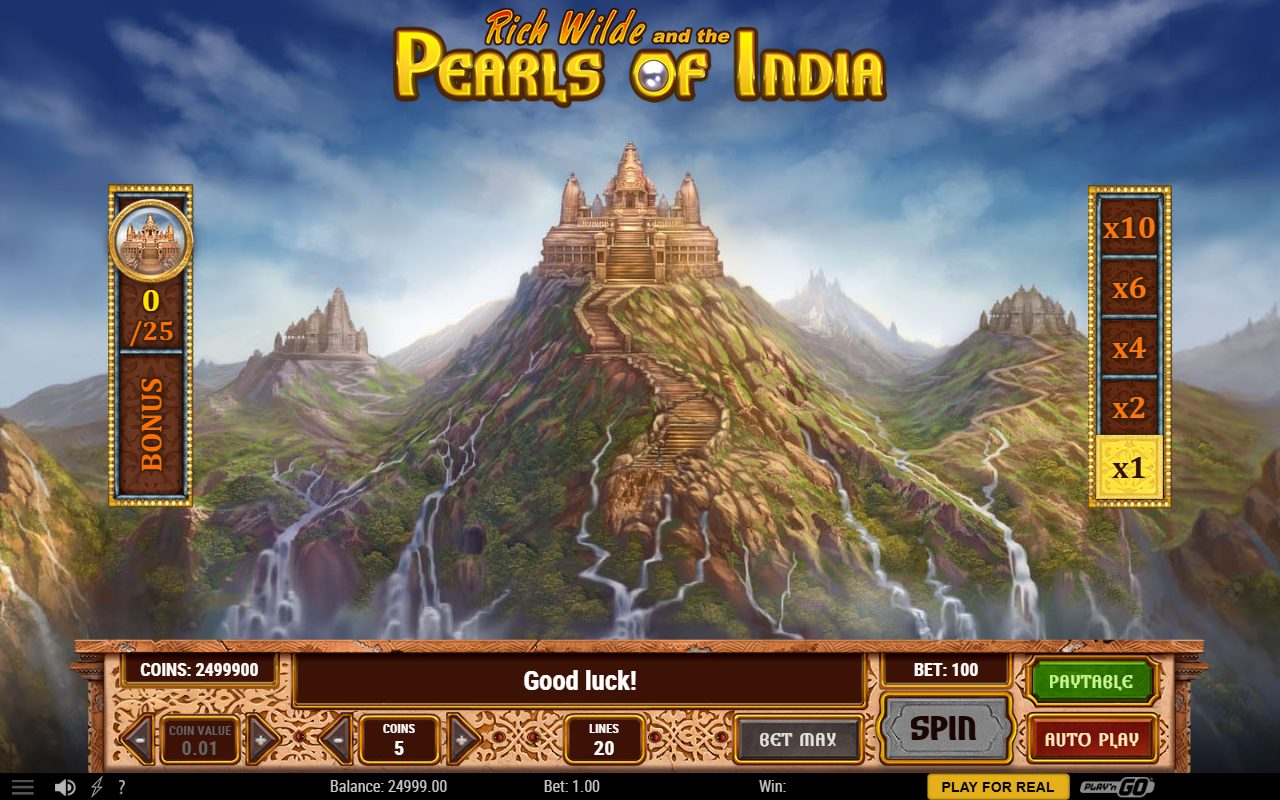
How Pearls of India Plays
The layout is a standard 5x3 grid with 20 fixed paylines. Rich Wilde appears on the reels as a character symbol, and the Indian artifact theme — temples, statues, pearls, stone carvings — fills out the paytable across the remaining positions. Wilds substitute for standard symbols in the usual fashion, and scatter symbols are the key to triggering the free spins round.
What separates Pearls of India from a generic 20-line slot is the dual-bonus architecture. Most sessions will involve working toward one of two distinct bonus states: the scatter-triggered free spins or the progressive Golden Temple bonus. The base game functions as the engine that feeds both, which gives each spin a sense of dual purpose even when neither bonus is close to triggering.
The gamble (double) feature is also available after wins, letting players risk their payout for a chance to double it. This is a standard Play'n Go addition across many of their catalog titles and adds an optional risk layer for players who want it without forcing it on those who don't.
Bonus Features: Free Spins and the Golden Temple
The free spins round is activated by scatter symbols and carries multipliers that increase as the round progresses. The escalating multiplier structure means later spins in the sequence are worth more than earlier ones — a design choice that rewards patience and creates a natural build of tension across the feature.
The Golden Temple bonus operates on a collection mechanic. Players must accumulate 25 specific symbols across base-game spins to unlock it — a progressive trigger that can take many spins to reach. Once unlocked, the bonus presents a choice of three temple options, each carrying different prize structures, with the top reward reaching 250x the total bet. That 250x figure is meaningful on larger stakes but modest at minimum bet levels, so this particular bonus rewards players who size their bets accordingly.
The combination of a multiplier-driven free spins round and a collection-based bonus game gives Pearls of India more replay texture than its age might suggest. Neither feature is common to trigger in the same session, which keeps the game from feeling repetitive across longer play periods. The risk/gamble option after standard wins rounds out the feature set for players who want an additional decision point mid-session.
Bet Range and Accessibility
Pearls of India supports bets from $0.01 up to $100 per spin across its 20 fixed paylines. The $0.01 floor makes it one of the more accessible Play'n Go titles for low-stakes players, and the $100 ceiling is sufficient for mid-to-high rollers who want meaningful exposure to the 10,000x max win.
The fixed 20-payline structure keeps the math straightforward — no adjustable lines means no risk of accidentally reducing coverage and distorting the RTP. Every spin at every stake level uses the same 20 lines, which simplifies session planning and bankroll management.
For players using the gamble feature, the doubling mechanic applies to individual wins rather than accumulated balance, so it functions as a controlled risk tool rather than an all-or-nothing escalation. That design keeps the feature optional and low-stakes in feel even at higher bet levels.
Theme and Presentation
Pearls of India is an adventure and ancient civilizations slot with an Indian temple setting. Released in 2014, the visual production reflects the standards of that era — functional rather than cutting-edge by 2026 benchmarks.
The Rich Wilde character ties this slot into Play'n Go's broader explorer series, which includes Book of Dead and other titles built around the same protagonist. Players familiar with that catalog will recognize the character-driven structure immediately.
Who Pearls of India Is Best For
The medium volatility profile and dual-bonus structure make Pearls of India a reasonable fit for players who enjoy progression mechanics — specifically, the satisfaction of working toward a collection-based trigger rather than waiting purely on random scatter hits. The Golden Temple's 25-symbol accumulation gives each base-game spin a secondary purpose that purely RNG-driven slots lack.
Players who prioritize RTP above other factors will note the 94.87% figure and likely prefer newer Play'n Go titles. That's a fair trade-off. But players who enjoy the Rich Wilde series, or who want a medium-volatility slot with a meaningful max win and two distinct bonus paths, will find Pearls of India delivers on both counts.
The $0.01 minimum bet also makes it suitable for players who want to explore the bonus mechanics without significant bankroll exposure — particularly useful for understanding the Golden Temple collection rate before committing to higher stakes.
Final Verdict
Pearls of India holds up better than many 2014-era slots because its bonus architecture was ahead of the curve for its time. The progressive Golden Temple collection mechanic and the escalating multiplier free spins give the game a structural depth that pure payline slots from the same period lack.
The 94.87% RTP is the clearest reason to temper enthusiasm — it's a real cost over volume, and players should go in with that awareness. But medium volatility, a 10,000x max win, and a $0.01 minimum bet make the overall package accessible and mechanically interesting enough to justify at least a demo session.
For Play'n Go loyalists working through the Rich Wilde catalog, Pearls of India is a worthwhile stop. For players optimizing purely on RTP, newer entries in the same series offer better theoretical return without sacrificing the explorer theme.
- +10,000x max win ceiling with medium volatility — balanced risk profile
- +Two distinct bonus paths: scatter free spins and progressive Golden Temple collection
- +Escalating multipliers during free spins add late-round value
- +Bet range $0.01–$100 suits a wide range of bankroll sizes
- +Fixed 20 paylines — no coverage confusion at any stake level
- +Part of Play'n Go's Rich Wilde series for players who follow the catalog
- -94.87% RTP sits roughly 1.3–1.7 points below current Play'n Go catalog averages
- -Golden Temple bonus requires 25-symbol collection — can take many spins to trigger
- -Visual production reflects 2014 standards, not current-gen quality
- -Hit frequency not published by Play'n Go
Best for
Pearls of India is a mechanically solid older Play'n Go title with a genuinely interesting two-track bonus system. The 94.87% RTP is the one number that gives pause — it's low by current standards — but medium volatility and a 10,000x ceiling keep the risk-reward profile reasonable. Best suited to players who enjoy progressive collection mechanics and multiplier-driven free spins rather than pure volatility chasers.