
The Wildwood Curse Review
A 10,000x ceiling on medium volatility is not the combination you see every day. Hacksaw Gaming's The Wildwood Curse, released in September 2025, pairs a horror-forest theme with a 6x5 grid, 19 betways, and a layered feature set built around sticky wilds and a three-variant multiplier cluster system. The RTP sits at 96.3% — above Hacksaw's typical studio average of around 96.2% — and a 40% hit frequency means the base game returns something reasonably often, even if the transformative moments are gated behind the Cursed Cluster mechanic.
The feature list is dense: Nightmare Respins, three distinct Cursed Cluster types, two scatter-triggered free spin modes, a hidden bonus for five scatters, Bonus Bet options, and direct Bonus Buy entries into the free spin rounds. That is a lot of moving parts for a medium-volatility slot, and whether they cohere into a satisfying session depends heavily on which RTP variant your casino has configured. That detail matters more here than with most Hacksaw releases, and it shapes the recommendation at the bottom of this review.

RTP, Volatility, and Max Win
The Wildwood Curse publishes a headline RTP of 96.3%, but the game ships with multiple configurable RTP tiers — a now-standard Hacksaw practice that puts real responsibility on the player to check which setting their casino has enabled. The Bonus Buy into The Swamp runs at 96.26%, The Playground buy at 96.28%, and the two Bonus Bet modes sit at 96.29% and 96.23% respectively. None of those figures are alarming, but the spread matters when you're choosing how to enter the game.
Medium volatility with a 40% hit frequency positions The Wildwood Curse differently from most Hacksaw output, which skews toward high or very-high variance. For context, Hacksaw's Wanted Dead or a Wild carries a 12,500x max win and high volatility; The Wildwood Curse trades some ceiling and variance for a smoother session shape while still offering a 10,000x top payout — a figure that genuinely competes with high-volatility peers from other studios.
The 40% hit rate means roughly two in every five spins return something, which is solid for a feature-heavy grid slot. Most of those base-game returns will be modest; the real payout weight sits inside the free spin rounds where Cursed Clusters and their multipliers can compound. Players who prioritise bankroll longevity over spike potential will find the medium volatility profile useful, but the slot is not a grind-friendly low-variance pick — the big numbers still require feature activation.

How The Wildwood Curse Plays
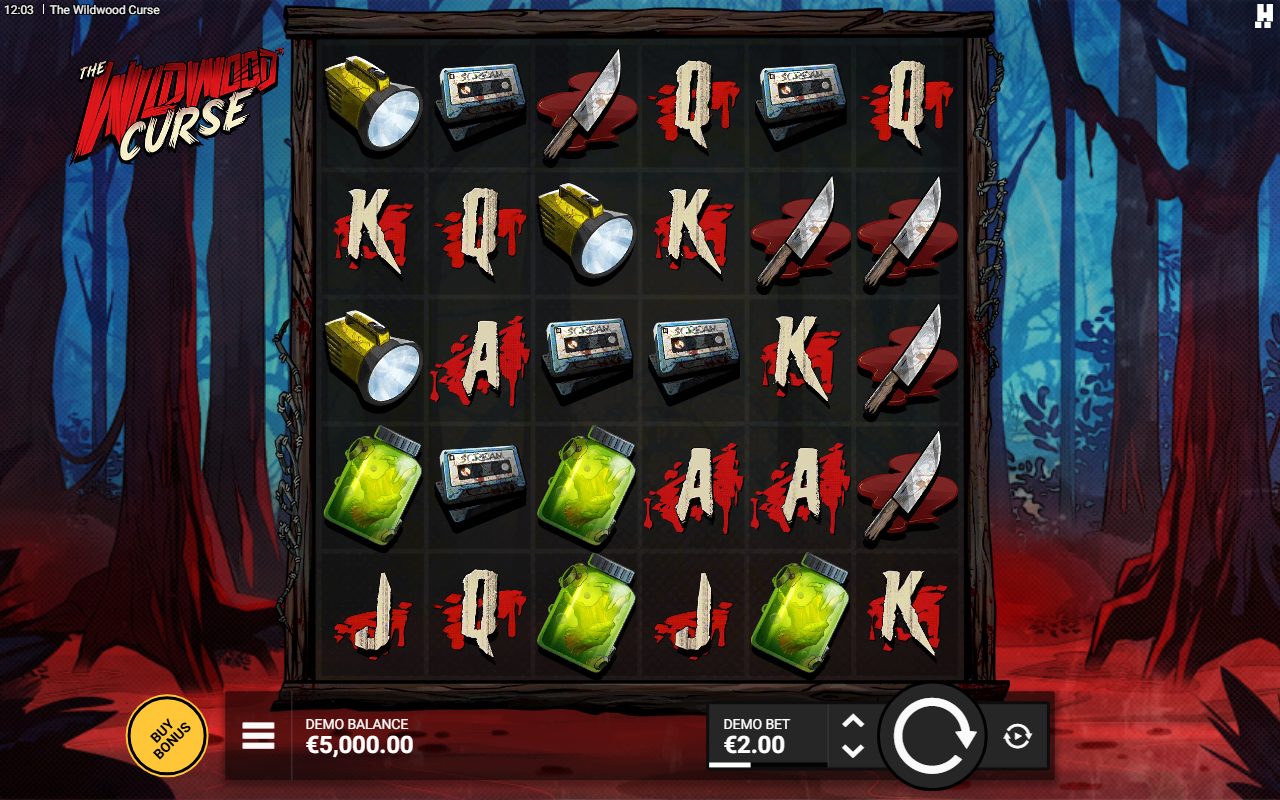
The Wildwood Curse runs on a 6x5 grid with 19 fixed betways, accepting bets from $0.10 to $100 per spin. The layout is wider than the typical 5-reel setup, which gives wilds more room to cluster and the Nightmare Respin mechanic more space to extend.
Every wild that lands sticks to its position and triggers a Nightmare Respin. Subsequent wilds also lock, and the sequence continues until no new wilds arrive or the grid fills entirely — wins are paid after each individual spin in the chain. The mechanic is self-extending in a way that can turn a single wild into a multi-spin event without any scatter involvement, which keeps base-game sessions from feeling purely dormant.
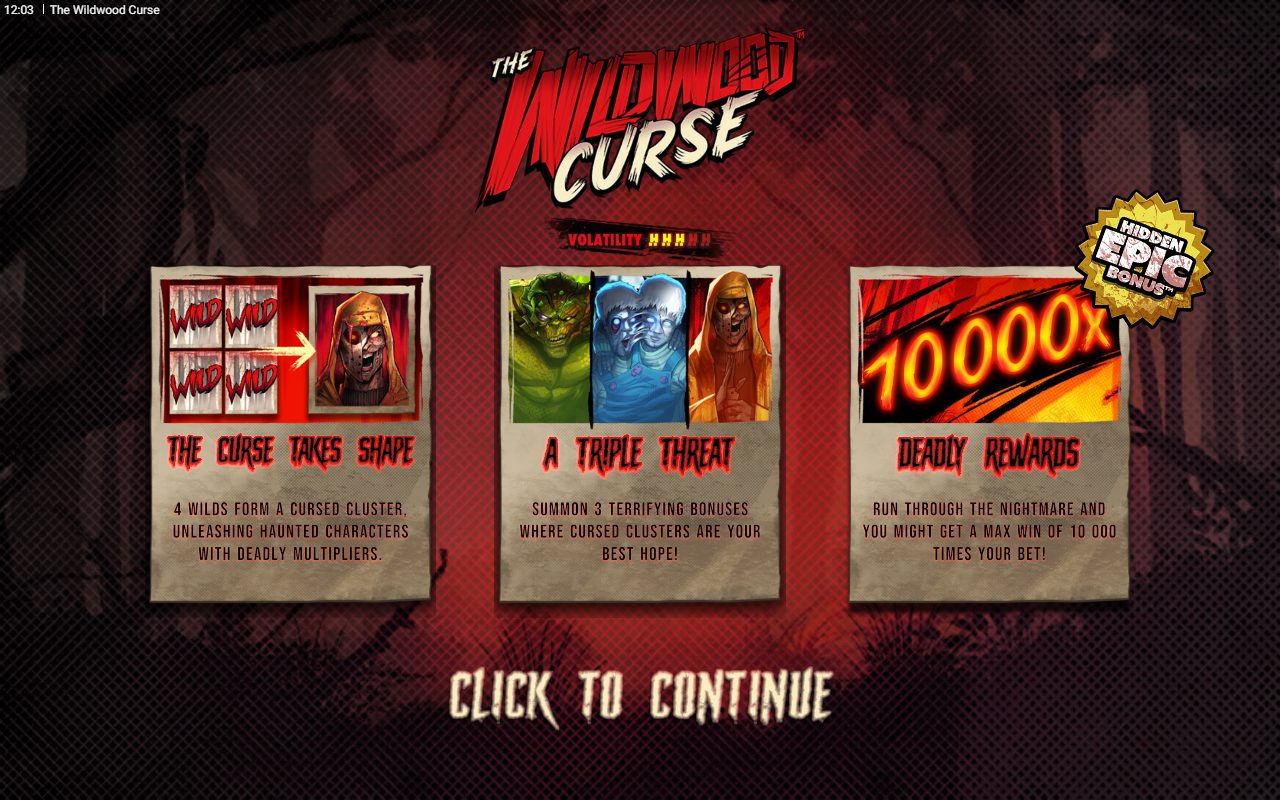
The critical escalation happens when four wilds form a 2x2 block, creating a Cursed Cluster. Three character types can emerge from that formation: the Psycho Cluster applies a x2–x100 multiplier (additive if multiples appear), the Monster Cluster scatters multipliers to random grid positions that can stack and refresh on each respin, and the Twins Cluster starts at x2 and doubles every respin up to x1,000, with values combining across multiple Twins. Up to six Cursed Clusters can be active simultaneously, and their multipliers merge when contributing to the same win line. That stacking potential is where the 10,000x figure becomes reachable.
Bonus Features in Detail
Three scatter symbols unlock The Swamp: 8 free spins with elevated wild frequency, making Nightmare Respins substantially more common than in the base game. Four scatters open The Playground: 10 free spins where Cursed Cluster probability is boosted, shifting the session's weight toward the multiplier system rather than raw wild volume. Five scatters activate No Escape — also 10 free spins — which mirrors The Swamp's wild frequency but guarantees at least one Cursed Cluster is active from the start.
The three-mode structure is meaningful rather than cosmetic. The Swamp suits players who want extended respin chains; The Playground targets the multiplier ceiling; No Escape blends both approaches with the guaranteed cluster acting as a floor on the feature's potential. Each mode has a different risk-reward profile within the same nominal free spin count.
For players who prefer direct access, Bonus Buy entries are available: The Swamp costs its standard multiplier of the base bet and runs at 96.26% RTP, while The Playground entry runs at 96.28%. The Bonus Bet menu offers two alternatives without bypassing the base game entirely — Bonushunt FeatureSpins™ raises scatter odds at 96.29% RTP, and Cursed FeatureSpins™ focuses on Cursed Cluster frequency at 96.23% but disables scatter symbols entirely. That last detail is worth noting: choosing Cursed FeatureSpins™ means free spin rounds cannot trigger through normal scatter landings.
Live Tracked-Bet Data on Spindex
Spindex has tracked 5,000 bets on The Wildwood Curse across five crypto-casino sources over the past 30 days, with the game currently reading as warm on our trend signal. For a title released in September 2025, that volume suggests steady early adoption rather than a viral spike — players are finding it and returning, which aligns with the medium-volatility profile making sessions more repeatable than a high-variance release would allow.
The largest confirmed hit in our tracked data sits at 631x. That number is well below the 10,000x theoretical ceiling but consistent with medium-volatility behaviour over a relatively small sample — big cluster stacks at the top of the Twins multiplier range require a specific confluence of conditions that a 5,000-bet window is unlikely to capture. It does confirm the feature rounds are paying out at meaningful multiples in real play.
As the game accumulates more tracked volume through Q4 2025, we will update the hit distribution data. Players using Spindex's crypto-casino sources can filter The Wildwood Curse sessions directly from the tracked-bet dashboard to see current payout distribution across the three free spin modes.
Theme and Visual Design
The Wildwood Curse occupies the horror, forest, and dark-mythology categories — a slasher-adjacent aesthetic with three distinct antagonist characters anchoring the Cursed Cluster symbols.
The three cluster portraits — a hooded figure, a swamp creature, and conjoined twins — are visually differentiated enough that players can read which cluster type has triggered at a glance, which matters practically when multipliers are stacking mid-respin. Symbol clarity on a 6x5 grid is not trivial, and Hacksaw's design choices here serve the mechanics directly rather than existing purely for atmosphere.
Standard pay symbols run from J–A ranks through cassette tapes, a knife, flashlights, and a jarred hand. The design language is consistent throughout, and nothing in the symbol set conflicts with reading the grid during active respin sequences.
Bet Range and Accessibility
The $0.10 minimum bet makes The Wildwood Curse accessible to casual bankrolls, while the $100 maximum covers most recreational high-roller sessions. At minimum bet, a Bonus Buy into The Playground would cost a fixed multiple of the base stake — the exact cost is determined at runtime by the casino client, but Hacksaw's standard Playground buy typically runs in the 80–100x range, placing it at $8–$10 minimum investment at the lowest stake.
The Bonus Bet modes add a smaller surcharge per spin — typically 25–50% above the base bet — and are a practical middle ground for players who want improved feature odds without committing to a full Bonus Buy. Cursed FeatureSpins™ in particular is worth considering for players whose primary interest is the multiplier system, provided they understand scatter-triggered free spins are disabled in that mode.
At $100 maximum bet, a 10,000x hit would return $1,000,000 — a theoretical figure, but one that confirms the game's ceiling is competitive at higher stakes. The medium volatility means that ceiling is not being approached on a regular cadence; it represents the extreme tail of the Twins Cluster multiplier stack under optimal conditions.
Who The Wildwood Curse Is Best For
The Wildwood Curse is best suited to players who want a feature-rich session without committing to the extreme variance swings that characterise most Hacksaw output. The 40% hit frequency and medium volatility create a more sustainable base-game rhythm than titles like Stick'em or Wanted Dead or a Wild, while the 10,000x ceiling ensures the slot isn't sacrificing ambition for stability.
The Cursed Cluster mechanic rewards players who understand the three character types and their multiplier behaviours — this is not a slot where passive play extracts full value. Knowing that Twins Clusters compound multiplicatively while Monster Clusters scatter independently changes how you interpret an active respin sequence and whether a Bonus Buy into The Playground makes sense for your session goal.
Players who prefer lighter themes or straightforward mechanics will find The Wildwood Curse unnecessarily complex. The horror aesthetic is committed rather than decorative, and the feature interactions require attention across multiple simultaneous cluster types. For players who enjoy that level of engagement, the medium volatility makes it a more repeatable choice than the genre typically allows.
Final Verdict
The Wildwood Curse is a technically accomplished release that justifies its feature complexity with genuine mechanical differentiation between its cluster types and free spin modes. The Twins Cluster's doubling multiplier structure in particular creates a distinct risk curve that separates this from generic sticky-wild slots, and the 10,000x max win on medium volatility is a pairing Hacksaw doesn't often offer.
The base game pacing can drag between respin sequences — 19 betways on a 6x5 grid means dry spins feel emptier than on a denser payline structure, and the Cursed Cluster mechanic is entirely dependent on wilds clustering into 2x2 formations, which doesn't happen on every feature activation.
The RTP variant question remains the most important practical consideration. At 96.3% the slot is priced fairly; at lower operator-configured settings the value proposition weakens. Check before playing. Subject to that caveat, The Wildwood Curse is one of the more interesting medium-volatility releases Hacksaw has produced, and the live data showing warm trend momentum in early tracked play suggests the player base agrees.
- +10,000x max win on medium volatility — a rare combination in Hacksaw's catalogue
- +Three mechanically distinct Cursed Cluster types with different multiplier logic
- +40% hit frequency supports bankroll longevity relative to high-variance peers
- +Three free spin modes with meaningfully different risk-reward profiles
- +Bonus Bet and Bonus Buy options cover multiple entry strategies
- +96.3% RTP sits above Hacksaw's typical studio average
- -Multiple RTP tiers — lower operator-configured settings significantly affect value
- -Base game pacing slows between respin sequences on 19 betways
- -Cursed FeatureSpins™ Bonus Bet disables scatter symbols entirely — easy to miss
- -Cluster formation requires specific 2x2 wild arrangement, limiting frequency
- -Horror theme is committed and not suited to all player preferences
Best for
The Wildwood Curse earns its place in Hacksaw's 2025 lineup. The Cursed Cluster system — three character types, each with distinct multiplier logic — gives the feature rounds genuine depth, and a 10,000x max win on medium volatility is a rare pairing. The base game can stall between respins, but the 40% hit rate keeps it from feeling barren. Verify the RTP variant before depositing; the difference between the top and lower settings is meaningful.