
Fire Strike Review
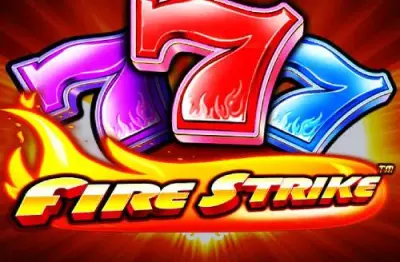
Fire Strike is a 2019 Pragmatic Play release built around a deceptively simple premise: land enough scatter and wild symbols in a single spin and collect an instant prize — no bonus round required. On a 5x3 grid with just 10 paylines, the action is stripped back to its essentials, and the entire weight of the game rests on one escalating prize ladder that tops out at 25,000x your stake for a full screen of 15 Fire Strike scatters. That ceiling has since been revised upward to 27,000x in updated configurations.
The betting range runs from $0.10 to $50 per spin, which keeps it accessible without offering the high-roller ceiling of some Pragmatic titles. Volatility sits at medium-high — enough to produce long dry spells between meaningful hits, but not the extreme variance of something like Gates of Olympus. With RTP options of 94.5%, 95.5%, or 96.5% depending on the casino, the version you actually play matters more than most players realize.

RTP, Volatility, and Max Win
The RTP on Fire Strike is not a fixed number — it's a configurable setting that casinos select from three tiers: 94.5%, 95.5%, or 96.5%. The version you encounter depends entirely on the operator. Spindex data sources track the 95.5% variant most commonly across crypto casinos, which sits marginally below the industry midpoint of around 96%. If you're choosing where to play, it's worth checking whether the casino discloses which RTP tier they've deployed.
Volatility is rated medium-high — Pragmatic's own in-game scale places it at 3.5 out of 5. That positioning is meaningful: the hit frequency is unlisted, but the prize ladder structure suggests most spins resolve with nothing, while occasional mid-tier hits (8 to 12 symbols in view) deliver between 8x and 500x. The distribution is steep rather than gradual.
The 27,000x max win is the headline number, and it compares favorably within Pragmatic's classic-style catalog. For context, Fruit Party 2 — another Pragmatic release with a similar volatility band — caps at 5,000x, making Fire Strike's ceiling roughly five times higher. That said, reaching 27,000x requires a specific, low-probability outcome: 15 scatters with no wilds substituting. It's a real ceiling, not a theoretical one padded by free spins multipliers.

How Fire Strike Plays
Fire Strike runs on a standard 5-reel, 3-row layout with 10 fixed paylines. The symbol set is classic in orientation — bars, dice, and 7s form the core of the paytable, with the Fire Strike wild and scatter serving as the primary value drivers. There is no free spins round, no pick-me bonus, and no hold-and-win mechanic. The entire feature set resolves within the base game on every spin.
The wild symbol has a dual function. It substitutes for standard pay symbols to complete line wins, and it also counts toward the scatter prize ladder — with one critical exception. To trigger the top prize of 25,000x (or 27,000x in updated configurations), all 15 qualifying symbols must be scatters. Wilds count for every other prize tier but are excluded from the Grand Jackpot condition. That distinction changes how you read near-misses: a screen heavy with wilds is valuable, but it can never deliver the top payout.
The prize ladder activates at 6 combined symbols in view (1x stake) and escalates sharply: 12 symbols pays 500x, 13 pays 1,000x, 14 pays 2,500x, and 15 pays 5,000x from the mixed tier — or 25,000x if all 15 are pure scatters. That gap between the mixed 15-symbol prize (5,000x) and the scatter-only version (25,000x) is the slot's defining tension.
Bonus Features Breakdown
Fire Strike's feature list is intentionally minimal: a wild symbol, an instant scatter prize system, and the Grand Jackpot condition. There is no bonus buy option, no free spins trigger, and no progressive multiplier. What exists is the 9 Pots of Gold-style instant prize mechanic — a format popularized by Gameburger Studios' 9 Masks of Fire — adapted here with Pragmatic's own symbol set and prize structure.
The wild pays up to 200x on its own as a line symbol, which provides a baseline of base-game value independent of the scatter ladder. More practically, the wild's ability to substitute for scatter symbols on all prize tiers except the top one means it actively accelerates mid-tier payouts. Landing 10 combined symbols (mix of wilds and scatters) pays 50x; landing 11 pays 150x. These mid-range outcomes are the realistic frequency band for players who hit the feature at all.
The absence of a bonus round is the most significant structural fact about Fire Strike. Every spin is resolved in the base game. There's no secondary screen, no retriggering mechanic, and no escalating multiplier sequence. For some players that's a clarity advantage — the rules never change mid-session. For others, it means there's no secondary excitement layer to sustain engagement during losing streaks. That trade-off is worth understanding before committing to extended play.
Live Tracked-Bet Data on Spindex
Across Spindex's five crypto-casino data sources, Fire Strike recorded 702 tracked bets over the past 30 days. That's a modest volume figure — enough to establish a reliable trend signal, but below the activity levels of higher-traffic Pragmatic titles in the same period. The current trend reads cold, meaning recent return rates across tracked sessions are running below the slot's stated RTP.
The largest confirmed hit in the tracking window came in at 500x. That's a meaningful data point: it confirms the mid-tier prize ladder is firing, but no session in the tracked period approached the upper prize tiers (1,000x+). A 500x top hit over 702 bets suggests the slot is behaving within its medium-high volatility profile — big wins are infrequent but not absent.
For players using Spindex data to time sessions, the cold signal on Fire Strike is a practical caution flag rather than a definitive verdict. Volatility slots can run cold for extended windows before reverting. Still, 702 bets with a 500x ceiling hit and no tracked session above that threshold in 30 days is a realistic picture of what short-to-medium sessions look like on this title right now.
Bet Range and Accessibility
Fire Strike accepts bets from $0.10 to $50 per spin. The lower end makes it reachable for casual bankrolls, and the $50 ceiling is standard for Pragmatic's non-VIP catalog. At minimum stake, the Grand Jackpot pays $2,500 (25,000x) or $2,700 in updated configurations — a meaningful sum at that bet level. At $50 per spin, the same outcome pays $1,250,000 to $1,350,000, which is where the slot's appeal to higher-stakes players becomes clear.
The medium-high volatility at minimum bet creates a specific bankroll math problem: long dry spells between meaningful hits at $0.10 per spin are low-cost to sustain, but the prize ladder doesn't scale down in terms of probability. A 200-spin session at minimum bet ($20 total exposure) is a reasonable exploration window, though the cold trend signal on Spindex suggests variance runs long on this title currently.
Who Fire Strike Is Best For
Fire Strike is best suited to players who prefer mechanical simplicity over feature complexity. The entire game state is visible on the base grid — there's no secondary mechanic to track, no bonus buy to budget for, and no free spins variance to absorb. What you see on every spin is what determines the outcome.
The 27,000x max win and the scatter-only Grand Jackpot condition make it relevant for jackpot-oriented players who want a defined target rather than an open-ended multiplier chain. The rules for hitting the top prize are explicit: 15 scatters, no wilds, full grid. That transparency is genuinely useful for players who want to understand exactly what they're chasing.
Players who require a bonus round or a free spins feature to stay engaged will find Fire Strike structurally limiting. The base game pacing can feel repetitive during losing streaks precisely because there's no secondary event to break the rhythm. The slot works best for short, targeted sessions rather than extended marathon play.
Final Verdict
Fire Strike is a well-constructed single-mechanic slot. Pragmatic Play built the entire experience around one escalating prize condition, and the execution is clean: the wild's dual role, the scatter-only restriction on the top prize, and the steep prize ladder all reinforce each other logically. There are no wasted features and no misleading complexity.
The RTP tiering is the most important practical consideration. The difference between the 94.5% and 96.5% configurations is significant over any meaningful session volume, and most players have no visibility into which version they're playing. That's a structural issue with the slot's deployment model, not the game design itself — but it's real.
Spindex's current cold trend and 500x top hit over 702 tracked bets suggest this is a slot in a low-return cycle. The 27,000x ceiling remains intact as a mathematical possibility, and the mid-tier prize ladder (500x–2,500x) is demonstrably reachable. For a patient player at a casino confirmed to run the 96.5% RTP variant, Fire Strike is a legitimate high-ceiling option in the classic-style category.
- +27,000x max win is exceptionally high for a classic-style slot
- +Dual-function wild counts toward scatter prizes on all tiers except the Grand Jackpot
- +Transparent prize ladder — exact symbol counts and payouts are fixed and visible
- +Three RTP tiers available (94.5%, 95.5%, 96.5%) — top tier is above industry average
- +Low minimum bet ($0.10) makes the jackpot accessible at small stakes
- -No bonus round, free spins, or secondary feature of any kind
- -RTP is operator-configurable — most players won't know which tier they're on
- -Hit frequency is undisclosed, and cold trend on Spindex suggests extended dry spells
- -Grand Jackpot requires 15 pure scatters — wilds excluded at the top tier only
Best for
Fire Strike is a no-frills scatter-jackpot slot that delivers one clear proposition: accumulate 15 qualifying symbols and win big. The 27,000x ceiling is legitimate, the mechanics are transparent, and the lack of a bonus round keeps the experience honest. It suits patience-tested players who prefer a single high-stakes trigger over layered feature complexity. The currently cold trend on Spindex warrants caution for short-session players.