





Honey Rush 100 Review
Play'n Go released Honey Rush 100 in August 2023, building on the original Honey Rush with a substantially higher max win ceiling, a redesigned multiplier system, and a more layered Colony Feature. The core mechanic is unchanged — cluster pays on a hexagonal grid, winning symbols collected into a Rush Meter — but the upgrades compound meaningfully. The multiplier now reaches 100x, up from the original's lower cap, and the max win climbs to 15,000x. That combination puts this firmly in the upper tier of Play'n Go's high-volatility catalogue.
The layout runs 4-5-6-7-6-5-4 across four reels with five rows, generating a diamond-shaped grid. Clusters of 5 to 37 matching symbols trigger wins, with no traditional paylines in play. Bets range from $0.10 to $50, making it accessible across bankroll sizes. The RTP of 96.2% is the published ceiling — operators can dial it down via configurable settings, so the number you see at any given casino may be lower. That caveat matters more here than on fixed-RTP titles.

RTP, Volatility, and Max Win
The 96.2% RTP sits slightly above the industry standard of 96.0%, but that figure is only meaningful if your casino is running the top-tier setting. Play'n Go builds in a configurable RTP range on Honey Rush 100, which means operators can and do reduce the return without disclosing it prominently. Before playing for real money, it's worth checking whether the casino publishes its active RTP configuration — many do not.
Volatility is rated high, which aligns with the mechanics. The game is designed around infrequent but large Colony Feature triggers, and the base game can grind through several dry spins before the Rush Meter fills to a meaningful level. The 15,000x max win is a significant jump from the original Honey Rush and compares favourably to Play'n Go's own Reactoonz 2, which caps at 5,000x — though it trails the studio's absolute ceiling seen in titles like Tombstone RIP at 15,000x (matching here) and Lil' Devil at 20,000x.
Hit frequency data isn't published for this title, which is a common Play'n Go omission on cluster-pay releases. Given the high volatility classification and the mechanics, expect the kind of session variance where a single well-charged cascade sequence can account for the majority of a session's return.
How Honey Rush 100 Plays
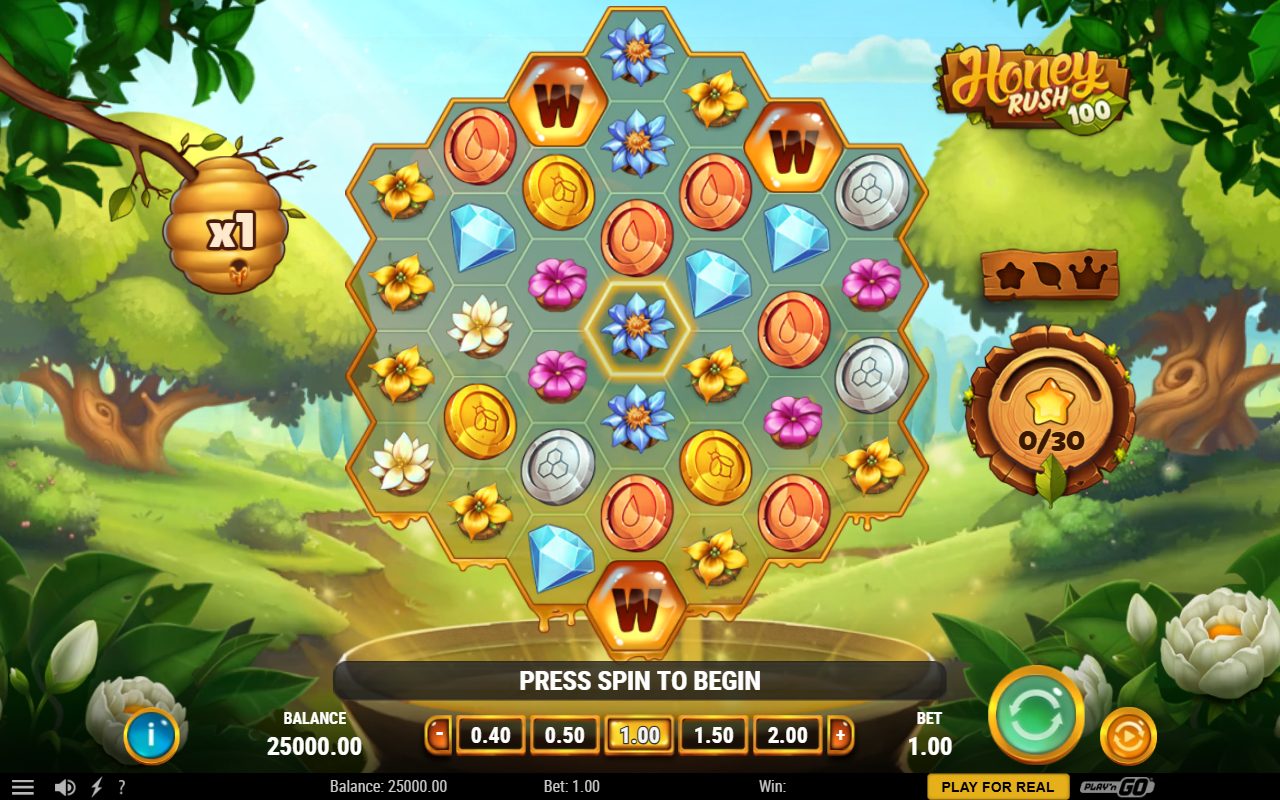
The grid shape is the first thing to register: a symmetrical diamond running 4-5-6-7-6-5-4, which means the widest point is the central column with seven symbol positions. Wins require a cluster of at least 5 matching symbols touching horizontally or vertically. The maximum cluster of 37 symbols — effectively filling the grid — pays between 10x and 50x stake depending on the symbol, before any multiplier is applied.
After each winning cluster, those symbols are removed and new symbols drop in from above via the Avalanche mechanic. Cascades continue as long as each new arrangement produces a win. Every symbol cleared is logged in the Rush Meter on the right side of the grid, and that meter is the engine driving everything else in the game.
Sticky Wilds land during play and behave differently from standard wilds. Rather than simply substituting for pay symbols, they drop to the bottom of their column and contribute to the win multiplier. Each wild reaching the bottom adds +1 to the multiplier. Once the Colony Feature has been activated at a higher tier, that increment increases to +2 or +3 per wild. The multiplier has no cap until 100x, and it persists across cascades within the same sequence.
Rush Meter and Colony Feature Explained
The Rush Meter fills as winning symbols are collected during a single cascading sequence. At 30 symbols collected, the first Colony tier activates. At 60, the second tier triggers. At 90, the third and highest tier — the Queen Colony — fires. Each tier guarantees a full-cluster win of a chosen symbol, with higher tiers awarding larger guaranteed clusters.
Collecting beyond 90 symbols in the same sequence triggers the Overcharge mechanic. Every additional 15 symbols collected upgrades the symbol that will be cloned at the end of the sequence, cycling it up toward the highest-value symbol on the paytable. Overcharging also adds +3 to the win multiplier per threshold crossed. In the best-case scenario — hitting the Queen Colony tier with a fully overcharged high-value symbol and a multiplier stacked from multiple sticky wilds — the path to four or five-figure multipliers becomes plausible, though it requires a very specific alignment of conditions.
The absence of a free spins mode is a deliberate design choice. Everything in Honey Rush 100 is channelled through this single base-game loop. There is no bonus buy option either, which means the only route to the Colony Feature is grinding through the Rush Meter organically. For players used to bonus-buy titles, that changes the session dynamic considerably — patience is not optional here.
Live Tracked-Bet Data on Spindex
Spindex has tracked 1,000 bets on Honey Rush 100 across five crypto-casino sources over the past 30 days. That's a relatively modest sample compared to perennial high-traffic titles — for reference, Honey Rush 100 sits well below the bet volume of Play'n Go's Reactoonz 2 on our network — but it's enough to identify a clear trend signal: the slot is currently running cold.
The top recorded hit in that window was 762x. That's a respectable return in absolute terms, but it's a long way from the 15,000x ceiling, and it underscores how rarely the conditions for a maximum-range payout align. A 762x top hit on a 15,000x game over 1,000 tracked bets is consistent with what high-volatility cluster mechanics produce in normal variance — the big numbers exist, but they require session volumes well beyond what most players log.
For players considering a session right now, the cold trend signal is worth factoring in. It doesn't predict future outcomes — variance doesn't carry memory — but it does reflect the recent distribution of results across our tracked sources. If you're sizing your bankroll for a Honey Rush 100 session, the current data argues for conservative bet sizing rather than top-end stakes.
Betting Range and Bankroll Considerations
The $0.10 minimum bet is standard for Play'n Go titles and makes Honey Rush 100 accessible to low-stakes players. The $50 maximum is on the lower end for a high-volatility slot — some competing cluster-pay titles from Hacksaw Gaming and NoLimit City allow $100 or more per spin, which matters to high-rollers chasing large nominal payouts.
For high-volatility play, bankroll depth is a practical concern. Without a bonus buy, reaching the Queen Colony tier requires organic progression through the Rush Meter, and that can mean extended periods of small wins or near-misses before a meaningful sequence develops. A working rule for high-volatility sessions is a minimum of 100 spins' worth of bankroll — at $0.50 per spin, that's $50 set aside before the first spin. At $1 per spin, you'd want $100 available.
The configurable RTP is also a bankroll factor. If your casino is running a reduced RTP setting — say, 94% instead of 96.2% — the expected return per $100 wagered drops from $96.20 to $94.00. Over extended play, that 2.2 percentage point difference compounds. Check the casino's game info panel before committing to a session at stakes you care about.
Who Honey Rush 100 Is Best For
Honey Rush 100 is built for players who understand cluster mechanics and are comfortable with the feast-or-famine rhythm that comes with high-volatility titles. The Rush Meter system rewards patience — the game's biggest moments come from sustaining long cascade sequences, not from landing a single high-symbol combination.
Players who prefer frequent small wins, bonus rounds with defined durations, or bonus buy access will find the format frustrating. There are no free spins, no scatter triggers, and no shortcut to the Colony Feature. The entire game is one continuous base-game loop, and sessions can feel slow when the cascades dry up.
For players who enjoy mechanical depth and are willing to study how the Overcharge and multiplier systems interact, Honey Rush 100 offers more strategic texture than most cluster-pay titles. Understanding that overcharging the meter beyond 90 symbols upgrades the cloned symbol and adds multiplier increments — rather than simply extending the Colony trigger — changes how you think about session management and bet sizing.
Final Verdict
Honey Rush 100 delivers on its core promise: it takes the original Honey Rush framework and makes it bigger, more layered, and more capable of producing outsized results. The 15,000x ceiling, 100x multiplier, and Overcharge mechanic all represent genuine upgrades rather than cosmetic changes.
The trade-off is a slot that demands patience and bankroll discipline. No bonus buy, no free spins, and a cold current trend on Spindex's tracked data all point toward a title that rewards deliberate play over impulsive sessions. The RTP range caveat is also worth repeating: 96.2% is the best-case figure, and the number at your specific casino may be lower.
For the right player — someone who enjoys cluster mechanics, tolerates high variance, and is playing at a casino running the full 96.2% RTP — this is one of Play'n Go's stronger high-volatility releases from 2023. For everyone else, it's worth trying in demo mode before committing real stakes.
- +15,000x max win is among Play'n Go's highest-ceiling cluster titles
- +100x multiplier via sticky wilds adds meaningful depth to base game
- +Overcharge mechanic creates a second layer of escalation beyond the standard Colony tiers
- +96.2% RTP is above the 96.0% industry average at the top-tier setting
- +$0.10 minimum bet keeps it accessible across bankroll sizes
- -No bonus buy — the only route to the Colony Feature is organic meter progression
- -No free spins mode; the entire game runs through one base-game loop
- -Configurable RTP means the published 96.2% may not reflect what your casino is running
- -Hit frequency data is unpublished, making bankroll planning less precise
- -Currently trending cold on Spindex's tracked-bet data with a 762x top hit in 30 days
Best for
Honey Rush 100 is a meaningful step up from its predecessor — the 15,000x ceiling, 100x multiplier, and overcharge mechanic give it genuine depth. High volatility means long dry spells are part of the deal, and Spindex's own tracked data currently shows a cold trend. Best suited to patient players who understand cluster-pay mechanics and can absorb variance.