






Oracle of Gold Review
A 10,000x max win ceiling and a 6×6 cluster engine — that's the pitch Pragmatic Play is making with Oracle of Gold. Released in late October 2025, this high-volatility video slot ditches traditional paylines entirely, requiring clusters of five or more identical symbols to register a win. Tumbles clear winning clusters and drop new symbols in, meaning a single spin can chain multiple payouts without an additional wager.
The RTP sits at 95.54%, which is a touch below Pragmatic's more common 96.00–96.50% range, and the hit frequency of 30.86% reflects just how long stretches between meaningful wins can feel. Wild symbols carry x2 or x3 multipliers, golden symbols convert into multiplier Wilds, and a global free-spins multiplier climbs with every tumble. A Bonus Buy option and Ante Bet round out the feature set for players who don't want to grind for the bonus.
Spindex has logged 3,000 tracked bets on Oracle of Gold across five crypto-casino sources in the past 30 days, with the top recorded hit landing at 524x. Here's everything you need to know before you spin.
RTP, Volatility, and Max Win
At 95.54% RTP, Oracle of Gold sits below Pragmatic Play's own average. For comparison, Pragmatic's Gates of Olympus carries a 96.50% RTP with a 15,000x max win — higher ceiling and better return. Oracle of Gold's 10,000x cap is respectable but not exceptional for a cluster-pays format; Big Time Gaming's cluster titles routinely push 50,000x+. What Oracle of Gold does offer is a structured path to that ceiling through multiplier stacking rather than pure symbol luck.
The volatility is rated high, and the 30.86% hit frequency confirms it. Roughly 7 in 10 spins return nothing, which means bankroll management is not optional — it's survival. The base game can run cold for extended sessions before a Wild cluster chain or scatter trigger changes the trajectory.
For players accustomed to medium-volatility cluster slots like Sweet Bonanza (96.48% RTP, 21,100x max win), Oracle of Gold demands a different mindset. The lower RTP and tighter hit frequency are the trade-off for a multiplier system that, in theory, can compound faster than additive Wild setups.
How Oracle of Gold Plays
Oracle of Gold runs on a 6×6 grid with no fixed paylines. A win requires a cluster of five or more identical symbols touching horizontally or vertically. Once a cluster forms, those symbols explode off the grid and new ones cascade down — the tumble mechanic — potentially triggering additional clusters within the same paid spin. There is no cap on the number of tumbles per spin.
The symbol set includes low-value card ranks (9 through Ace) paying up to x35 for a 15+ symbol cluster, and higher-value zodiac and animal icons — including Cancer, Aquarius, Leo, ram, goat, and lion — paying up to x300 for 15+ in a cluster. Wild symbols display as a purple W and substitute for everything except Scatters.
The cluster format is the defining mechanical choice here. Players used to 5-reel payline slots will find the minimum cluster size of five symbols more demanding than it sounds, particularly on a 36-symbol grid where symbol density doesn't always cooperate. The tumble chain is where the real variance lives — a cold spin produces nothing, but a hot tumble sequence can stack multipliers across multiple clusters in one round.
Wild Multipliers and Golden Symbols
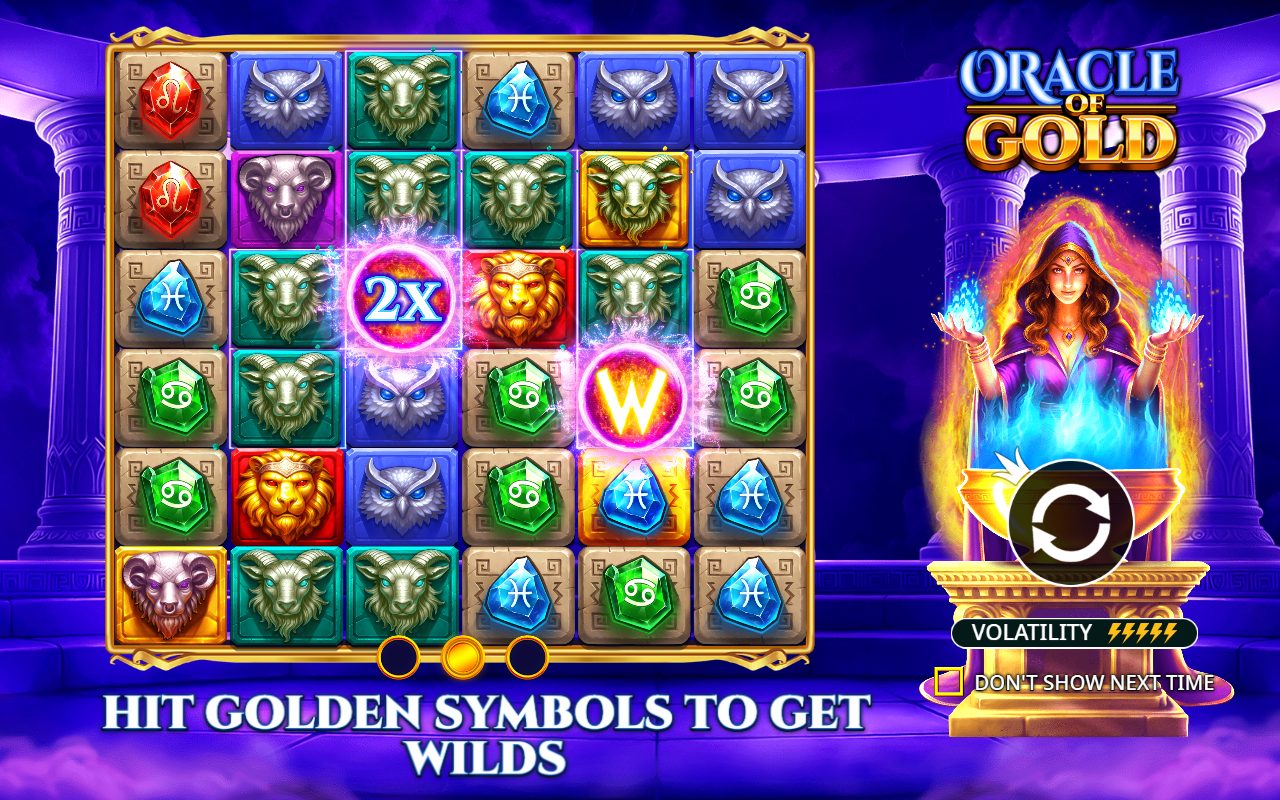
The Wild mechanic in Oracle of Gold is more sophisticated than a standard substitute. Each Wild carries an attached multiplier of x2 or x3, applied to any cluster it completes or contributes to. That alone is common in cluster slots, but the golden symbol layer adds a second tier.
Golden versions of regular symbols appear randomly on the grid. When a golden symbol is part of a winning cluster, it converts into a Wild with its own attached multiplier. The critical distinction: where most comparable slots add these Wild multipliers together, Oracle of Gold multiplies them against each other. Two x3 Wilds in the same cluster produce x9, not x6. Three Wilds — x27. The compounding effect is what makes the base game capable of producing outsized hits before the free spins round is even reached.
This multiplier-multiplication mechanic is the strongest argument for Oracle of Gold over similarly structured Pragmatic releases. It's the mechanism most likely responsible for the 524x hit recorded in Spindex's recent tracking data, and it's what gives the slot's 10,000x ceiling a plausible path rather than a theoretical one.
Free Spins Bonus and Scatter Pays
Scatter symbols in Oracle of Gold pay independently of the cluster requirement. Landing 4, 5, or 6 Scatters in a single spin pays x20, x60, or x200 the total bet respectively, and simultaneously awards 10, 15, or 20 free spins. That scatter pay alone can represent a meaningful hit before the free spins even begin.
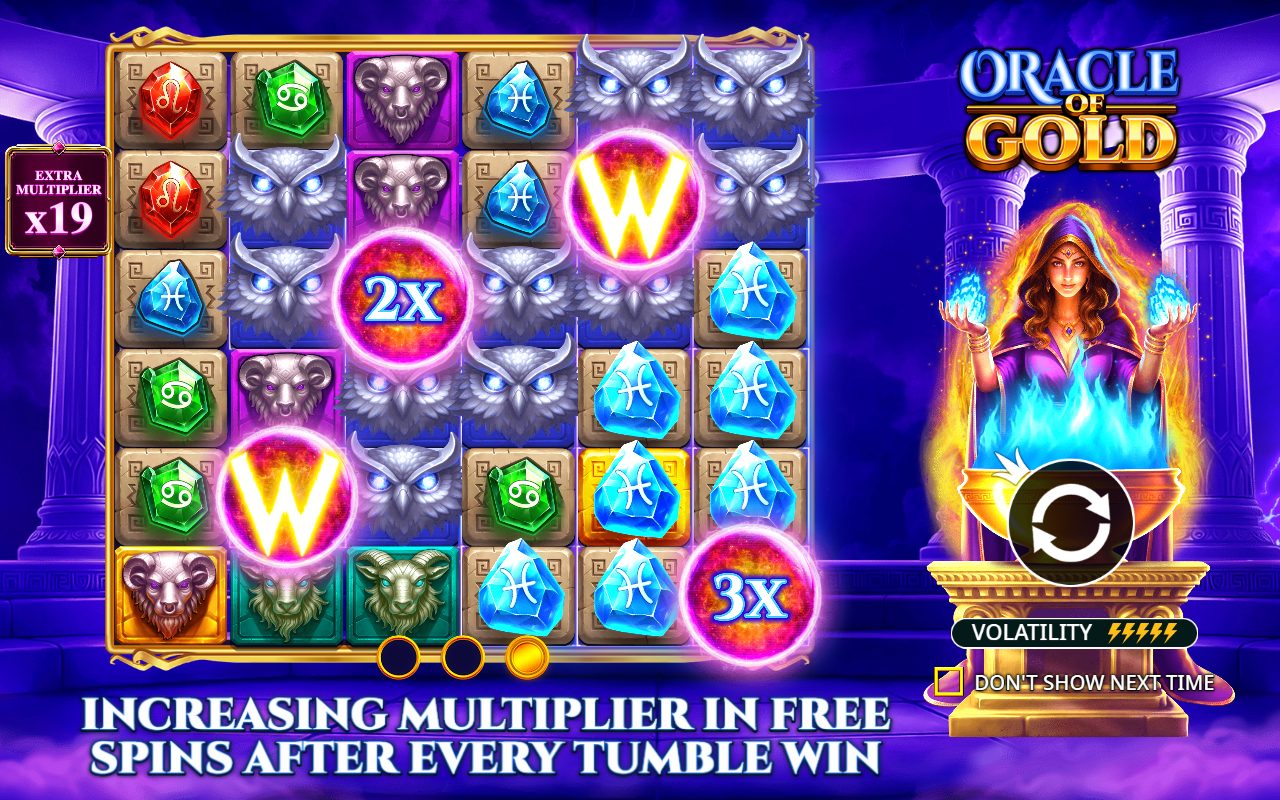
The free spins round introduces a global multiplier starting at x1, which increments by 1 with every tumble. A single free spin with four tumble sequences pushes the global multiplier to x5 before the next spin begins. Since the multiplier persists across all free spins rather than resetting each spin, a late-stage tumble chain on a high-multiplier spin is where the game's max win potential concentrates. Landing 3 or more additional Scatters during the bonus adds 5, 10, or 15 extra free spins.
The honest caveat: reaching the free spins through natural play is infrequent. The source data confirms this, and the 30.86% overall hit frequency only reinforces it. The bonus is powerful when it arrives, but patient bankroll management is the prerequisite.
Bonus Buy, Ante Bet, and Super Spins
Oracle of Gold includes several paid-entry mechanics. The Ante Bet option increases the base bet by 20x in exchange for a 5x higher chance of triggering the free spins naturally. For players who find the standard trigger rate too slow, this is the most cost-efficient escalation available.
The Buy Feature offers two direct purchase options: standard free spins (4–6 Scatters guaranteed) for 100x the base bet, or Super Free Spins for 400x. Super Free Spins upgrade Wild multipliers during the bonus to x3/x4 instead of the base x2/x3, meaningfully increasing the multiplier-stacking potential. The Super Spins base game mode, accessible at 200x the bet, attaches x5 or x10 multipliers to Wilds instead of the standard x2/x3 — the version most likely to breach the 10,000x max win threshold.
These costs are steep. A 400x buy on a €1 base bet costs €400 for a single bonus entry. That's at the expensive end even by Pragmatic Play's own bonus-buy catalogue. Players considering the Buy Feature should weigh it against the fact that the RTP of 95.54% applies across all entry methods — there is no premium-RTP buy option here.
Live Spindex Data: What Our Tracking Shows
Oracle of Gold has accumulated 3,000 tracked bets across Spindex's five crypto-casino sources in the past 30 days — a modest but meaningful early sample for a slot released in late October 2025. The trend signal is currently normal, meaning no unusual volatility clustering or payout anomalies have been flagged in the tracked pool.
The top recorded hit in that window is 524x, which is notable context. A 524x result on a slot with a 10,000x ceiling tells you the big-win distribution is still in its early accumulation phase. The 10,000x cap requires a specific confluence of high-multiplier Wilds and a climbing global free-spins multiplier — a combination that hasn't yet appeared in our tracked sample but is mechanically achievable.
For players using Spindex data to time entries, the normal trend signal suggests Oracle of Gold is behaving within expected variance parameters. The 3,000-bet sample will grow significantly over the next 60 days as the slot reaches broader casino distribution, and the max-hit figure will be worth revisiting once the tracked pool reaches 10,000+ spins.
Theme and Presentation
Oracle of Gold carries an Ancient Egypt / Mythical Adventure theme with zodiac, animal, and mystical treasure iconography. The 6×6 grid is visually clean despite its size, and the game is confirmed to be optimized for mobile play including lower-spec devices.
Visuals are functional and consistent with Pragmatic Play's current production standard — cluster explosions and Wild glow effects are present but don't impede readability of the grid state, which matters more than aesthetics in a cluster format where tracking symbol positions is part of the gameplay.
Who Should Play Oracle of Gold
Oracle of Gold is built for high-bankroll players who understand cluster mechanics and can sustain the variance required to reach the free spins round. The 30.86% hit frequency and high volatility rating are not marketing language — they reflect a slot that will genuinely punish underfunded sessions.
Players new to cluster-pays formats should use the demo version before committing real money. The minimum cluster size of five symbols, combined with the tumble dependency for meaningful wins, creates a learning curve that affects how you size bets and manage expectations. A session that feels like a losing run may be entirely within normal variance for this game type.
The Bonus Buy at 100x–400x the bet is viable for players who want to evaluate the free spins quality without grinding the base game, but it's not a value play at 95.54% RTP. The sweet spot for Oracle of Gold is a patient player with a 200–300 spin bankroll, treating the base-game Wild multiplier chains as the primary entertainment and the free spins as the upside scenario.
Final Verdict
Oracle of Gold delivers a technically well-constructed cluster slot with a multiplier system that genuinely differentiates it from Pragmatic Play's existing catalogue. The decision to multiply Wild multipliers rather than add them creates compounding win potential that can surprise even in the base game — and the global free-spins multiplier that climbs with every tumble gives the bonus round a meaningful scaling mechanic.
The trade-offs are real. A 95.54% RTP is below average for a high-volatility release, the free spins trigger is infrequent, and the Buy Feature pricing is aggressive. The 10,000x max win is achievable in theory but requires a specific chain of events that Spindex's current 3,000-bet tracked sample hasn't yet captured at full scale.
For the right player profile — experienced, well-bankrolled, comfortable with cluster mechanics — Oracle of Gold is a serious release worth tracking. For everyone else, the demo is the right starting point.
- +Multiplier-multiplication Wild mechanic creates compounding win potential
- +Global free-spins multiplier climbs with every tumble — no reset between spins
- +Scatter pays (up to x200 bet) trigger independently of cluster requirement
- +Tumble chains allow multiple wins per single paid spin
- +6×6 cluster grid with no payline restrictions
- +Mobile-optimized including lower-spec devices
- +Ante Bet offers a cost-efficient path to higher bonus frequency
- -95.54% RTP is below Pragmatic Play's typical range
- -High volatility with only 30.86% hit frequency — long dry spells are expected
- -Free spins trigger is genuinely difficult to reach in natural play
- -Buy Feature costs 100x–400x the base bet — expensive even by industry standards
- -10,000x max win ceiling is modest relative to other cluster-pays formats
Best for
Oracle of Gold is a technically deep cluster slot with serious upside — but the 95.54% RTP and punishing volatility mean the free spins round needs to hit hard to justify the wait. The multiplier-stacking Wild mechanic is the real differentiator here. Best suited to high-bankroll players comfortable with long dry spells. The Bonus Buy is expensive but the only reliable path to the game's peak potential.