
Retro Trader Review
A 99% RTP is rare enough to stop any serious player in their tracks. Retro Trader, released by BGaming in May 2025, is a cryptocurrency-themed crash game — not a traditional slot — built around a rising multiplier that you cash out before the market collapses. The mechanic is the same family as Bustabit and Bust-the-Bank style games: a curve climbs, your multiplier grows, and the tension is entirely in deciding when to pull out.
BGaming has leaned into a retro-computing aesthetic for the visual wrapper, which fits the crypto-trading concept without demanding much explanation. The real story here is that 99% theoretical return — one of the highest RTPs BGaming has published on any title. Low volatility rounds out the profile, suggesting this is designed for sustained, low-risk session play rather than moonshot swings.
Spindex is tracking early activity on Retro Trader across five crypto-casino sources. The numbers are modest so far, but the RTP alone makes this worth understanding before you sit down with real money.
RTP, Volatility, and What the Numbers Actually Mean
The 99% RTP on Retro Trader is the single most important number on the spec sheet. To put it in context: the BGaming portfolio average sits around 96–97% across its slot catalogue, and most crash-style games from competing studios land between 95% and 97%. A 99% return means for every $100 wagered theoretically, $99 comes back to players — a house edge of just 1%. That's territory usually reserved for video poker or certain table games, not casual crash titles.
Volatility is rated low, which aligns with the crash-game format when played conservatively. Low volatility means more frequent, smaller returns rather than long dry spells punctuated by large hits. For a crash game, this likely translates to a multiplier curve that resolves at modest values more often than it runs to extreme heights — consistent with the 2x top hit Spindex has recorded in early tracking.
The max win is currently undisclosed by BGaming, which is a genuine gap in the spec. Without a published ceiling, players can't assess the true risk-reward profile the way they could with, say, BGaming's Aztec Magic Deluxe (max win 2,500x at 96% RTP). That comparison highlights the trade-off: Retro Trader gives back more per bet on average but offers no clarity on upside potential.
How Retro Trader Plays: The Crash Mechanic Explained
Retro Trader operates on a crash mechanic — the same core loop made popular by Bustabit and later adopted by dozens of crypto-casino originals. A multiplier starts at 1x and climbs continuously. Players place a bet and must manually cash out before the multiplier crashes. If the crash happens before you exit, the bet is lost. Cash out in time and you lock in whatever multiplier was live at that moment.
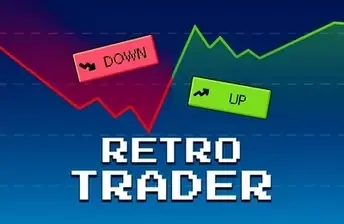
The game frames this around a stock-market metaphor: the rising multiplier represents a market rally, and the crash is the inevitable correction. BGaming has added a historical outcomes tracker, which lets players review past crash points before placing their next bet — a standard feature in the crash-game genre that adds a layer of pattern analysis, though outcomes remain independently random.
The layout is non-standard — there are no reels, rows, or paylines. This is categorised as "Other types" in our database, and that classification is accurate. Players coming from traditional slots will need to adjust their expectations entirely. There is no spin button, no symbol grid, and no bonus round in the conventional sense. The single feature set is the crash multiplier itself.
Bonus Features: Multiplier Is the Only Mechanic
Retro Trader's feature list is deliberately minimal: a crash mechanic and a rising multiplier. That's the complete set. There are no free spins, no scatter pays, no pick-me bonus, no expanding wilds. For players who evaluate slots by feature density, this will feel sparse — but that's by design for the crash format.
The multiplier is both the core gameplay loop and the only variable that matters. How high it can theoretically climb before crashing is the undisclosed piece. BGaming has not published a hard ceiling, which means the multiplier is either uncapped or capped at a value they've chosen not to market. In comparable crash titles from studios like Spribe (Aviator) or Turbo Games, multipliers routinely reach 100x or higher in documented sessions — though those events are rare by probability.
For Retro Trader specifically, the low-volatility classification suggests the multiplier crashes at lower values more often than not. The practical implication: a strategy built around cashing out early at 1.5x–2x will align better with the game's actual distribution than waiting for a 50x run. The 99% RTP supports this approach — the edge is thin, and frequent small wins are the mechanism through which that return is delivered.
Live Spindex Data: Early Tracking on Retro Trader
Spindex has tracked approximately 3,000 bets on Retro Trader over the past 30 days across five crypto-casino sources. That's a limited sample — most established titles on our platform log 50K–200K bets per month — so the data should be treated as directional rather than statistically conclusive.
The top recent hit recorded is 2x. That figure is consistent with the low-volatility profile and reinforces the picture of a game where the multiplier resolves at modest values in the vast majority of sessions. It does not mean a higher multiplier is impossible, but it does mean our tracked player base has not yet produced a standout result worth highlighting.
The low bet volume likely reflects the game's May 2025 release date and its niche positioning as a crash title rather than a mainstream slot. As more crypto casinos integrate Retro Trader and player familiarity grows, the tracked-bet count should rise and give us a clearer picture of the actual multiplier distribution. We'll update this section as the data matures. If you play Retro Trader through a Spindex-tracked casino, your sessions contribute to that dataset.
Theme and Presentation
Retro Trader sits in the Cryptocurrency and Gray theme categories — a retro-computing aesthetic applied to a crypto-trading concept. The visual language is old-school monitor and terminal styling rather than modern UI design.
Beyond that categorical description, the presentation is functional rather than elaborate. Crash games generally prioritise the clarity of the multiplier display over decorative animation, and Retro Trader follows that convention. The interface includes a past-results tracker, which is the most practically useful visual element in the game.
Who Should Play Retro Trader
Retro Trader is built for a specific type of player: someone who wants a high theoretical return, is comfortable with a non-slot format, and is not chasing a life-changing max win. The 99% RTP is the draw, and the low volatility means the game rewards patience and disciplined cash-out strategy over aggressive multiplier hunting.
Crypto-casino regulars who already play crash titles like Aviator or JetX will find Retro Trader immediately familiar. The BGaming branding and the stock-market framing are different surface details on the same underlying mechanic. The 99% RTP is meaningfully better than Aviator's published 97% return, which makes Retro Trader worth considering as an alternative for volume players where the long-run edge matters.
Traditional slot players looking for reel-based gameplay, bonus rounds, or a defined max-win multiplier will find this format unsatisfying. The absence of a published win ceiling and the lack of conventional features make it a poor fit for players who evaluate games on feature richness or jackpot potential. This is a low-edge, low-ceiling game — and that's exactly what it's designed to be.
Final Verdict on Retro Trader
Retro Trader earns its place in BGaming's catalogue primarily on the strength of its 99% RTP — a number that genuinely stands out in the crash-game segment. Low volatility and a straightforward multiplier mechanic make it accessible, and the retro-computing presentation is coherent without being distracting.
The gaps are real, though. No published max win, limited early data showing a 2x top hit, and an undisclosed bet range mean players are committing to a game without full information. The 3,000 tracked bets on Spindex is too small a sample to draw firm conclusions about the multiplier distribution, and that uncertainty is worth acknowledging.
For bankroll-preservation sessions at crypto casinos, Retro Trader is a rational choice. The 1% house edge is hard to beat in a casual game format. For players who need the possibility of a large multiplier to justify the session, the low-volatility profile and the absence of any documented high-multiplier hit in current data make this a harder sell.
- +99% RTP is among the highest in the crash-game category
- +Low volatility suits conservative, session-based play
- +Historical outcomes tracker built into the interface
- +Familiar crash mechanic for crypto-casino regulars
- +BGaming's established platform reliability
- -Max win multiplier not published by BGaming
- -No free spins, bonus rounds, or traditional slot features
- -Bet range undisclosed — difficult to plan session bankroll
- -Early Spindex data shows only a 2x top hit — limited upside evidence
- -Not suitable for players seeking reel-based gameplay
Best for
Retro Trader is a crash-mechanic game, not a slot, but its 99% RTP makes it one of the most player-friendly titles BGaming has released. Low volatility keeps variance tight. The multiplier ceiling is undisclosed, and early Spindex tracking shows a top recent hit of only 2x — so this is a grind-friendly, low-ceiling game best suited to bankroll preservation rather than big-win hunting.