






Rich Wilde and the Pearls of Vishnu Review
Play'n Go's Rich Wilde franchise has produced some of the most recognisable slots in the industry — Book of Dead sits near the top of that list by almost any measure. The series' latest entry, Rich Wilde and the Pearls of Vishnu, takes the explorer to India for the first time, built around a 5x3, 20-payline layout with cascading reels, a progressive multiplier, free spins, and a three-tier bonus game. The RTP lands at 96.17%, volatility is rated medium, and the max win is capped at 2,000x your stake.
On paper, that package sounds solid. In practice, the 2,000x ceiling is the number that most players in the Rich Wilde fanbase will fixate on — it sits well below what other entries in the series deliver. Whether that trade-off is acceptable depends heavily on what you're after: a mechanically layered medium-volatility session, or the kind of ceiling that makes a franchise slot feel worth the brand recognition. This review works through both sides of that question.

Where Pearls of Vishnu Sits in the Rich Wilde Franchise
The Rich Wilde series spans multiple titles across different mythologies and civilisations, with Book of Dead remaining its commercial anchor. Pearls of Vishnu is the first instalment to bring the explorer into an Indian setting, drawing on Vishnu — Hinduism's preserver deity — as the thematic centrepiece. That's a meaningful creative step for the franchise, and Play'n Go has built a visually coherent world around it.
What matters more for returning players is how the mechanics compare. Book of Dead runs at 96.21% RTP with a 5,000x max win. Pearls of Vishnu comes in at 96.17% RTP but with a 2,000x ceiling — less than half the max-win potential of its most famous sibling. That gap is not a rounding error; it's a structural design choice that shapes the entire risk-reward profile of the game.
For players new to the franchise, that comparison may carry less weight. But anyone choosing between Rich Wilde titles based on payout potential should go in with clear expectations: Pearls of Vishnu is the most conservative entry from a max-win standpoint, and the medium volatility rating reinforces that positioning.
RTP, Volatility, and the 2,000x Max Win
The 96.17% RTP is respectable — it sits above the 96% threshold that most analysts use as a baseline for fair value, and it's broadly in line with Play'n Go's studio average. The slot also carries an RTP range feature, which means the published figure can shift depending on the casino operator's configuration. Players should check the in-game paytable to confirm which RTP variant is active on their platform.
Volatility is rated medium, which in practice means more frequent smaller returns relative to high-variance peers. The hit frequency is not published by Play'n Go, so session-level win rate can't be precisely quantified from official data. What the source material does note is that reaching the 2,000x maximum requires approximately one billion spins — a figure that underscores just how theoretical that ceiling is, even accounting for the cascading multiplier that can reach 10x.
The 2,000x cap is the most debated spec in this slot. For context, Hacksaw Gaming's Stick 'Em — a medium-volatility cascading slot with a comparable RTP — offers a 10,000x max win, making Pearls of Vishnu's ceiling look modest even outside the Rich Wilde franchise comparison. Players who accept the lower ceiling in exchange for medium volatility's smoother ride will find the RTP defensible. Those expecting franchise-level upside will find the numbers don't fully deliver it.
Cascading Reels and the Progressive Multiplier
The base game is built on an avalanche mechanic: every winning combination removes the contributing symbols from the grid, allowing new ones to fall into the vacated positions. Consecutive wins within a single spin extend the cascade chain indefinitely — there's no hard cap on how many times the reels can re-fill in one sequence.
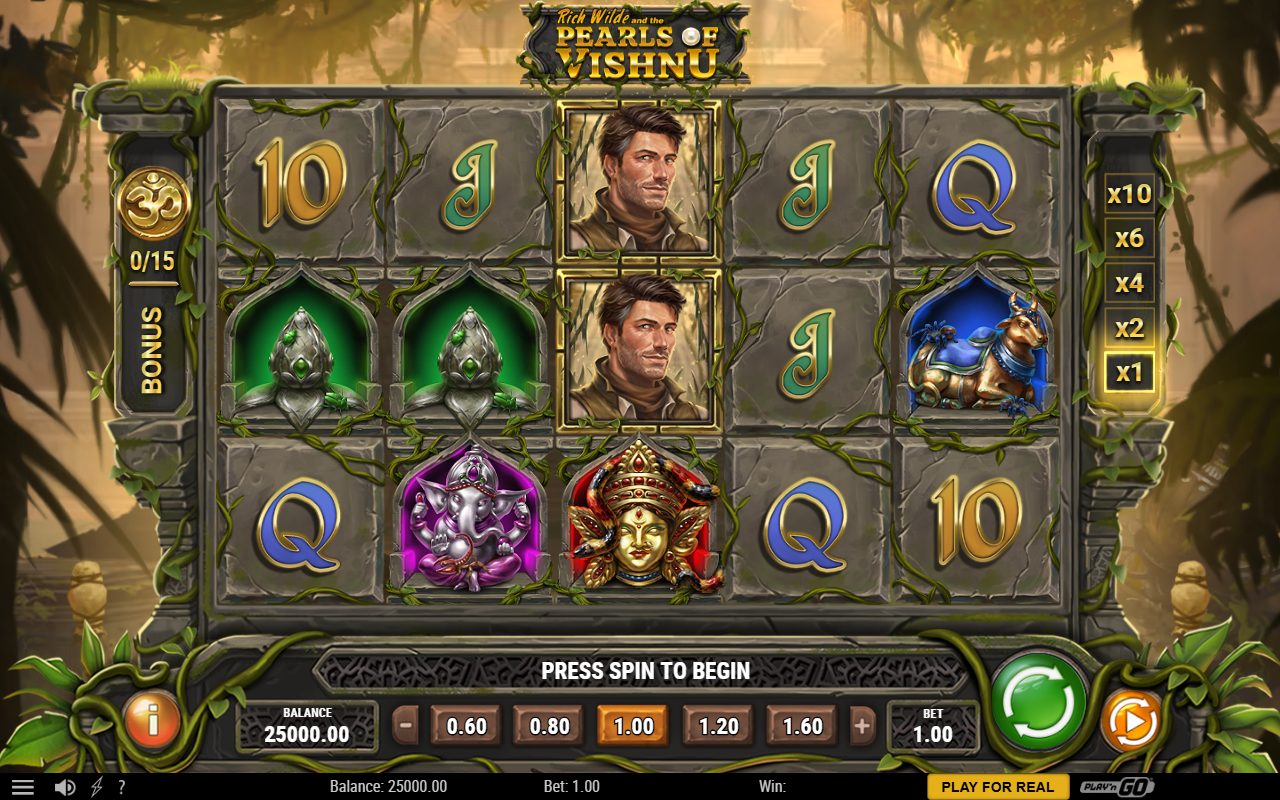
Each cascade advances a progressive multiplier. The sequence runs 1x, 2x, 4x, 6x, and then 10x on the fifth consecutive win. It resets to 1x at the start of each new spin. The structure is functionally similar to the DoubleMax system used in some other cascade-based slots, though the multiplier here is capped at 10x rather than growing without a ceiling. That cap is the right design call for a medium-volatility product — an uncapped multiplier would push variance significantly higher — but it also means the base game's highest achievable multiplier is relatively modest.
In practice, the multiplier is the main engine driving meaningful base-game wins. Four or five consecutive cascades with the 10x active can produce returns that feel substantial within a medium-variance framework. The mechanic rewards patience and gives each spin a sense of escalating stakes without requiring the bonus round to justify the session.
Free Spins: Pearl Wilds and the Upgradable Multiplier
Free spins are triggered by landing three Pearl scatter symbols simultaneously, awarding 10 initial spins. A retrigger is available during the feature — another three Pearls adds 10 more, with a total cap of 50 free spins. That retrigger ceiling is generous relative to many competitors and gives the feature genuine longevity if the scatters cooperate.
The key mechanical shift in free spins is what happens to Pearl symbols: they convert to wilds, substituting for all standard symbols in the same way Rich Wilde himself does. Each Pearl wild that lands during free spins is also collected into a dedicated meter. Once five Pearls are stored, the player receives additional free spins and the available multiplier values increase. This creates a compounding dynamic where the longer the free-spins round runs, the more the multiplier ceiling can expand beyond the base game's 10x cap.
This is where the slot's realistic big-win potential lives. The upgraded multiplier values during an extended free-spins run — particularly with Pearl wilds landing regularly — represent the best-case scenario for hitting returns that approach the 2,000x maximum. The base game's 10x multiplier cap means the free-spins feature isn't just a bonus; it's effectively a prerequisite for the slot's upper payout range.
The Three-Tier Bonus Game
Separate from the free-spins trigger, Pearls of Vishnu includes a token-collection bonus game. Token symbols can land anywhere on the reels during the base game, and they accumulate across spins. Collecting 15 tokens unlocks the bonus game — and critically, this collection counter is tracked per bet level, so changing your stake resets or adjusts the progress.
The bonus itself unfolds across three distinct stages, adding a mini-game layer that breaks up the standard reel-spin rhythm. The three-stage structure gives the bonus game more depth than a single pick-and-click screen, though players should note that the token collection requirement means the bonus is not triggered at random — it requires sustained play at a consistent bet level to accumulate.
This design choice has a practical implication: players who vary their bet size frequently will find the bonus game harder to reach. Consistent staking is effectively rewarded. For players who prefer session stability and don't want to chase the free-spins trigger exclusively, the token mechanic offers a secondary progression path that adds texture to longer sessions.
Themes, Layout, and Betting Range
Pearls of Vishnu is an Adventure / Mythical / India-themed slot. The 5x3 grid with 20 fixed paylines is a conventional layout — no cluster pays, no megaways — which keeps the payline structure straightforward and the math relatively transparent.
Betting runs from $0.20 to $100 per spin. The $0.20 floor is accessible for casual players, while the $100 ceiling gives higher-stakes players room to scale. At medium volatility, the range suits a broad audience without skewing specifically toward either end of the bankroll spectrum.
Play'n Go released this slot in November 2024, making it a relatively recent addition to the franchise catalogue as of mid-2026. It's available in demo mode at most Play'n Go partner casinos, which is worth noting given the token collection mechanic — understanding how bet-level progression works before committing real money is useful.
Who Should Play Rich Wilde and the Pearls of Vishnu
Medium-volatility players who want structured base-game mechanics — specifically the cascading multiplier — will find Pearls of Vishnu genuinely engaging. The progressive multiplier gives each spin a sense of momentum, and the dual bonus triggers (free spins and the token bonus game) mean there are two separate objectives to pursue during a session.
Players who follow the Rich Wilde franchise specifically should calibrate expectations carefully. The 96.17% RTP is fine, but the 2,000x max win is the lowest in the series. If the brand name is the draw, Book of Dead or other franchise entries offer more headroom on the upside.
High-variance hunters should look elsewhere — the 10x base-game multiplier cap and medium volatility rating mean this slot is not built for the kind of session variance that produces outsized single-spin returns. The free-spins feature with upgraded multipliers is the closest this slot gets to high-variance territory, but it still operates within a medium-volatility framework overall.
Final Verdict
Rich Wilde and the Pearls of Vishnu is a well-constructed medium-volatility slot with a coherent mechanic stack — cascading reels, a capped progressive multiplier, Pearl wilds in free spins, and a three-tier token bonus game. The 96.17% RTP is above average, and the feature set gives players more to engage with than a standard free-spins-only design.
The honest limitation is the 2,000x max win. For a franchise that carries significant brand weight, that ceiling underdelivers. The base-game multiplier topping out at 10x, combined with a max win that requires approximately one billion spins to reach, means the slot's theoretical upside is largely decorative. Bigger returns are realistically confined to free-spins runs with upgraded multipliers — and even then, the ceiling constrains what's achievable.
That said, the slot does what medium-volatility products are supposed to do: it offers structured, sustained play with enough mechanical variety to stay interesting across a session. The base game pacing before the bonus triggers can feel slow for players accustomed to higher-frequency feature games, but the cascading multiplier at least gives each spin a reason to watch the chain extend. A reasonable choice for medium-stakes play — just not the Rich Wilde title to reach for if max-win potential is the priority.
- +96.17% RTP sits above the 96% baseline threshold
- +Cascading multiplier adds genuine base-game structure (up to 10x)
- +Free spins feature includes Pearl wilds and an upgradable multiplier
- +Three-tier token bonus game provides a secondary progression path
- +Up to 50 free spins available via retriggers
- +Wide betting range: $0.20 to $100 per spin
- -2,000x max win is the lowest ceiling in the Rich Wilde franchise
- -Base-game multiplier capped at 10x limits single-spin upside
- -Token collection resets when bet level changes — punishes stake variation
- -RTP range feature means the published 96.17% may not apply at all casinos
- -Hit frequency not published by Play'n Go
Best for
Rich Wilde and the Pearls of Vishnu is a mechanically competent entry in Play'n Go's long-running series — the cascading multiplier and upgraded free-spins wilds give the base game genuine structure. But the 2,000x max win is the lowest ceiling in the franchise, and that single number will be a dealbreaker for players who come to Rich Wilde slots expecting serious upside. Best suited to medium-stakes players who prioritise session length over jackpot chasing.