












King Carrot Review
Hacksaw Gaming has built a reputation for pushing unconventional slot concepts, and King Carrot fits that pattern. Tracked across seven crypto-casino platforms on Spindex — including Stake, Gamdom, and Roobet — the game has logged 2,000 bets over the last 30 days, with a top recent hit of 709x. That single data point tells us more about the slot's ceiling in real play than most spec sheets do.
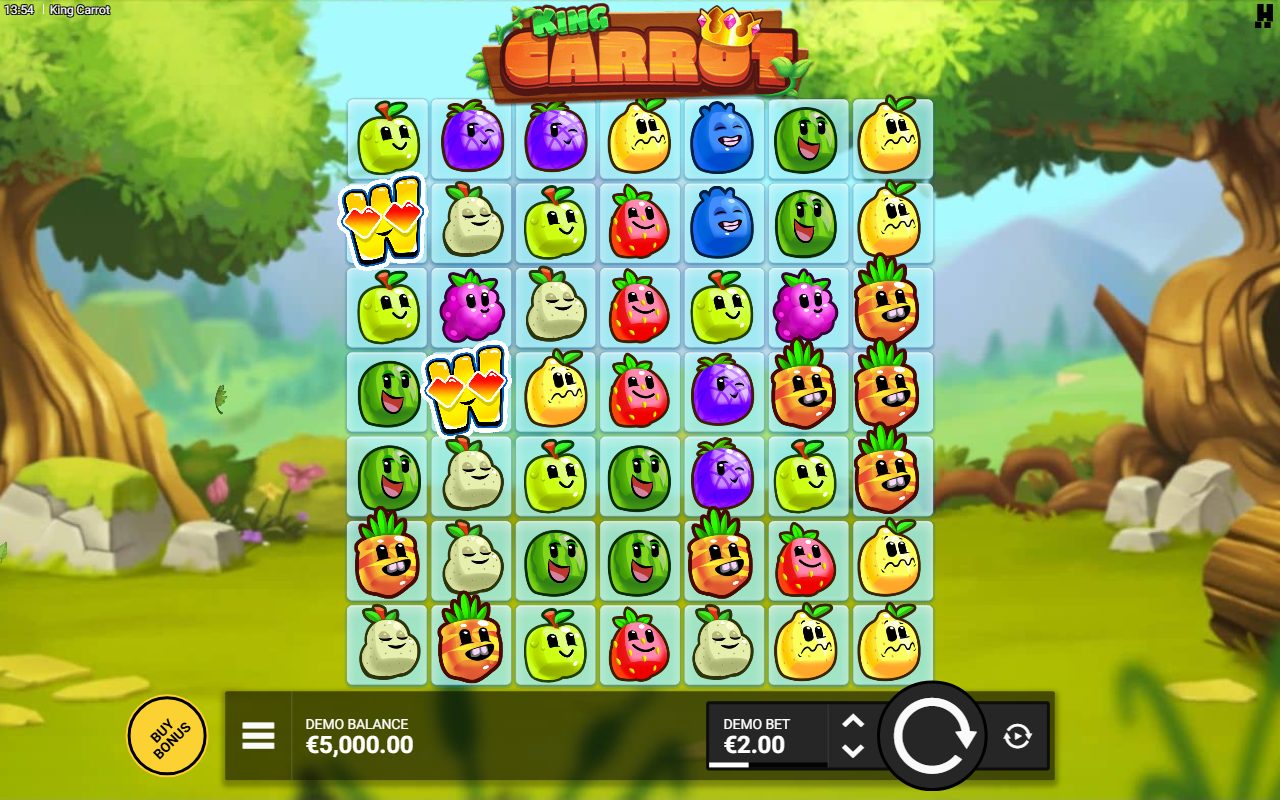
The catch with King Carrot is that Hacksaw hasn't published formal spec data for this title at the time of writing. RTP, volatility class, reel layout, bet limits, and feature list are all officially undisclosed. That's not unusual for Hacksaw's catalog — the studio occasionally releases games into crypto-native environments before full public documentation lands. What we can do is let the live tracked-bet data carry the analytical weight, and on that front, Spindex has something concrete to work with.

Live Tracked-Bet Data on Spindex
Spindex tracks bets in real time across seven crypto-casino sources: Stake, Gamdom, Roobet, Rainbet, Duelbits, Shuffle, and MyPrize. Over the past 30 days, King Carrot has generated 2,000 tracked bets — a modest but meaningful sample that places it in active rotation rather than dormant status on these platforms.
The standout figure is the top recent hit of 709x. For context, that sits below the headline max wins Hacksaw advertises on its most volatile titles — Wanted Dead or a Wild, for instance, carries a 12,500x ceiling — but 709x is a legitimate result from a real tracked session, not a theoretical maximum. It confirms the game can produce multi-hundred-times-stake returns in live play, which is a meaningful baseline for players sizing their sessions.
With official volatility and RTP figures absent, this live data becomes the primary lens for understanding King Carrot's behavior. A 709x top hit across 2,000 bets suggests the game isn't distributing tiny, frequent wins at the low-volatility end of the spectrum. The hit is large enough to indicate meaningful variance, even without a formal classification to confirm it.
What We Know — and Don't — About the Specs
Hacksaw Gaming hasn't published official figures for King Carrot's RTP, volatility, max win, reel layout, bet range, or feature set at this time. That's the full picture on the spec side: the studio has not released this information publicly, and Spindex won't substitute estimates or provider-typical averages in place of verified data.
What that means practically is that players can't anchor their session expectations to a published return-to-player percentage the way they could with a fully documented Hacksaw title. For comparison, Hacksaw's documented releases typically publish RTPs in the 96.20% range — but applying that figure to King Carrot would be speculation, and this review won't do that.
The absence of published specs is not a signal about the game's quality or fairness. Hacksaw is a licensed, regulated studio operating across multiple jurisdictions. Undocumented specs at launch — particularly on crypto-native platforms — reflect a release pipeline reality rather than anything players should read as a warning sign.
Hacksaw Gaming as a Provider
Hacksaw Gaming has established itself as one of the more distinctive voices in the modern slot space, particularly within crypto-casino ecosystems. The studio's catalog leans toward high-variance mechanics, unconventional reel structures, and bonus-buy accessibility — features that have made it a default choice for players on platforms like Stake and Roobet.
King Carrot sits within a provider catalog that includes titles like Stick 'Em, Chaos Crew, and the aforementioned Wanted Dead or a Wild. Hacksaw's willingness to experiment with themes and mechanics means King Carrot could diverge significantly from the studio's more recognizable formats — the name alone signals a departure from the gritty or mythological themes common elsewhere in the lineup.
For players already familiar with Hacksaw's output, King Carrot's presence across all seven of Spindex's tracked crypto platforms suggests it has cleared the studio's standard distribution pipeline and is receiving genuine player attention — not just sitting in a catalog as a filler title.
Performance Signal: Reading the 709x Hit
A 709x hit is a useful reference point even when formal specs are missing. Across 2,000 tracked bets, one session reaching 709x indicates the game's distribution isn't capped at low multiples. For a player betting $1 per spin, that hit would represent a $709 return — a result that lands in the range serious variance players look for when choosing a session.
The more interesting question is how often hits of that magnitude occur. With 2,000 bets in the sample, the 709x result represents the top of the distribution we've observed — it doesn't tell us whether 500x+ hits are common or rare. As Spindex accumulates more tracked bets on King Carrot, the frequency distribution will sharpen and give a clearer picture of where the game's hit curve actually sits.
For now, the 709x ceiling in live tracked data compares reasonably against mid-tier Hacksaw titles. It's not the headline-grabbing territory of Hacksaw's most volatile releases, but it's a credible result that keeps King Carrot on the watchlist for players who prioritize real-world performance data over theoretical maximums.
Who King Carrot Is Best For
Without confirmed RTP, volatility, or bet limits, recommending King Carrot to a specific player profile requires leaning entirely on the live data and provider context. The 709x top hit and crypto-platform distribution suggest this is a game aimed at players comfortable with variance and familiar with Hacksaw's general design philosophy.
Crypto-casino regulars who already rotate through Stake, Gamdom, or Roobet will find King Carrot naturally accessible — it's live and playable on all seven of Spindex's tracked sources. Players who require published RTP documentation before committing to a session will want to wait until Hacksaw releases formal specs.
Anyone building a Hacksaw-focused session roster and looking for a title with confirmed live traction — rather than a dormant catalog entry — will find the 2,000 tracked bets and 709x hit a reasonable basis for adding King Carrot to the rotation.
Final Verdict
King Carrot is a Hacksaw Gaming slot with real live activity and a 709x top hit confirmed through Spindex's tracked-bet data — but it arrives without the published spec sheet players typically use to calibrate expectations. That's the honest summary of where this title stands right now.
The live data is encouraging enough to make King Carrot worth watching. Two thousand tracked bets across seven crypto platforms in 30 days is active engagement, not token presence. The 709x hit confirms meaningful win potential exists in real sessions. What's missing is the formal documentation that would let players compare it precisely against Hacksaw's wider catalog.
Spindex will update this review as official RTP, volatility, and feature data becomes available. Until then, the tracked-bet data is the most reliable signal we have — and for Hacksaw regulars on crypto platforms, that signal is positive enough to warrant a closer look.
- +Live on all seven of Spindex's tracked crypto platforms
- +709x top hit confirmed in real tracked-bet data
- +2,000 tracked bets in 30 days shows active player engagement
- +Hacksaw Gaming is a licensed, established studio with a strong catalog track record
- -No published RTP, volatility, max win, or bet limits at time of writing
- -Limited sample size (2,000 bets) means win-frequency patterns aren't yet fully defined
Best for
King Carrot is a Hacksaw Gaming title with genuine live traction on crypto platforms, headlined by a 709x top hit tracked across 2,000 real bets in 30 days. Official specs are unpublished, so the Spindex live data is currently the most reliable performance signal available. Worth monitoring as documentation fills in — the hit size alone justifies attention from Hacksaw regulars.